Colchester, Connecticut: Rubber, Bacon Academy and a Farming Colony
Colchester, Connecticut
Pictures from Colchester
See all 3 photos →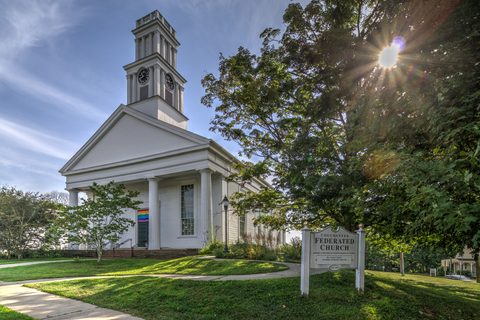
English colonists settled Colchester in 1698 on land Mohegan Sachem Uncas had granted to Jeremy Adams in 1661, and the court approved town status in 1699, naming the settlement for Colchester in Essex, England. Pierpont Bacon's 1800 will left $35,000 to found Bacon Academy in 1803; its alumni include Stephen F. Austin, the "father of Texas," and Lyman Trumbull, co-author of the Thirteenth Amendment. Nathaniel Hayward opened the Hayward Rubber Company on Lebanon Avenue in 1847, the largest industrial establishment in the town's history at nearly a thousand employees; he developed a rubber-sulfur process in the late 1830s and assigned the rights to Charles Goodyear, who patented vulcanization in 1844 and took the credit. Aided by the Baron de Hirsch Fund, Eastern European Jewish immigrants built one of Connecticut's largest Jewish farming communities here beginning in the 1890s; by 1920, half of Colchester's population was Jewish.
-
sight
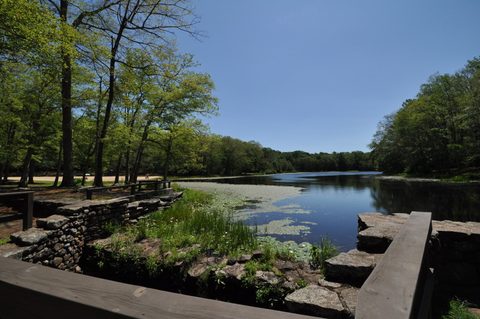
A mill pond with trails to Salmon River State Forest and its waterfalls.
-
Nearly 7,000 acres with the blue-blazed Salmon River Trail.
-
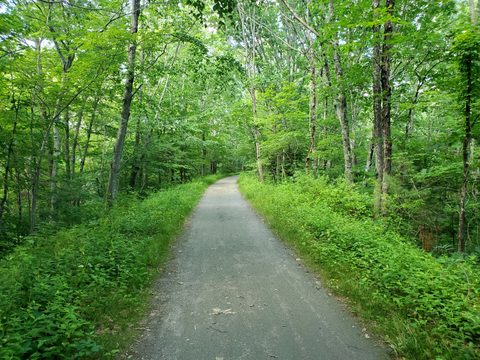
A 50-mile rail-trail on the route of the 1870s "Ghost Train."
-
sight
Antique farm machinery, open for three annual weekend shows.
-
sight
Raw-milk farmstead cheese sold from an on-site store.
-
Rubber, education and Jewish farming history on Linwood Avenue.
-
food
Roadside burgers and hot dogs since 1920.
-
food
Chicken, brisket and ribs with a Saturday brunch.
-
A farm brewery taproom on Cato Corner Road.
-
Italian dining across two levels, with a Monday-only menu.
-
stay
An 1840 Greek Revival bed and breakfast on Broadway.
Bacon Academy, rubber and a farming colony
Bacon Academy, founded in 1803 under Pierpont Bacon's will, still operates as Colchester's public high school on Norwich Avenue; besides Austin and Trumbull, its alumni include U.S. Supreme Court Chief Justice Morrison R. Waite. Nathaniel Hayward's rubber works on Lebanon Avenue employed nearly a thousand people at its height; Hayward donated the land for the town green and helped found the fire department and a bank, and his name survives in Hayward Avenue, Lake Hayward and the Hayward Volunteer Fire Department. Aided by the Baron Maurice de Hirsch Fund, Eastern European Jewish immigrants established a cemetery in 1894, Congregation Ahavath Achim in 1898, synagogue buildings in 1902 and 1913, a Jewish Farmers' Cooperative Credit Union in 1912 and the Colchester Farmers Produce Company in 1916. In 2010 Colchester became the first Connecticut town, and the 36th nationally, certified as a Community Wildlife Habitat by the National Wildlife Federation.
Getting there
Colchester sits roughly midway between Hartford and New London along CT Route 2, where Route 11's short expressway from Salem comes to an end; there is no passenger rail station in town, so travelers by train use Shore Line East and Amtrak at New London or Old Saybrook and finish the trip by car. Route 11, a 7.1-mile freeway from Route 82 in Salem, was meant to continue toward Waterford, but only about half the planned route was ever built and the extension was formally abandoned in October 2016 — which is why the highway simply ends onto Colchester's two-lane roads. Route 16 runs past Salmon River State Forest, and Route 149 carries an Air Line State Park Trail trailhead.
Trails, a working farm and where to eat
Day Pond State Park's mill-pond trails connect to Salmon River State Forest and its 1873 Comstock Covered Bridge, jointly built by Colchester and neighboring Chatham, now East Hampton; the Air Line State Park Trail follows the route of the 1870s Air Line Railroad through town on its way toward the Hop River Trail. Zagray Farm Museum, a working antique-machinery collection, opens to the public chiefly for three annual weekend shows, and Cato Corner Farm sells its own raw-milk farmstead cheese from an on-site store. The Colchester History Museum, run by the Colchester Historical Society on Linwood Avenue, covers the town's rubber, education and Jewish farming history. For food, Harry's Place has served burgers and hot dogs since 1920, Oz'N Bones BBQ and Fornarelli's Ristorante anchor the sit-down scene, and Hop Culture Farms & Brew Co. pours from its Cato Corner Road taproom. The O'Connell House, an 1840 Greek Revival bed and breakfast on Broadway, is the only lodging verified inside town limits.
Frequently asked questions
- How do I get to Colchester?
- By car — CT Route 2 runs through town, and Route 11's short expressway from Salem ends at Route 2. There is no passenger rail station in Colchester; the nearest stations are Shore Line East and Amtrak stops at New London or Old Saybrook.
- Is there a train to Colchester?
- No. Shore Line East runs along the shoreline through New London and Old Saybrook, well south of Colchester, and no branch line reaches town.
- What is the Comstock Covered Bridge?
- An 1873 covered bridge over the Salmon River, jointly built by Colchester and Chatham (now East Hampton) for about $4,000. It sits within Salmon River State Forest on the East Hampton side, not at a Colchester address, and is preserved for pedestrians.
- Is there a hotel in Colchester?
- The O'Connell House, a four-room bed and breakfast in an 1840 Greek Revival building on Broadway, is the only lodging verified inside Colchester. Book well ahead.
- What is Colchester's Jewish farming history?
- Aided by the Baron de Hirsch Fund, Eastern European Jewish immigrants built one of Connecticut's largest Jewish farming communities here starting in the 1890s, with a cemetery, synagogue, credit union and produce cooperative; by 1920 half the town's population was Jewish. Congregation Ahavath Achim's 1913 synagogue still stands.
Foliage
Turning this week · estimated peak Oct 21–27
Derived from the Connecticut DEEP fall foliage map. DEEP's map is a climatological estimate last published in 2023; it describes a normal year, not this one. Stage names are ours. See the statewide forecast.
Connected pages
Nearby
-
East Haddam, Connecticut: A Castle, an Opera House, and a Schoolhouse
· East Haddam, Connecticut
The two towns share a border
-
Hebron, Connecticut: A Rescued Family and a Ghost Mill Town
· Hebron, Connecticut
The two towns share a border
-
Lebanon, Connecticut: Heartbeat of the Revolution
· Lebanon, Connecticut
The two towns share a border
-
Salem, Connecticut: A Vanished Music Conservatory
· Salem, Connecticut
The two towns share a border
-
Bozrah, Connecticut: A Biblical Name and Three Mill Villages
· Bozrah, Connecticut
Colchester borders Bozrah to the east.
-
East Hampton, Connecticut: Belltown, USA
· East Hampton, Connecticut
The 1873 Comstock Covered Bridge was jointly built by Colchester and Chatham, now East Hampton, and sits on their shared border.
-
Marlborough, Connecticut: Three Towns' Corners and a Colonial Tavern
· Marlborough, Connecticut
Marlborough borders Colchester, one of its three parent towns.
Shared history
-
Salem, Connecticut: A Vanished Music Conservatory
· Salem, Connecticut
Salem was incorporated in 1819 partly from Colchester's land.
Same region
-
Hebron, Connecticut: A Rescued Family and a Ghost Mill Town
· Hebron, Connecticut
Salmon River State Forest, nearly 7,000 acres, spans Colchester, Hebron and three other towns.
What travelers think
Log in to react.
No reviews yet.