
Orientation
Vinegar Hill, Brooklyn: Irishtown Beside the Navy Yard
Vinegar Hill, New York

The shipbuilder John Jackson opened a yard at the foot of present-day Hudson Avenue in the late eighteenth century and built housing nearby for his workers; in the first years of the nineteenth century he sold forty acres to the United States government for the Brooklyn Navy Yard. He named the place Vinegar Hill after the 1798 battle at Enniscorthy in Ireland's County Wexford, where the English defeated an Irish rebellion — a name chosen to draw Irish labor and residents. It worked. By the late nineteenth century this was a dense industrial neighborhood popularly called Irishtown, though Germans, Norwegians, Swedes, Poles, Italians and Eastern European Jews lived here too, most of them working the waterfront, the Navy Yard, or neighborhood industry.
Whiskey, demolition, and what survived
The rowhouses that remain were built by Jackson and his heirs between 1801 and the 1830s, in simplified Federal and Greek Revival forms, and on the Sands family's lots further west in the 1840s and 1850s. A few vacant lots on Hudson Avenue, Water Street and Front Street filled in after the Civil War.
In the years after that war the neighborhood became a center of illegal moonshine distilling, aimed at dodging a federal liquor tax of two dollars a gallon. The raids escalated: a hundred army veterans in October 1869, then two thousand soldiers under Colonel John L. Broome on November 2, 1870, who destroyed roughly twenty illegal distilleries. The distillery organizer John Devlin was tried in 1868 for defrauding the government of some $700,000 in six months, drew a $500 fine and a two-year sentence, and was later pardoned by President Andrew Johnson.
The neighborhood shrank in the twentieth century. From 1903, construction of the Manhattan Bridge and the industrial expansion that followed the 1898 consolidation of New York City brought down hundreds of small dwellings, and more went in the 1920s and 1930s for truck storage, parking and warehouses. By 1930, three-quarters of the remaining population was Lithuanian-American, and Lithuanian immigrants built St. George R.C. Church on York Street. Artists and other new residents began arriving in the early 1970s, drawn by the Manhattan views, the reasonably priced housing and the historic architecture, and they revived the old name. The Landmarks Preservation Commission designated the Vinegar Hill Historic District on January 14, 1997.
Getting there
Vinegar Hill has no subway station of its own. The two nearest are described by their sources as serving other neighborhoods, and neither is stated to be in Vinegar Hill: York Street, at York and Jay Streets, is served by the F and is described as serving Dumbo and Downtown Brooklyn; High Street, at High Street and Cadman Plaza East, is served by the A and C and is described as serving Brooklyn Heights, Dumbo and Downtown Brooklyn.
Buses are the direct answer. The B62 lists Vinegar Hill among the communities it serves, and the B67 runs via the Brooklyn Navy Yard to serve Dumbo and Vinegar Hill.
There is no NYC Ferry landing in Vinegar Hill. The nearest, DUMBO/Fulton Ferry at Old Fulton Street and Furman Street, is described by NYC Ferry as serving Downtown Brooklyn and Dumbo rather than Vinegar Hill.
What's here
-
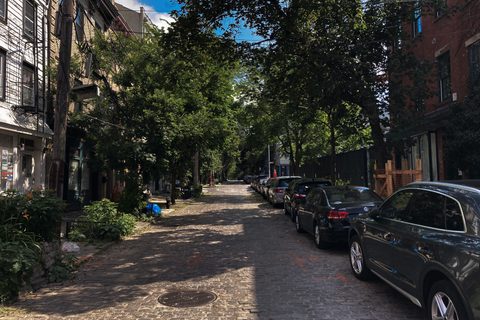
Vinegar Hill Historic District
Three small groups of early-nineteenth-century rowhouses on Belgian-block streets, designated in January 1997.
-
Vinegar Hill House
A 41-seat restaurant at 72 Hudson Avenue, open since 2008.
Questions
How do I get to Vinegar Hill?
By bus, most directly: the B62 lists Vinegar Hill among the communities it serves, and the B67 runs via the Brooklyn Navy Yard to serve Dumbo and Vinegar Hill. There is no subway station in the neighborhood and no NYC Ferry landing. The nearest stations are York Street on the F and High Street on the A and C, both described by their sources as serving Dumbo and Downtown Brooklyn rather than Vinegar Hill.
Where does the name Vinegar Hill come from?
From the Battle of Vinegar Hill of 1798, fought at Enniscorthy in County Wexford, Ireland, where the English defeated an Irish rebellion. The shipbuilder John Jackson gave the name to his development in the hope of attracting Irish immigrant labor and residents.
Is the Brooklyn Navy Yard part of Vinegar Hill?
No. The Landmarks Preservation Commission's designation report describes the adjacent Navy Yard as set off from the Vinegar Hill neighborhood by an iron fence and a drop in elevation. The Yard's two designated city landmarks — the Commandant's House at the southeast corner of Evans and Little Streets, built in 1806 by Charles Bulfinch and John McComb Jr., and Dry Dock No. 1, built in 1840-51 — sit inside the Yard's own boundary, not the historic district's.
Connected pages
Nearby
-
Navy Yard, Brooklyn: The Can-Do Shipyard's Second Life
· Navy Yard, New York
The Landmarks Preservation Commission describes the adjacent Brooklyn Navy Yard as set off from Vinegar Hill by an iron fence and a drop in elevation.
-
Dumbo, Brooklyn: A Name Coined to Deter Developers
· Dumbo, New York
The B67 bus runs via the Brooklyn Navy Yard to serve both Dumbo and Vinegar Hill.
Same region
-
Downtown Brooklyn, Brooklyn: Borough Hall and the Fulton Mall
· Downtown Brooklyn, New York
York Street on the F, the nearest station to Vinegar Hill, is described by its source as serving Dumbo and Downtown Brooklyn.