.jpg)
New York Botanical Garden
Park · Bronx Park, New York
A 250-acre botanical garden founded on April 28, 1891 by an act of the New York State Legislature, occupying the section of Bronx Park north of Fordham Road. It was designated a National Historic Landmark on May 28, 1967 and listed on the National Register of Historic Places the same day, reference number 67000009. Over a million people visit annually, on a 2016 figure that counts nearly 90,000 children from underserved communities and 3,000 teachers from New York City public schools.
History
Cornelius Vanderbilt II, Andrew Carnegie and J. P. Morgan were among the Garden's principal officers. Nathaniel Lord Britton served as secretary and led the fundraising campaign with his wife, Elizabeth Gertrude Britton, taking the Royal Botanic Gardens at Kew in London as the model.
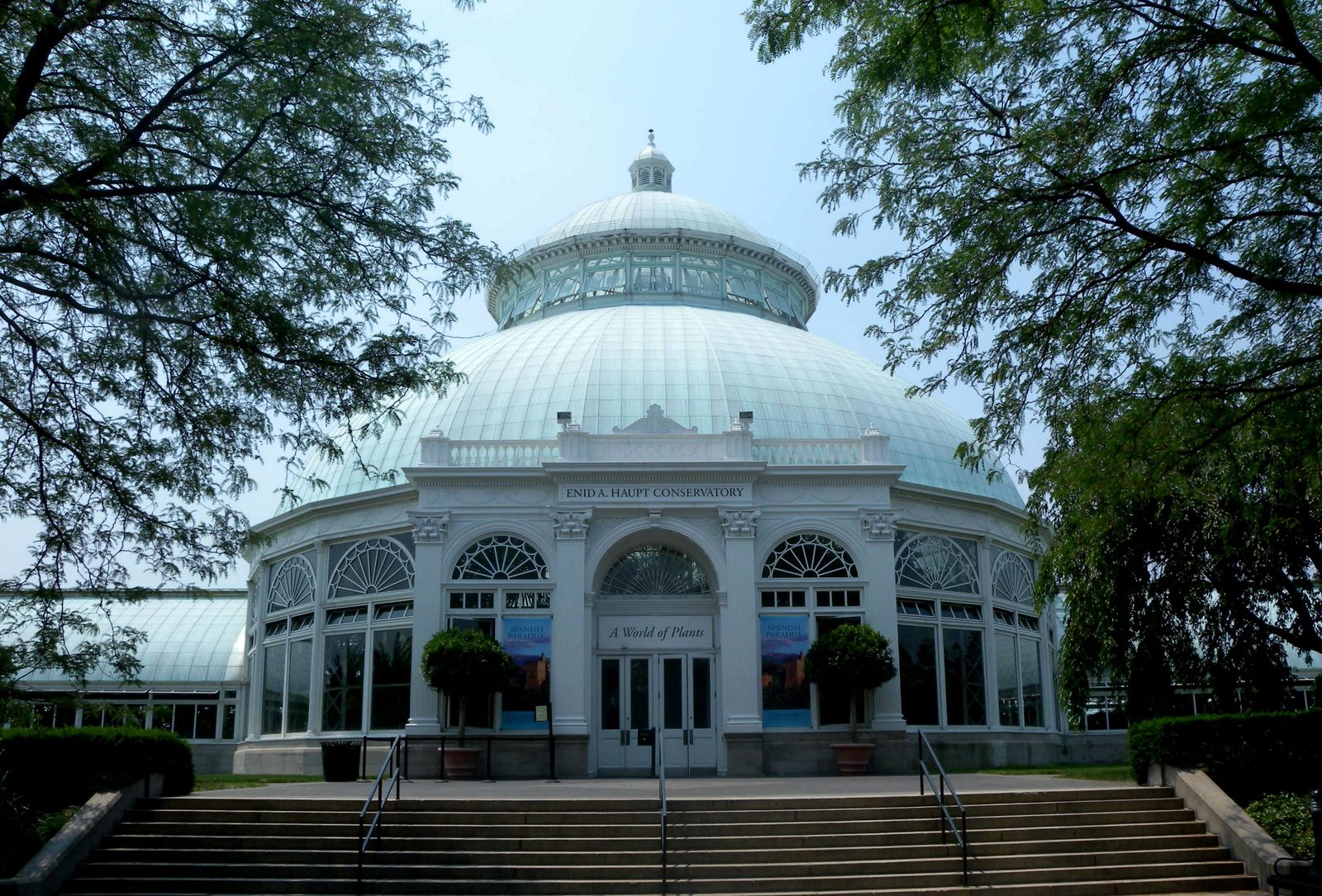
Ground was broken for the Enid A. Haupt Conservatory on January 3, 1899 and it was completed in 1902 at a cost of $177,000, built by John R. Sheehan for the city's Department of Parks and Recreation. Lord & Burnham designed it, with William R. Cobb as primary designer, in an Italian Renaissance style modelled on Kew's Palm House and Joseph Paxton's Crystal Palace: a 512-foot "C" of eleven pavilions under a 90-foot central dome. Renovations in 1935 and 1950 removed the original decoration, and a 1978 restoration led by Edward Larrabee Barnes moved the building back toward it, funded by Enid Annenberg Haupt's $5 million gift and a $5 million maintenance endowment; it was renamed for her that year. Beyer Blinder Belle carried out a $25 million renovation between 1993 and 1997. The Conservatory was designated a New York City landmark on October 16, 1973, the date the Landmarks Preservation Commission's designation report carries.
The LuEsther T. Mertz Library was founded in 1899, in a Renaissance Revival building designed by Robert W. Gibson and completed in 1900. It was first the Museum Building, then the Administration Building, and was renamed for its donor in the 1990s. It became a National Historic Landmark contributing property on May 28, 1967 and a New York City landmark on March 24, 2009. Its holdings include two copies of the Circa Instans, of about 1190 and about 1275, and a 2002 New York Times article stated that the collection held "75 percent of all systematic botany literature in the world and 70 percent of all flora that had been published." The William & Lynda Steere Herbarium, founded in 1891 and housed in the Garden's International Plant Science Center, holds roughly 7.2 to 7.8 million specimens, among them the Columbia College herbarium acquired in 1895 with some 600,000 specimens.
The Thain Family Forest covers 50 acres along the Bronx River, old growth tracing to pre-colonial Lenapehoking. Eastern hemlock was historically dominant in a canopy of oak, beech and sweet gum, and declined in the early twentieth century under hemlock woolly adelgid and elongate hemlock scale infestation. It was called Hemlock Grove first and Native Forest for a time before taking its present name. Britton called the site "the most precious natural possession of the city of New York," and the Garden's site was chosen in 1895 primarily for this forest; John and Carmen Thain supported a 2011 restoration that removed invasive species and expanded native vegetation.
Beatrix Jones Farrand designed the rose garden in 1916 and it was renovated in 2007. Charles Tefft sculpted the Fountain of Life in 1905. The Everett Children's Garden opened in 1998, the International Plant Science Center in 2002, the Leon Levy Visitor Center in 2004, the Pfizer Plant Research Laboratory in 2006, the Hudson Garden Grill in 2015 and the Edible Academy in 2018.
Visit
Southern Boulevard and Bedford Park Boulevard, Bronx, NY
Photo "Enid A. Haupt Conservatory": Jim.henderson, CC0, via Wikimedia Commons

Featured in these guides
More in Bronx Park
- Bronx Park · Park
- Bronx River Forest · Park
- Bronx Zoo · Attraction
- Lorillard Snuff Mill · Historic site
What travelers think
Log in to react.
No reviews yet.