
Orientation
Bronx Park, the Bronx: A Garden and a Zoo in One Park
Bronx Park, New York

Bronx Park covers 718 acres, the eighth-largest park in New York City, bounded by Southern Boulevard, Webster Avenue, Gun Hill Road, Bronx Park East and East 180th Street. Much of the land came to the city under the 1884 New Parks Act, from Fordham University and from the Lorillard family, who had operated a snuff mill on the estate. Fordham Road divides the park between its two institutions: the New York Botanical Garden, founded in 1891, holds the northern 250 acres, and the Bronx Zoo, which opened on November 8, 1899, holds the southern 265. The Bronx River runs 2 miles through the park. Pelham Parkway adjoins it to the east, West Farms to the south and Belmont to the west.
A park, a garden and a zoo
Much of Bronx Park came to the city under the 1884 New Parks Act, from Fordham University and from the Lorillard family, who had operated a snuff mill beside the Bronx River. Fordham's Rose Hill campus spanned over 100 acres before that transfer reduced it, and the campus now stands immediately west of the Bronx Zoo and the New York Botanical Garden; a 138-plot cemetery on the campus was relocated in 1890 from its original location at what is now the Garden.
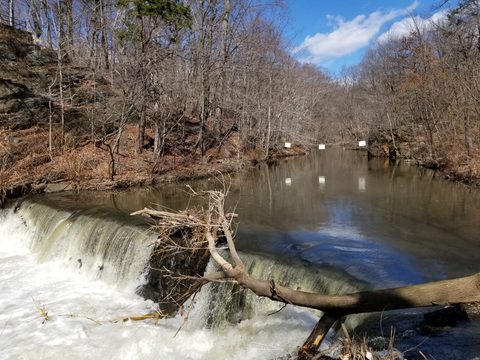
The river is the park's spine. It runs 2 miles (3.2 km) through Bronx Park, on a course of roughly 24 miles (39 km) from Westchester County to the East River that also carries it through the Garden and the Zoo. Lake Agassiz and Bronx Lake lie inside the park, along with waterfalls and ponds, and a 35-acre "Forever Wild" nature preserve occupies part of the northern section.
Fordham Road divides Bronx Park between its two institutions, and both the Bronx Zoo and the New York Botanical Garden stand at the road's eastern terminus in the park. The Garden was founded on April 28, 1891 by an act of the New York State Legislature and holds the northern 250 acres. Cornelius Vanderbilt II, Andrew Carnegie and J. P. Morgan were among its principal officers; Nathaniel Lord Britton served as secretary and led the fundraising campaign with his wife, Elizabeth Gertrude Britton, taking the Royal Botanic Gardens at Kew in London as the model. The Bronx Zoo holds 265 acres in the southern section and opened on November 8, 1899, four years after members of the Boone and Crockett Club — principally Madison Grant and C. Grant LaFarge — founded the New York Zoological Society. William Temple Hornaday was its first director, and served thirty years.
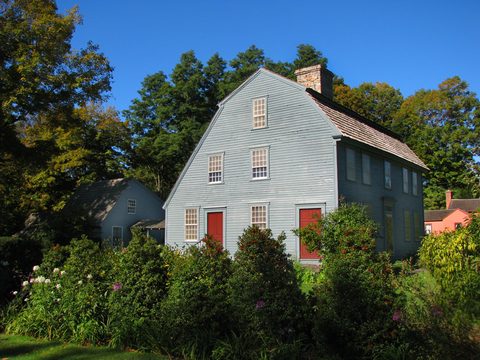
One older building on the Garden's grounds predates both institutions. The Lorillard Snuff Mill, built around 1840 on Snuff Mill Road, was designated a New York City Landmark in 1966, before any designation the Garden or the Zoo carries, and became a National Historic Landmark in 1977.
Getting there
Routes here run to a named gate rather than to the park as a whole, so which entrance you want decides which one to take.
By subway, the B, D and 4 stop at Bedford Park Boulevard; from there the Bx25 and Bx26 run east to the Botanical Garden's Mosholu Entrance, which is also reached on foot down Bedford Park Boulevard to Southern Boulevard. The 2 stops at Allerton Avenue for the Garden's East Gate — west on Allerton, then south on Bronx Park East to Waring Avenue — and that gate is pedestrian and daytime access only. The 2 also stops at Pelham Parkway for the Zoo, whose Bronx River entrance, Gate B, is west of there on foot. The Zoo's own page adds the 2 or 5 to West Farms Square–East Tremont, East 180th Street or Pelham Parkway without naming a gate for any of the three, so none of those is tied to an entrance here.
Metro-North's Harlem Line has a station named Botanical Garden, which serves the Garden's Mosholu Entrance.
Buses run to specific entrances too. The Bx19, Bx12, Bx22, Bx9 and Bx17 serve the Garden's Main Entrance at 2900 Southern Boulevard, and the Bx25, Bx26, Bx41 and Bx34 the Mosholu Entrance at 2950 Southern Boulevard. At the Zoo, the Bx9 and Bx19 stop at 183rd Street and Southern Boulevard for the Southern Boulevard pedestrian entrance, Gate C, as do the Bx12 and Bx22 at Fordham Road and Southern Boulevard, south on foot to the same gate. The Q44 from Queens stops at 180th Street and Boston Road, north on foot to the Asia entrance, Gate A. The BxM11 express, which stops along Madison Avenue between 26th and 99th Streets in Manhattan, runs direct to Gate B.
Neither institution's own directions page names an NYC Ferry landing.
The Garden's remaining gates are the Main Entrance, which takes vehicles and buses, and the Everett Garden Gate on Southern Boulevard at Fordham, for school groups only. The Zoo has a car-service drop-off at the Southern Boulevard gate, at Southern Boulevard and 185th Street.
What's here
-
Bronx Park
718 acres, the eighth-largest park in New York City, with the Bronx River running 2 miles (3.2 km) through it.
-
New York Botanical Garden
250 acres founded on April 28, 1891, holding the Enid A. Haupt Conservatory and the 50-acre Thain Family Forest.
-
Bronx Zoo
2300 Southern Boulevard. Opened on November 8, 1899 with 843 animals in 22 exhibits; Astor Court was landmarked on June 20, 2000.
-
Lorillard Snuff Mill
Built around 1840 of locally quarried schist on Snuff Mill Road, and designated a New York City Landmark on April 19, 1966.
-
Bronx River Forest
Paths, nature trails, boardwalks and overlooks along the Bronx River corridor, reaching into the Botanical Garden at its southern extent.
Questions
How do I get to Bronx Park?
By subway, the B, D and 4 stop at Bedford Park Boulevard for the Botanical Garden's Mosholu Entrance, and the 2 at Allerton Avenue for the Garden's East Gate or at Pelham Parkway for the Zoo's Bronx River entrance, Gate B. Metro-North's Harlem Line has a station named Botanical Garden, which serves the Mosholu Entrance. Buses run to particular gates rather than to the park as a whole, and the Getting there section lists which route serves which entrance.
Why are the Botanical Garden and the Zoo in the same park?
Much of Bronx Park's land came to the city under the 1884 New Parks Act, from Fordham University and from the Lorillard family. The New York Botanical Garden was founded on April 28, 1891 by an act of the New York State Legislature and took 250 acres in the northern section; the Bronx Zoo opened on November 8, 1899 with 843 animals in 22 exhibits and holds 265 acres in the southern. Fordham Road divides the park between them, and both stand at the road's eastern terminus in Bronx Park. The Bronx River runs through both.
What is the Lorillard Snuff Mill?
A stone mill built around 1840 by the P. Lorillard Company beside the Bronx River, of locally quarried schist, on what is now the New York Botanical Garden's grounds. The firm had moved its operations to the Bronx site in 1792 and abandoned the mill in 1870 for Jersey City. It was designated a New York City Landmark on April 19, 1966 and a National Historic Landmark on December 22, 1977. A $10.5 million restoration was completed in 2010, and it is now the Lillian and Amy Goldman Stone Mill, holding Garden staff offices and a catering facility rather than a public exhibit.
Connected pages
Nearby
-
Belmont, the Bronx: Arthur Avenue and Bronx Little Italy
· Belmont, New York
Belmont's own article gives its eastern boundary as Bronx Park; building the Zoo and the Garden from 1898 gave work to Italian immigrants there.
Same region
-
Woodlawn, the Bronx: Katonah Avenue and a 400-Acre Cemetery
· Woodlawn, New York
The Bronx River is Woodlawn's eastern boundary, and Muskrat Cove, the northernmost segment of the Bronx River Greenway, lies in the neighborhood.
-
Hunts Point, the Bronx: Food Markets, Waterfront Parks and THE POINT
· Hunts Point, New York
Another Bronx neighborhood covered elsewhere in this series.
See also
-
New York Aquarium
· museum · Coney Island
The Bronx Zoo is managed by the Wildlife Conservation Society, which also operates the New York Aquarium in Coney Island.