
Orientation
Woodlawn, the Bronx: Katonah Avenue and a 400-Acre Cemetery
Woodlawn, New York
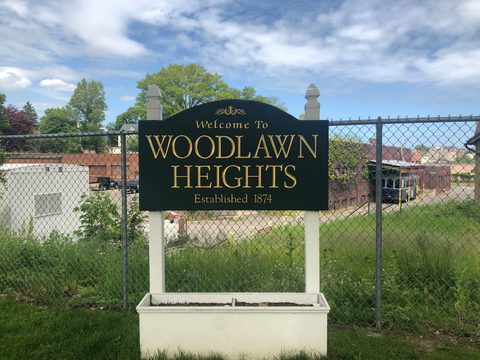

Woodlawn Heights, also known as Woodlawn, is a predominantly Irish-American working class neighborhood at the very north end of the borough of the Bronx: 0.240 square miles, with a 2020 census population of 7,985, bounded by McLean Avenue to the north, the Bronx River to the east, Woodlawn Cemetery to the south and Van Cortlandt Park to the west. Katonah Avenue runs north–south through the heart of it, and the businesses named along it are the Emerald Isle Immigration Center, an Italian bakery, an Italian restaurant and an Irish butcher shop. McLean Avenue, the northern boundary, is known for its Irish pubs, restaurants and gift shops, whose pubs and shops are considered to be some of the neighborhood's most notable fixtures, although technically it is within the city of Yonkers. Historically a German neighborhood, it is now a mostly Irish American neighborhood, which also has a small but recognizable Italian-American community, and it remains one of the few communities to which young and newly arrived Irish immigrants regularly arrive en masse.
What's here
Katonah Avenue is the commercial spine. The Emerald Isle Immigration Center stands at 4275 Katonah Avenue and the New York Public Library's Woodlawn Heights branch at 4355; the avenue's named specialty businesses are the immigration center, an Italian bakery, an Italian restaurant and an Irish butcher shop. Katonah Avenue at East 242nd Street is the northern terminal of the Bx31, the Bx34 and the BxM4. The Roman Catholic church of St. Barnabas, whose parish was founded in 1910, is at 409 East 241st Street, and Wikipedia's Woodlawn Heights article calls it the largest church in Woodlawn Heights.
McLean Avenue, running east–west, is separately known for its Irish pubs, restaurants and gift shops; its pubs and shops are considered to be some of the neighborhood's most notable fixtures, although technically it is within the city of Yonkers. The Aisling Irish Community and Cultural Center sits on that avenue, at an address its own site gives as 990 McLean Ave., Yonkers, NY 10704 — in Westchester County, not the Bronx.
Two small public spaces are named in the neighborhood. Oneida Triangle is a memorial to residents of Woodlawn Heights who served in World War I. Muskrat Cove is the northernmost segment of the Bronx River Greenway, a local park between the Woodlawn station and the southbound off-ramp from the Bronx River Parkway to East 233rd Street.
The neighborhood is served by Judith K. Weiss School P.S. 19. The NYPD's 47th Precinct, at 4111 Laconia Avenue, patrols Woodlawn Heights and neighboring Williamsbridge, and FDNY Engine Co. 63/Ladder Co. 39/Battalion 15 is at 755 East 233rd Street. Woodlawn falls under Bronx Community Board 12; the ZIP code is 10470 and the area codes are 718, 347, 929 and 917.
The cemetery on the southern boundary
Woodlawn Cemetery covers over 400 acres (160 hectares) at Webster Avenue and East 233rd Street, along the whole southern edge of the neighborhood, and is the resting place for more than 300,000 people. It was founded in 1863, on land then in undeveloped Yonkers, in Westchester County; that land was annexed to New York City in 1874.
It was designated a National Historic Landmark, listed on the National Register of Historic Places, and listed on the New York State Register of Historic Places all on the same date, June 23, 2011, under National Register reference number 11000563. Within the grounds, the gravesite of Admiral David Glasgow Farragut received its own separate individual National Register listing on October 16, 2012, reference number 12001008, at Lot 1429–44, Section 14, Aurora Hill Plot. That is a National Register listing, not a second National Historic Landmark designation.
Architects with work in the cemetery include McKim, Mead & White; John Russell Pope; James Gamble Rogers; Cass Gilbert; Carrère and Hastings; and Sir Edwin Lutyens. Beatrix Jones Farrand designed the Harkness Memorial Garden and the Milliken Memorial, Ellen Biddle Shipman designed landscapes for three mausoleums, and the Olmsted Brothers handled lot designs for the Frederick Constable and Ernest Stauffen family plots. The National Park Service counts approximately 1,300 individual burial sites and describes the grounds as holding a serious collection of trees. Eight of those trees have been individually designated Great Trees by NYC Parks, in rounds dated 1985 — a European Cutleaf Beech, White Pine, White Oak, Weeping Beech and Umbrella Pine — and 2024, a Littleleaf Linden, Japanese Maple and Black Oak.
Seven Commonwealth War Graves are here from the First and Second World Wars: six from the first, of British and Canadian servicemen, and one Royal Canadian Air Force airman from the second. A stone plaque within the grounds marks the site of a 1776 Continental Army redoubt. The cemetery is nicknamed Brewer's Row for its concentration of burials from historic brewing families.
The cemetery's own site names Celia Cruz, Miles Davis, Elizabeth Cady Stanton, Joseph Pulitzer, Nellie Bly and Irving Berlin among those buried there. Also buried at Woodlawn are Charles Evans Hughes, Robert Moses, Cicely Tyson, George M. Cohan, Duke Ellington, Herman Melville, F. W. Woolworth and Madam C. J. Walker. Jay Gould was interred in the Gould family mausoleum. Isidor Straus was first buried in the Straus-Kohns Mausoleum at Beth-El Cemetery in Brooklyn and moved to the Straus Mausoleum at Woodlawn in 1928; his wife Ida's body was never recovered from the Titanic, so the family collected water from the wreck site and placed it in an urn in the mausoleum, and the couple are memorialized on a cenotaph outside it with a quote from the Song of Solomon.
Getting there
There are currently no New York City Subway routes serving Woodlawn; the Woodlawn station on the IRT Jerome Avenue Line is actually in Norwood. That station stands at Bainbridge Avenue and Jerome Avenue. It opened on April 15, 1918, to a design by Squire J. Vickers, and was listed on the National Register of Historic Places on July 6, 2005, following mid-2000s renovations that highlighted its ornamental concrete construction. It is not ADA-accessible; in July 2025 the MTA announced plans to add elevators there under its 2025–2029 capital program. The Bx95 is a shuttle bus running between the Woodlawn subway station and the Kingsbridge Road station along Jerome Avenue, used to temporarily replace portions of 4 service during system maintenance.
Commuter rail does serve the neighborhood. Woodlawn station on Metro-North Railroad's Harlem Line, at 555 East 233rd Street, serves the Woodlawn section of the Bronx. It has two elevated side platforms, each accommodating four cars, across four total tracks. Metered and private parking is accessed via Webster Avenue, and the Bx16 and Bx31 connect there. The line here was originally developed by the New York and Harlem Railroad in the mid-1840s, rebuilt during a late-19th-century grade elimination project, and transferred to Metro-North operation in 1983; until the 1990s it served as the changeover point between catenary and third-rail power systems. As of June 2025 the MTA began adding elevators here, work covering three Bronx Metro-North stations including this one.
Woodlawn Heights is served by the Bx16, Bx31, Bx34 and BxM4 buses operated by MTA Regional Bus Operations. The Bx16 runs from Norwood, at East 206th Street and Bainbridge Avenue, to Eastchester, at Ropes Avenue and Boston Road, via Bainbridge Avenue, East 233rd Street and Nereid Avenue. The Bx31 runs from Westchester Square, at Lane Avenue and East Tremont Avenue, to Woodlawn at Katonah Avenue and East 242nd Street, via Eastchester Road and East 233rd Street. The Bx34 runs from Fordham, at Valentine Avenue and Fordham Road, to that same Katonah Avenue terminal, via Bainbridge Avenue and East 233rd Street; select Woodlawn-bound buses terminate at Jerome Avenue. The BxM4 express also has its Bronx terminus at Katonah Avenue and 242nd Street, running in Manhattan along Fifth Avenue southbound and Madison Avenue northbound, crossing the Madison Avenue Bridge and continuing via the Grand Concourse and Jerome Avenue, with Midtown terminals at Fifth Avenue and 27th Street for drop-off and Madison Avenue and 29th Street for pick-up.
What's here
-
Woodlawn Cemetery
Webster Avenue and East 233rd Street. Over 400 acres, founded in 1863, and a National Historic Landmark since June 23, 2011.
-
St. Barnabas Roman Catholic Church
409 East 241st Street. St. Barnabas Parish was founded in 1910 and its elementary school opened in 1914.
-
Woodlawn Heights Library
4355 Katonah Avenue. The branch opened in 1931 and moved to its current one-story location in 1969.
-
Emerald Isle Immigration Center
4275 Katonah Avenue, and one of the specialty businesses the neighborhood's own article names along the avenue.
Questions
How do I get to Woodlawn?
There are currently no New York City Subway routes serving Woodlawn; the Woodlawn station on the IRT Jerome Avenue Line is actually in Norwood, at Bainbridge Avenue and Jerome Avenue. Commuter rail does serve the neighborhood: Woodlawn station on Metro-North Railroad's Harlem Line, at 555 East 233rd Street, with connecting Bx16 and Bx31 buses. Woodlawn Heights is served by the Bx16, Bx31, Bx34 and BxM4 buses; the Bx31, Bx34 and BxM4 all terminate at Katonah Avenue and East 242nd Street, and the BxM4 runs on to Midtown Manhattan.
Is the subway station called Woodlawn in Woodlawn?
No. The Woodlawn station on the IRT Jerome Avenue Line sits at Bainbridge Avenue and Jerome Avenue, and that intersection is in the Norwood neighborhood of the Bronx, and not in Woodlawn. The station opened on April 15, 1918, to a design by Squire J. Vickers, and was listed on the National Register of Historic Places on July 6, 2005.
Who is buried at Woodlawn Cemetery?
More than 300,000 people. The cemetery's own site names Celia Cruz, Miles Davis, Elizabeth Cady Stanton, Joseph Pulitzer, Nellie Bly and Irving Berlin; also buried there are Charles Evans Hughes, Robert Moses, Cicely Tyson, George M. Cohan, Duke Ellington, Herman Melville, F. W. Woolworth and Madam C. J. Walker. Jay Gould was interred in the Gould family mausoleum, and Isidor Straus was moved to the Straus Mausoleum at Woodlawn in 1928 from Beth-El Cemetery in Brooklyn. The gravesite of Admiral David Glasgow Farragut carries its own National Register listing, made on October 16, 2012.
Connected pages
Same region
-
Bronx Park, the Bronx: A Garden and a Zoo in One Park
· Bronx Park, New York
The Bronx River is Woodlawn's eastern boundary, and Muskrat Cove, the northernmost segment of the Bronx River Greenway, lies in the neighborhood.
-
City Island, the Bronx: Boatyards, Seafood and One Bridge
· City Island, New York
Another Bronx neighborhood at the borough's edge, covered elsewhere in this series.