.jpg)
Orientation
Columbia Street Waterfront District, Brooklyn: Twenty-Two Blocks by the Bay
Columbia Street Waterfront District, New York
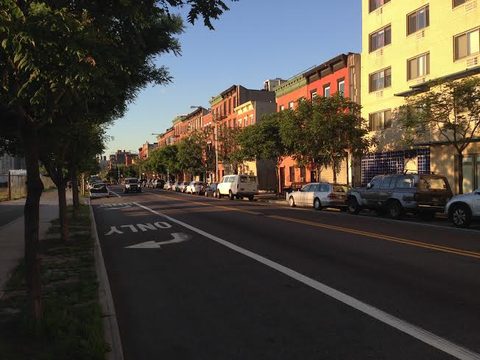

The Columbia Street Waterfront District sits on Upper New York Bay between Cobble Hill and Red Hook, about twenty-two blocks between the Brooklyn-Queens Expressway and the waterfront, from Atlantic Avenue to the Hugh L. Carey Tunnel. It was established in 1957, when the newly constructed expressway effectively separated Columbia Street from Carroll Gardens and Cobble Hill. A 1975 accident during a sewer-line repair caused the death of a construction worker, emptied the district further of tenants, and was followed by the demolition of 33 buildings. By 1984 an urban renewal project was completed, as well as a brand-new street, houses along which sold out quickly. It is one of Brooklyn's smallest neighborhoods, and is sometimes characterised as an extension of Carroll Gardens or Cobble Hill rather than a distinct entity.
A corridor rebuilt
The rebuilding that followed the 1975 demolitions arrived in phases. Also in 1984, the first phase of Columbia Terrace was completed: a seventeen-building low-rise project on President Street with 51 one-, two- and three-bedroom condominium units. Phases two through four added 129 more apartments on President and Carroll Streets.
Industrial buildings were converted rather than replaced. In 1986 a former Louis Comfort Tiffany factory building on the cobblestone street named Tiffany Place became condominiums. In 2010 a former pasta manufacturing facility at 25 Carroll Street was converted into 17 loft condominiums.
Through the 2000s the district saw a wave of new bakeries, restaurants and small businesses open along Columbia Street, and several of them are still trading. Because sources fold the district into Carroll Gardens or Cobble Hill as often as they treat it separately, no boundary line here should be read as settled.
Getting there
No subway station sits inside the district, so the bus is the direct answer. The B61 runs along Columbia Street through the neighborhood, travelling north via Van Brunt Street from Red Hook, then Columbia Street, then Atlantic Avenue through Boerum Hill and Cobble Hill into Downtown Brooklyn, terminating at Smith Street and Livingston Street just south of the Fulton Mall and the Jay Street-MetroTech subway station.
Three subway stations sit outside the district in neighbouring areas. Carroll Street, on the F and G, is in Carroll Gardens at Carroll and Smith Streets, with no entrance directly on Carroll Street. Bergen Street, also on the F and G, is at the intersection of Bergen Street and Smith Street on the border of Cobble Hill and Boerum Hill. Smith-Ninth Streets, on the same lines, is over the Gowanus Canal near Smith and Ninth Streets, in Gowanus.
What's here
-
Van Voorhees Playground
The district's own park, 5.25 acres of courts and playground under trees that have stood since before the expressway reshaped the block.
-
Jalopy Theatre and School of Music
A nonprofit folk venue and music school on Columbia Street, running since 2006.
-
Tiffany Place
A cobblestone street with a former Louis Comfort Tiffany factory on it, converted to condominiums in 1986.
-
Alma
Three floors of Mexican cooking on Columbia Street, open since 2002, with a rooftop Sky Lounge at the top.
-
Mazzat
Grilled meats, kebabs, hummus and falafel on Columbia Street, open seven days.
Questions
How do I get to the Columbia Street Waterfront District?
By the B61 bus, which runs along Columbia Street through the district between Red Hook and Downtown Brooklyn. There is no subway station in the district itself; the nearest are Carroll Street on the F and G, in Carroll Gardens, and Bergen Street on the F and G, on the Cobble Hill and Boerum Hill border.
Is this really a separate neighborhood?
Sources disagree. Wikipedia calls it one of Brooklyn's smallest neighborhoods but notes it is sometimes characterised as an extension of Carroll Gardens or Cobble Hill rather than a distinct entity. It became identifiable at all in 1957, when the Brooklyn-Queens Expressway cut Columbia Street off from both.
What is Tiffany Place?
A cobblestone street named for the former Louis Comfort Tiffany factory building that stands on it. The building was converted into condominiums in 1986. It is private housing, so the street and its industrial-era fabric are what a visitor sees.
Connected pages
Nearby
-
Cobble Hill, Brooklyn: A Name Revived in 1959
· Cobble Hill, New York
The 1957 Brooklyn-Queens Expressway separated Columbia Street from Cobble Hill, which sources still sometimes treat this district as an extension of.
-
Red Hook, Brooklyn: Basins, Barges, and No Subway
· Red Hook, New York
The district sits on Upper New York Bay between Cobble Hill and Red Hook, and the B61 links the two along Van Brunt and Columbia Streets.
-
Carroll Gardens, Brooklyn: Front Yards Written Into Law
· Carroll Gardens, New York
The Columbia Street corridor was cut off from Carroll Gardens in 1957, when the newly built Brooklyn-Queens Expressway separated it.
Same region
-
Boerum Hill, Brooklyn: A Name Coined in 1964
· Boerum Hill, New York
The B61 runs from Columbia Street along Atlantic Avenue through Boerum Hill and Cobble Hill.
-
Downtown Brooklyn, Brooklyn: Borough Hall and the Fulton Mall
· Downtown Brooklyn, New York
The B61 terminates at Smith and Livingston Streets, just south of the Fulton Mall and the Jay Street-MetroTech subway station.