
Orientation
Concourse, the Bronx: The Grand Concourse and Its Historic District
Concourse, New York

Concourse is a neighborhood in the Bronx, New York City, centered on the intersection of the Grand Concourse and 161st Street and divided into three subsections: West Concourse, East Concourse and Concourse Village, with the Grand Concourse as the main thoroughfare. Its boundaries are East 169th Street to the north, Webster Avenue to the east, East 149th Street to the south, and Jerome Avenue and the Harlem River to the west. It is bordered to the west by Highbridge and the Harlem River; to the north by Mount Eden; to the east by Claremont Village, Melrose and Morrisania; and to the south by Mott Haven. The 2010 census gave the combined population as 101,566 over 855.37 acres, and the racial makeup as 62.2% Hispanic or Latino, 32.7% African American, 1.6% White and 1.8% Asian. Concourse falls under Bronx Community Board 4; its ZIP codes are 10451 and 10452, and it is policed by the 44th Precinct at 2 East 169th Street.
The Grand Concourse
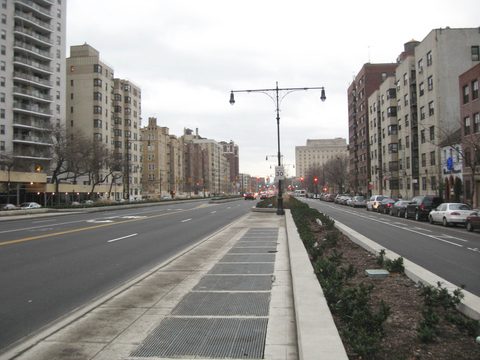
The Grand Concourse is a 5.2-mile (8.4 km) thoroughfare. Louis Aloys Risse, an immigrant from Saint-Avold, Lorraine, France, conceived the road in 1890 to connect Manhattan to the northern Bronx. Construction ran from 1894 to 1909, and the southward extension was completed in 1927. The road is 180 feet wide and carries three tree-lined roadways with medians. It was modeled on the Champs-Élysées but is considerably larger, and it cost $14 million, about $541.8 million today. Along its course it passes through Bedford Park, Concourse, Highbridge, Fordham, Mott Haven, Norwood and Tremont.
By the mid-1930s roughly 300 apartment buildings had gone up along it, described as the finest examples of Art Deco and Art Moderne architecture in the United States, and by 1939 the road was being called the Park Avenue of middle-class Bronx residents. A 1934 count found that about 99% of residences had private bathrooms and 95% had central heating. The IRT Jerome Avenue Line opened in 1917 and spurred enormous development.
The road went into decline through disinvestment, urban renewal and redlining in the 1960s and 1970s, and its median was replaced with cement that was painted green. The Special Grand Concourse Preservation District was created in 1989. The neighborhood around it declined after 1960 and began to rebound in the 1990s; the decline is attributed to white flight, incentives to move to the suburbs, redlining, the development of Co-Op City, disinvestment by New York City, and arson.
The Grand Concourse Historic District was designated by the New York City Landmarks Preservation Commission on October 25, 2011, as Designation No. 2403, covering the Grand Concourse from 153rd to 167th Streets. It had been listed on the National Register of Historic Places on August 24, 1987, under reference number 87001388, a nomination covering 730–1000, 1100–1520, 1560, and 851–1675 Grand Concourse. Its architectural styles are given as Late 19th and 20th Century Revivals and Art Deco, and its buildings are five or six stories with wide entrance courtyards.
What's here
The Andrew Freedman Home stands at 1125 Grand Concourse. Joseph H. Friedlander and Harry Allan Jacobs filed plans for it in 1922; construction started in 1924 and the home opened that year, with two wings added between 1928 and 1931. It is a four-story building in the French and Italian Renaissance style, faced in soft gray and yellow limestone, and it was designated a New York City Landmark on June 2, 1992.
The Concourse Plaza Hotel stands at the Grand Concourse and East 161st Street. Ground was broken in 1922 and it opened on October 22, 1923, as a 12-story luxury hotel, with a grand ballroom, four banquet halls, two meeting and dinner rooms, two kitchens — one banquet, one kosher — and a rifle range in the sub-basement. Al Smith said at the opening: "After seeing this new structure, I am convinced that anything can go in the Bronx."
Getting there
The 161st Street–Yankee Stadium station is at East 161st Street and River Avenue, and the station sits in both Highbridge and Concourse. The 4 serves it at all times; the B serves it weekday rush hours and middays; the D serves it at all times except rush hours in the peak direction, unless there is a Yankee Stadium event.
The IRT Jerome Avenue Line has a 167th Street station at 167th Street and River Avenue, in Concourse and Highbridge, served by the 4 at all times. The IND Concourse Line has its own 167th Street station at East 167th Street and the Grand Concourse, in Highbridge and Concourse, served by the B on weekdays and by the D at all times except rush hours in the peak direction.
Metro-North's Yankees–East 153rd Street station is on Exterior Street, in Concourse and Highbridge. Hudson Line trains serve it daily, and selected Harlem Line and New Haven Line trains serve it on game days. That game-day service is branded the Yankee Clipper, with shuttle and Hudson Line trains carrying fans to and from Grand Central.
The Bx1, Bx2, Bx6, Bx13, Bx35 and BxM4 buses serve the neighborhood. The Bx1 and the Bx2 share an alignment from the Grand Concourse and 149th Street north. The Bx1 runs between Mott Haven–138th Street and Riverdale–231st Street; the Bx2 runs between Mott Haven–138th Street and Kingsbridge Heights–Fort Independence Street.
What's here
-
Andrew Freedman Home
1125 Grand Concourse. Opened in 1924 to plans by Joseph H. Friedlander and Harry Allan Jacobs, and designated a New York City Landmark on June 2, 1992.
-
Concourse Plaza Hotel
The Grand Concourse and East 161st Street. Opened October 22, 1923, as a 12-story luxury hotel; purchased by the New York City government in 1974 and converted to senior citizens' housing.
Questions
How do I get to Concourse?
By subway, the 161st Street–Yankee Stadium station at East 161st Street and River Avenue is served by the 4 at all times, the B weekday rush hours and middays, and the D at all times except rush hours in the peak direction, unless there is a Yankee Stadium event. The IRT Jerome Avenue Line has a 167th Street station at 167th Street and River Avenue, served by the 4 at all times, and the IND Concourse Line has its own 167th Street station at East 167th Street and the Grand Concourse, served by the B on weekdays and the D at all times except rush hours in the peak direction. Metro-North's Yankees–East 153rd Street station on Exterior Street takes Hudson Line trains daily. The Bx1, Bx2, Bx6, Bx13, Bx35 and BxM4 buses serve the neighborhood.
What is the Grand Concourse?
A 5.2-mile (8.4 km) thoroughfare, 180 feet wide, carrying three tree-lined roadways with medians. Louis Aloys Risse conceived it in 1890 to connect Manhattan to the northern Bronx; it was built between 1894 and 1909, with the southward extension completed in 1927, and it cost $14 million, about $541.8 million today. It was modeled on the Champs-Élysées but is considerably larger. It passes through Bedford Park, Concourse, Highbridge, Fordham, Mott Haven, Norwood and Tremont.
What is the Andrew Freedman Home?
A four-story building at 1125 Grand Concourse, in the French and Italian Renaissance style and faced in soft gray and yellow limestone. Joseph H. Friedlander and Harry Allan Jacobs filed plans in 1922; construction started in 1924 and the home opened that year, with two wings added between 1928 and 1931. Andrew Freedman died in 1915 leaving a $4 million estate, which funded a home for aged and indigent persons of both sexes who had formerly been in good circumstances; residents originally lived rent-free and with free servants. The Mid Bronx Senior Citizens Council purchased it in 1982 and reopened it in 1983 as a residence for the elderly and the poor. It now functions as a daycare center, an event space, and an artists' hub with residency programs, workshops and exhibitions. It was designated a New York City Landmark on June 2, 1992.
What are Concourse's boundaries?
East 169th Street to the north, Webster Avenue to the east, East 149th Street to the south, and Jerome Avenue and the Harlem River to the west. It is bordered to the west by Highbridge and the Harlem River; to the north by Mount Eden; to the east by Claremont Village, Melrose and Morrisania; and to the south by Mott Haven. The neighborhood is divided into three subsections: West Concourse, East Concourse and Concourse Village.
Connected pages
Same region
-
Yankee Stadium: The Ballpark and the Streets Around It
· Bronx, New York
Yankee Stadium, the Bronx County Courthouse, Joyce Kilmer Park and the Bronx Museum of the Arts sit inside Concourse's boundaries and are covered there.
-
Mott Haven, the Bronx: Alexander Avenue and St. Ann's Church
· Mott Haven, New York
Mott Haven borders Concourse to the south, and the Grand Concourse runs through both neighborhoods.