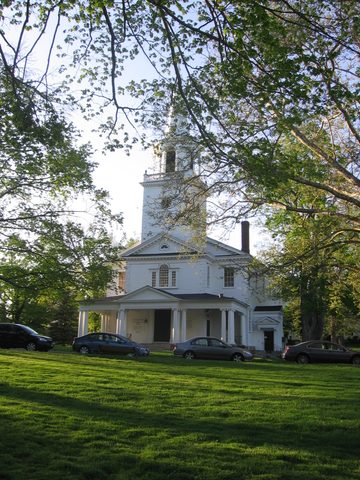

Flushing, Queens: The Bowne House, the Old Quaker Meeting House and Main Street
Flushing, New York
Pictures from Flushing
See all 1 photos →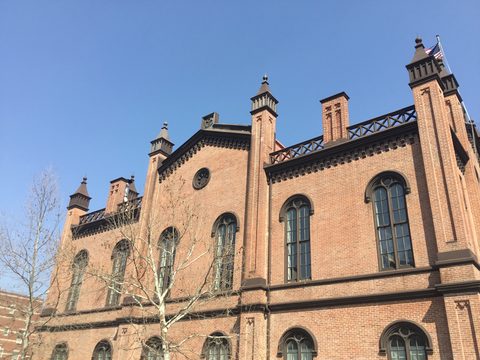
Flushing is a Queens neighborhood in Community District 7, filed by the city's planners as the tabulation area QN0707 Flushing-Willets Point and carrying the ZIP codes 11354, 11355 and 11358. The Landmarks Preservation Commission has designated nine individual landmarks inside that area and no historic district: the Bowne House on Bowne Street, the Friends Meeting House and Flushing Town Hall on Northern Boulevard, Kingsland Homestead on 37th Avenue, the Lewis H. Latimer House, St. George's Church on Main Street, the Bowne Street Community Church on Roosevelt Avenue, Flushing High School on Union Street, and the Weeping Beech Tree site. Kissena Park lies along Booth Memorial Avenue, and the Olde Towne of Flushing Burial Ground, established in 1840, is on 46th Avenue. Flushing Meadows-Corona Park carries the neighborhood's name but the city files it as a tabulation area of its own, belonging to no neighborhood.
-
sight
37-01 Bowne Street. Designated February 15, 1966 as LP-00143, in a report that calls it the oldest house in Queens.
-
sight
137-16 Northern Boulevard. LPC's 1970 report calls it "the oldest house of worship standing in New York City, and one of the oldest in the country."
-
46th Avenue between 164th Street and 165th Street. Established 1840 as a pauper's burial ground; final burial 1898; built over as Martin's Field in the 1930s.
-
sight
143-35 37th Avenue. Designated October 14, 1965 as LP-00005A, moved in 1968, and home to the Queens Historical Society.
-
37th Avenue between Parsons Boulevard and Bowne Street. The landmark site of the Weeping Beech Tree, which NYC Parks records as living from 1847 to 1998.
-
34-41 137th Street. LPC dates the house to about 1887-89; it was moved to its present site in 1988.
-
38-02 Main Street. Incorporated in 1761 under Samuel Seabury by Royal Charter from George III, per the LPC report.
-
143-11 Roosevelt Avenue. Built 1891-92, with windows by Agnes Fairchild Northrop of Tiffany Studios, per the LPC report.
-
sight
135-29 Northern Boulevard. An interior landmark only: the ticket lobby, grand foyer and twin staircases to the mezzanine promenade.
-
sight
137-35 Northern Boulevard. Designated a New York City landmark on July 30, 1968 as LP-00139.
-
149-19 38th Avenue. Designated a New York City landmark on October 30, 2007 as LP-02272.
-
145-15 Bayside Avenue, a Flushing street. Designated a New York City landmark on September 20, 2005 as LP-02160.
-
walk
164-01 Booth Memorial Avenue. 237.147 acres, a community park in Community Board 7, holding the Kissena Velodrome and a Korean War Memorial.
-
sight
Inside Kissena Park, which NYC Parks locates at 164-01 Booth Memorial Avenue.
-
sight
A memorial to the Korean War inside Kissena Park, which NYC Parks locates at 164-01 Booth Memorial Avenue.
-
sight
163-06 46th Avenue. A general reference work records Louis Armstrong's burial here; he lived in Corona.
-
The Ganesh Temple at 45-57 Bowne Street, the address the society gives on its own site.
-
food
45-57 Bowne Street, named on the Hindu Temple Society of North America's own site.
-
43-50 Main Street.
-
35-01 Union Street. Built 1912-15 to a design by C.B.J. Snyder, and designated January 8, 1991 as LP-01798.
-
food
155-14 Roosevelt Avenue. Charcoal Korean barbecue, with the meat grilled at the table under overhead smoke lamps.
The individual landmarks
The Bowne House stands at 37-01 Bowne Street. The Landmarks Preservation Commission designated it on February 15, 1966 as LP-00143, and that designation report calls it the oldest house in Queens. PLUTO records the current owner of the lot as the New York City Department of Parks and Recreation.
The Friends Meeting House, at 137-16 Northern Boulevard, was designated on August 18, 1970 as LP-00141. The Commission's report on it reads: "This is the oldest house of worship standing in New York City, and one of the oldest in the country." Flushing Town Hall, at 137-35 Northern Boulevard, was designated on July 30, 1968 as LP-00139. Along the same boulevard, the ground-floor interior of RKO Keith's, at 135-29 Northern Boulevard, is an interior landmark under LP-01257; the designation covers the ticket lobby and original ticket booth, the grand foyer and the twin staircases leading to the mezzanine promenade. The building's exterior is not designated.
Kingsland Homestead, at 143-35 37th Avenue, was designated on October 14, 1965 as LP-00005A, in the Commission's records as "Kingsland Homestead, Amendment to Landmark Site." The house was moved in 1968, which is why more than one address is attached to it, and it houses the Queens Historical Society. On the same avenue, between Parsons Boulevard and Bowne Street, is the landmark site of the Weeping Beech Tree, designated on April 19, 1966 as LP-00142. The tree itself is gone: NYC Parks, republished by the Queens Historical Society, records that it "lived for 151 years, from 1847 to 1998." The ground is now Margaret I. Carman Green-Weeping Beech Park, of 2.074 acres.
The Lewis H. Latimer House Museum is at 34-41 137th Street, designated on March 21, 1995 as LP-01924. The Commission dates the house to about 1887-89. In 1988, when it was threatened with demolition, it was moved to its present site; the Latimer Gardens housing project had been named in Lewis Latimer's honor.
St. George's Church, Old Parish House and Graveyard, at 38-02 Main Street, was designated on February 8, 2000 as LP-02053. That report records: "In 1761, under the leadership of Samuel Seabury, who later became the first bishop of the Episcopal Church in America, the church was officially incorporated under a Royal Charter from George III." The present church dates from 1853-54 and the Old Parish House from 1907.
The Bowne Street Community Church, the Protestant Reformed Dutch Church of Flushing, is at 143-11 Roosevelt Avenue and was designated on December 13, 2016 as LP-02137. The Commission records it as built in 1891-92, with George E. Potter attributed as architect and Edward Richardson as builder, and notes: "Several of the windows were designed by artist and congregant Agnes Fairchild Northrop of Tiffany Studios."
Flushing High School, at 35-01 Union Street, was designated on January 8, 1991 as LP-01798. Its report reads "Built 1912-15; architect C.B.J. Snyder, Superintendent of School Buildings, New York City Board of Education," and describes the institution as "the oldest public secondary school institution in New York."
Two further designated landmarks stand in the Murray Hill-Broadway Flushing tabulation area, also in Community District 7: the Voelker Orth Museum, Bird Sanctuary and Victorian Garden, at 149-19 38th Avenue, designated on October 30, 2007 as LP-02272; and the Fitzgerald/Ginsberg House, at 145-15 Bayside Avenue, designated on September 20, 2005 as LP-02160. Bayside Avenue is a Flushing street, and the house carries the ZIP code 11354.
The burial ground, the parks and the enclaves
The Olde Towne of Flushing Burial Ground is on 46th Avenue between 164th Street and 165th Street, 3.474 acres in Community Board 7. NYC Parks records that it was established in 1840 as a pauper's burial ground, and that "Over time, the burials were mostly people of African American and Native American descent." It has been called the Town Ground, the Pauper's Burial Ground and the Colored Cemetery of the Olde Towne of Flushing, and as many as 1,000 people were buried there. Parks records that "more than half of those interred here are under the age of five and only a quarter are over the age of 30." The final burial was in 1898 and the ground was transferred to Parks in 1914. A survey in 1919 recorded four marble headstones: Alfred E. Bunn, who died in 1876 aged 3; George H. Bunn, who died in 1887 aged 17; James Bunn, who died in 1890 aged 53; and Willie Curry, who died in 1874 aged 4. In the 1930s a playground called Martin's Field was built over the site; in Parks' words, "The bodies were never relocated, and the grounds were completely desecrated," with contemporary reports of "bones galore." The advocacy of the community activist Mandingo Osceola Tshaka (1931-2022) led to the site's National Register listing, and the memorial there carries "a commemorative wall engraved with the names of 320 people that were identified, with room for additional names that may be discovered."
Flushing Cemetery is at 163-06 46th Avenue. A general reference work records that Louis Armstrong is buried there; he lived in Corona, where his house museum stands.
Kissena Park is at 164-01 Booth Memorial Avenue, 237.147 acres, which NYC Parks classes as a community park in Community Board 7. The Kissena Velodrome and a Korean War Memorial are inside it.
The Hindu Temple Society of North America, the Ganesh Temple, is at 45-57 Bowne Street, and the temple's own site names the Temple Canteen at that address. The Queens Botanical Garden is at 43-50 Main Street.
On the enclaves, a general reference work places the heart of Flushing's Chinatown on Main Street between Kissena Boulevard and Roosevelt Avenue, and describes that Chinatown as Mandarin-speaking rather than Cantonese-speaking. The same source places the origin of the Long Island Koreatown on Union Street between 35th and 41st Avenues, and a South Asian corridor south of Franklin Avenue.
Flushing Meadows-Corona Park carries the neighborhood's name, but the city files it as a tabulation area of its own, QN8191, a joint interest area belonging to no neighborhood, and it lies outside Flushing's own tabulation area, QN0707 Flushing-Willets Point. NYC Parks records the park at 870.761 acres, spanning community boards 3, 4, 6, 7 and 8, with the ZIP codes 11354, 11355, 11367 and 11368. Citi Field and the institutions inside the park are covered by the Citi Field guide, at /g/citi-field-guide.
Getting there
The Main Street subway station stands on Main Street, which runs past St. George's Church at 38-02 and the Queens Botanical Garden at 43-50. A general reference work marks the heart of the Chinatown district on Main Street between Kissena Boulevard and Roosevelt Avenue by the overpass of the Long Island Rail Road's Port Washington Branch. The Q16 bus is routed via Union Street and Bayside Avenue, both of them Flushing streets.
Northern Boulevard carries the Friends Meeting House at 137-16, Flushing Town Hall at 137-35 and RKO Keith's at 135-29. Roosevelt Avenue crosses the neighborhood by the Bowne Street Community Church at 143-11, and Union Street runs past Flushing High School at 35-01. In the Murray Hill-Broadway Flushing tabulation area, 38th Avenue carries the Voelker Orth Museum at 149-19 and Bayside Avenue the Fitzgerald/Ginsberg House at 145-15.
For Kissena Park, the entrance address NYC Parks publishes is 164-01 Booth Memorial Avenue, which carries the ZIP code 11365 rather than one of Flushing's three; the Kissena Velodrome and a Korean War Memorial stand inside the park. For the Olde Towne of Flushing Burial Ground, the location is 46th Avenue between 164th Street and 165th Street. For Citi Field and everything else inside Flushing Meadows-Corona Park, see the Citi Field guide at /g/citi-field-guide.
The Landmarks Preservation Commission has designated no historic district in the QN0707 Flushing-Willets Point or QN0704 Murray Hill-Broadway Flushing tabulation areas. It has not designated the Main Street subway station, the Flushing Armory, the Free Synagogue of Flushing or the US Post Office-Flushing Main.
Frequently asked questions
- How do I get to Flushing?
- The Main Street subway station stands on Main Street. The Q16 bus is routed via Union Street and Bayside Avenue, both Flushing streets despite the second one's name. A general reference work places the overpass where the Long Island Rail Road's Port Washington Branch crosses Main Street between Kissena Boulevard and Roosevelt Avenue. Northern Boulevard carries Flushing Town Hall at 137-35, the Friends Meeting House at 137-16 and RKO Keith's at 135-29.
- Is Flushing Meadows-Corona Park part of Flushing?
- No. The park carries the neighborhood's name, but the city files it as a tabulation area of its own, QN8191, a joint interest area belonging to no neighborhood, and it lies outside Flushing's own tabulation area, QN0707 Flushing-Willets Point. NYC Parks records the park at 870.761 acres, spanning community boards 3, 4, 6, 7 and 8, with the ZIP codes 11354, 11355, 11367 and 11368. Citi Field and the institutions inside the park are covered by the Citi Field guide, at /g/citi-field-guide.
- Can I see the Weeping Beech tree?
- No. The Landmarks Preservation Commission designated the Weeping Beech Tree on April 19, 1966 as LP-00142, on 37th Avenue between Parsons Boulevard and Bowne Street, but the tree itself is gone: NYC Parks, republished by the Queens Historical Society, records that it "lived for 151 years, from 1847 to 1998." What stands there now is the landmark site, Margaret I. Carman Green-Weeping Beech Park, of 2.074 acres.
- Which is Flushing's oldest building?
- The Landmarks Preservation Commission's 1966 designation report for the Bowne House, at 37-01 Bowne Street, calls it the oldest house in Queens. The Commission's 1970 report for the Friends Meeting House, at 137-16 Northern Boulevard, reads: "This is the oldest house of worship standing in New York City, and one of the oldest in the country."
- What is the Olde Towne of Flushing Burial Ground?
- A 3.474-acre site on 46th Avenue between 164th Street and 165th Street, established in 1840 as a pauper's burial ground. NYC Parks records that "Over time, the burials were mostly people of African American and Native American descent," that as many as 1,000 people were buried there, and that "more than half of those interred here are under the age of five and only a quarter are over the age of 30." The final burial was in 1898. In the 1930s a playground called Martin's Field was built over it: "The bodies were never relocated, and the grounds were completely desecrated." The advocacy of Mandingo Osceola Tshaka (1931-2022) led to the site's National Register listing, and its memorial carries a commemorative wall engraved with the names of 320 people who were identified.
- Is the RKO Keith's building landmarked?
- Its ground-floor interior is, under LP-01257, at 135-29 Northern Boulevard. The designation covers the ticket lobby and original ticket booth, the grand foyer and the twin staircases leading to the mezzanine promenade. The building's exterior is not designated.
Connected pages
Nearby
-
Citi Field: The Ballpark and Flushing Meadows–Corona Park
· Flushing, New York
Flushing Meadows-Corona Park carries Flushing's name, but the city files it as its own tabulation area, QN8191, belonging to no neighborhood.
Shared history
-
Corona, Queens: The Armstrong House, Tifereth Israel and Spaghetti Park
· Corona, New York
A general reference work records Louis Armstrong's burial in Flushing Cemetery, 163-06 46th Avenue; he lived in Corona, where his house museum stands.
-
Douglaston, Queens: Douglas Manor, Douglaston Hill and Udalls Cove
· Douglaston, New York
LP-1957 names Broadway-Flushing in Flushing and Douglas Manor in Douglaston among the Rickert-Finlay Realty Company's tracts.
Same region
-
Korean BBQ in Queens: 149th Place, Downtown Flushing, Northern Boulevard East and Beyond
· Queens Korean BBQ, New York
Jongro BBQ is at 155-14 Roosevelt Avenue in downtown Flushing, where it burns charcoal under the grill at the table.
What travelers think
Log in to react.
No reviews yet.