
Corona, Queens: The Armstrong House, Tifereth Israel and Spaghetti Park
Corona, New York
Pictures from Corona
See all 1 photos →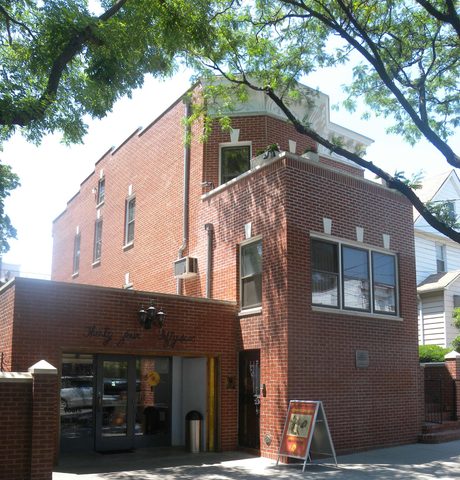
Corona is a neighborhood in the New York City borough of Queens, described in a Landmarks Preservation Commission report as "located in north-central Queens, just west of Flushing Meadows Park." It borders Flushing and Flushing Meadows–Corona Park to the east, Jackson Heights and Elmhurst to the west, Forest Hills and Rego Park to the south, and East Elmhurst to the north. Corona is mostly part of Queens Community District 4; the section north of Roosevelt Avenue, known as North Corona, is in Community District 3. The neighborhood is covered by ZIP Code 11368, and the city's planning table files it in a district named Elmhurst-Corona. Louis and Lucille Armstrong kept a house on 107th Street that is now a museum, Dizzy Gillespie lived on 37th Avenue, and a synagogue the Landmarks Preservation Commission calls "the oldest active synagogue in Corona" stands on 54th Avenue.
-
34-56 107th Street. Built 1910, architect Robert W. Johnson; a National Historic Landmark from May 11, 1976 and a New York City Landmark from December 13, 1988.
-
sight
34-49 107th Street, a second and separate building of the museum on the same street as the historic house.
-
105-19 37th Avenue, also given as 34-68 106th Street. Its designation report says it is "Located in Corona, Queens."
-
109-18 54th Avenue. Its designation report calls it "The oldest active synagogue in Corona."
-
sight
102-45 47th Avenue, which its designation report also calls "the 102-45 47th Avenue House."
-
97-28 43rd Avenue, described by its designation report as "one of Corona's most prominent public buildings."
-
Bounded by 108th Street and 51st and 52nd Avenues, Park ID Q029, and recorded by NYC Parks under the nickname "Spaghetti Park."
-
walk
0.04 acres at National Street and Roosevelt Avenue, Park ID Q172, renamed National Plaza in 1985.
-
walk
Pell Avenue, 34th Avenue and 113th and 114th Streets, Park ID Q410, in the part of Corona that falls in Community Board 3.
-
100-01 Northern Boulevard, printed by Queens Public Library as Corona, NY 11368.
-
food
107-01 Corona Avenue, which its own site places "in the heart of Corona, Queens."
-
Wikipedia gives 52-02 108th Street as the address and 1944 as the date.
-
sight
96–18 43rd Avenue, where Wikipedia says Tiffany's favrile glass was manufactured from 1901 to 1932.
-
NYC Parks gives it as "Bounded by 109th Street, 46th Avenue, and 47th Avenue," with Park ID Q450, in ZIP 11368 and Community Board 4.
-
38-23 104 Street, printed by Queens Public Library as Corona, NY 11368.
-
33-16 108th Street, printed by Elmcor as Corona, NY 11368. The organization's name is a portmanteau of East Elmhurst and Corona.
-
A lost racecourse. Wikipedia writes of a game on September 10, 1858: "Spectators paid to see a baseball game for the first time in the sport's history."
The Armstrong house and the streets around it
The Louis Armstrong House stands at 34-56 107th Street. Its designation report gives the building as "Built 1910; architect, Robert W. Johnson; builder, Thomas Daly," on "Borough of Queens Tax Map Block 1748, Lot 36." The museum's own Visit page says it "is located in Corona, a quiet residential neighborhood in northern Queens, where Louis and Lucille Armstrong chose to make their home for nearly three decades." The house was added to the National Register of Historic Places and designated a National Historic Landmark on May 11, 1976, under reference number 76001265, and was designated a New York City Landmark on December 13, 1988, as Landmark number 1555.
The Louis Armstrong Center is a second, separate building on the same street, at 34-49 107th Street. The museum also names Selma's Place, the donated home of Selma Heraldo, as part of the campus.
Dizzy Gillespie's residence is at 105-19 37th Avenue, also given as 34-68 106th Street, and the Landmarks Preservation Commission's report on it says it is "Located in Corona, Queens." That report also sets out how the neighborhood came to hold the households it did. It records that "There was no racial covenant on the property at 105-19 37th Avenue (aka 34-68 106th Street)," and that "This was possible in large part due to the lack of racial covenants in most of Corona." It also records the other half of the picture: "However by 1937, all of Corona south of Astoria Boulevard was subject to Redlining, imposed by the Federal Housing Administration (FHA), insurance companies, and mortgage lending agencies," and that the Homeowners Loan Corporation "outlined Corona in red and described it as 'Hazardous.'" A Landmarks Preservation Commission report records that in 1890 African Americans in Queens numbered 3,582.
Landmarks, parks and the avenues
Corona and Elmhurst share their early history. A Landmarks Preservation Commission report writes of "Newtown (now Corona and Elmhurst)" and dates the Wandownock Fire, Hook & Ladder 1 to its founding there in 1843. The name itself is unsettled. One commission report states that "Newtown became part of Queens County in 1853, and it was not until 1872 that the name Corona (meaning 'crown' of Queens County) came into common use for the village"; another report by the same body puts it a year later, writing that "it was not until 1873 that the name Corona" came into use. The two reports give different years for the same change.
The Edward E. Sanford House is at 102-45 47th Avenue; its designation report also calls it "the 102-45 47th Avenue House," and names the man both "Edward E. Sanford" and "Edward R. Sanford" in the same document. Congregation Tifereth Israel is at 109-18 54th Avenue, and its report calls it "The oldest active synagogue in Corona." The firehouse of Fire Engine Company 289 and Ladder Company 138 is at 97-28 43rd Avenue, described by the commission as "one of Corona's most prominent public buildings."
William F. Moore Park occupies the ground bounded by 108th Street and 51st and 52nd Avenues, in ZIP 11368 and Community Board 4. NYC Parks records that it was "Originally known as Corona Heights Triangle," gives it Park ID Q029, and records the nickname "Spaghetti Park"; the sign in the park spells the honoree's name "Wiliam F. Moore." Corona Golf Playground, Q450, is "Bounded by 109th Street, 46th Avenue, and 47th Avenue." Hinton Park, Q410, lies in Community Board 3 and is bounded by Pell Avenue, 34th Avenue, and 113th and 114th Streets. National Plaza, Q172, is the 0.04-acre Parks property at the intersection of National Street and Roosevelt Avenue; it was renamed National Plaza in 1985 and is a different public space from the pedestrian plaza the Department of Transportation later built at the same intersection.
Queens Public Library runs the Corona branch at 38-23 104 Street and the Langston Hughes Community Library and Cultural Center at 100-01 Northern Boulevard, both printed by the library as Corona, NY 11368. Elmcor's recreation building is at 33-16 108th Street; the organization's name is a portmanteau of East Elmhurst and Corona, and a landmark report records its plaque reading "East Elmhurst Corona Area. Building a Better Community." Park Side Restaurant is at 107-01 Corona Avenue, which its own site places "in the heart of Corona, Queens." Wikipedia gives the Lemon Ice King of Corona at 52-02 108th Street and dates it to 1944, and says of Tiffany's favrile glass that it "was manufactured at the Tiffany factory located at 96–18 43rd Avenue in Corona, Queens from 1901 to 1932."
Corona borders Flushing Meadows–Corona Park to the east. NYC Parks writes that "This park gets its name from two adjacent communities, Flushing and Corona."
Getting there
Wikipedia gives Corona's subway service as the IRT Flushing Line, along Roosevelt Avenue. It gives the locale of the 103rd Street–Corona Plaza station as Corona and places it at 103rd Street and Roosevelt Avenue; it gives the same locale for the 111th Street station, at 111th Street and Roosevelt Avenue.
At the western edge, the Junction Boulevard station stands at Junction Boulevard and Roosevelt Avenue. Wikipedia's locale field for that station names Corona, Elmhurst and Jackson Heights together, and Junction Boulevard is the Corona–Elmhurst line: it is a boundary station shared with the neighborhoods on either side rather than Corona's own.
Roosevelt Avenue is also the administrative seam between the neighborhood's two community districts. For the mail, Wikipedia places a post office, the Corona A Station, at 103-28 Roosevelt Avenue, and records that a post office named Elmhurst Station, at 59-01 Junction Boulevard, serves part of Corona.
Frequently asked questions
- How do I get to Corona?
- By subway, Wikipedia gives Corona's service as the IRT Flushing Line, along Roosevelt Avenue. It gives the locale of the 103rd Street–Corona Plaza station as Corona, at 103rd Street and Roosevelt Avenue, and gives the same for the 111th Street station, at 111th Street and Roosevelt Avenue. The Junction Boulevard station, at Junction Boulevard and Roosevelt Avenue, is a boundary station: the same source names Corona, Elmhurst and Jackson Heights as its locale, and Junction Boulevard is the Corona–Elmhurst line.
- Where is the Louis Armstrong House Museum?
- At 34-56 107th Street, Corona, NY 11368. The museum's own Visit page says it "is located in Corona, a quiet residential neighborhood in northern Queens, where Louis and Lucille Armstrong chose to make their home for nearly three decades." The house was designated a National Historic Landmark on May 11, 1976, under National Register reference number 76001265, and a New York City Landmark on December 13, 1988. The Louis Armstrong Center is a second building on the same street, at 34-49 107th Street.
- Why is it called Corona?
- The official accounts disagree. One Landmarks Preservation Commission report says that "Newtown became part of Queens County in 1853, and it was not until 1872 that the name Corona (meaning 'crown' of Queens County) came into common use for the village." Another report by the same commission puts it a year later, writing that "it was not until 1873 that the name Corona" came into use. Both are official accounts and they do not agree.
- What is Spaghetti Park?
- It is the nickname NYC Parks records for William F. Moore Park, the Parks property bounded by 108th Street and 51st and 52nd Avenues, in ZIP 11368 and Community Board 4, with Park ID Q029. The agency records that the park was "Originally known as Corona Heights Triangle." The sign in the park spells the honoree's name "Wiliam F. Moore."
- Who else from Corona's music history has a marked address?
- Dizzy Gillespie's residence, at 105-19 37th Avenue — also given as 34-68 106th Street — which the Landmarks Preservation Commission's report describes as "Located in Corona, Queens." That report is also where the neighborhood's housing history is set out: it records that there was no racial covenant on that property, that this "was possible in large part due to the lack of racial covenants in most of Corona," and that "by 1937, all of Corona south of Astoria Boulevard was subject to Redlining."
- How does Corona relate to Flushing Meadows–Corona Park?
- Corona borders the park to the east. NYC Parks writes that "This park gets its name from two adjacent communities, Flushing and Corona."
Connected pages
Nearby
-
Citi Field: The Ballpark and Flushing Meadows–Corona Park
· Flushing, New York
Corona borders Flushing Meadows–Corona Park to the east, and NYC Parks writes that the park takes its name from Flushing and Corona.
-
Rego Park, Queens: REal GOod, the Crescents and the Remsen Cemetery
· Rego Park, New York
Corona borders Rego Park to the north, alongside Elmhurst.
Shared history
-
Elmhurst, Queens: Newtown's Village, Four Landmarks and the Whitney Avenue Grid
· Elmhurst, New York
The city's planning table files both in one district named Elmhurst-Corona, and the Wandownock Fire, Hook & Ladder 1 was founded in Newtown in 1843.
-
Flushing, Queens: The Bowne House, the Old Quaker Meeting House and Main Street
· Flushing, New York
A general reference work records Louis Armstrong's burial in Flushing Cemetery, 163-06 46th Avenue; he lived in Corona, where his house museum stands.
Same region
-
Jackson Heights, Queens: Garden Apartments, 37th Avenue and a Landmarked District
· Jackson Heights, New York
Jackson Heights borders Corona to the west, and Wikipedia's locale field for the Junction Boulevard station names Corona, Elmhurst and Jackson Heights.
-
Elmhurst, Queens: Newtown's Village, Four Landmarks and the Whitney Avenue Grid
· Elmhurst, New York
Elmhurst and Corona make up Community District 4, which City Planning names Elmhurst-Corona, and LPC writes of "Newtown (now Corona and Elmhurst)."
What travelers think
Log in to react.
No reviews yet.