
Orientation
Fort Hamilton, Brooklyn: The Army Post at the Narrows
Fort Hamilton, New York

A small American battery on this point at the Narrows fired on the British warship HMS Asia on July 4, 1776. The permanent fort followed: its designer, the French military engineer Simon Bernard, set the cornerstone on June 11, 1825, and six years and half a million dollars later the works received Battery F of the 4th US Artillery in 1831. References to the name Fort Hamilton appear as early as 1826, though the post was not officially named for Alexander Hamilton until the twentieth century. Robert E. Lee served as post engineer from 1841 to 1846 and Abner Doubleday commanded here in 1861. The name is also used for the residential blocks around the base, sometimes counted as a sub-neighborhood of Bay Ridge.
An active post, and what a visitor can see
Fort Hamilton is the only active-duty Department of Defense military post remaining in New York City. It hosts the North Atlantic Division headquarters of the United States Army Corps of Engineers, recruiting operations and reserve units. It is a working installation, not an open historic site: the Casemate Fort and the Robert E. Lee House both stand inside the perimeter.
The way in is the Harbor Defense Museum, housed in a nineteenth-century outwork called the Caponier. Admission is free and the museum is open Monday to Friday, 10am to 4pm, closed weekends and federal holidays. Every adult visitor must show a state or federally issued photo ID to enter the installation through the 101st Street gate. The museum states that it may close on short notice and asks visitors to call ahead.
Outside the gate, John Paul Jones Park is open parkland. In 1839 the federal government let New York State's 27th Regiment drill at the fort, an arrangement later cited as qualifying it as the nation's first National Guard training camp. During the Civil War the post served as a prisoner-of-war camp and provided troops to help put down the New York Draft Riots of 1863. From 1885 more than half the old fort was demolished for concrete gun batteries built between 1898 and 1905, and in 1948 the last coast defense gun was removed.
Getting there
The R train's southern terminal, Bay Ridge-95th Street, is in Fort Hamilton at Fourth Avenue and 95th Street. It opened on October 31, 1925 as 95th Street-Fort Hamilton and is the westernmost station in the New York City Subway.
Other stations carry the name Fort Hamilton Parkway without being here: the one on the D and the one on the N are both in Borough Park. No NYC Ferry landing serves this neighborhood.
What's here
-
Fort Hamilton
An active Army post, entered only through the 101st Street gate with photo identification.
-
Harbor Defense Museum
Free, in the Caponier, open weekdays; bring photo ID and call ahead, as it can close on short notice.
-
Casemate Fort, Whiting Quadrangle
The 1830s masonry fort, on the National Register since August 7, 1974, inside the installation.
-
Robert E. Lee House
Lee's residence as post engineer between 1841 and 1846, also inside the installation.
-
John Paul Jones Park
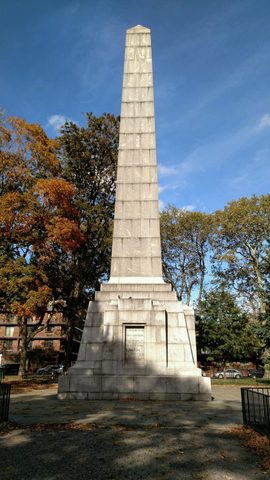
Open parkland at the foot of the post, with a Rodman gun and the Dover Patrol obelisk.
Questions
How do I get to Fort Hamilton?
Take the R to its southern terminal, Bay Ridge-95th Street, at Fourth Avenue and 95th Street in Fort Hamilton. Do not aim for the stations named Fort Hamilton Parkway on the D or N lines; both of those are in Borough Park.
Can the public go inside Fort Hamilton?
Only through the Harbor Defense Museum, and only with identification. The post is an active Army installation. The museum is free and open Monday to Friday, 10am to 4pm, closed weekends and federal holidays; every adult must show a state or federally issued photo ID at the 101st Street gate, and the museum may close on short notice, so call before setting out.
What is there to see outside the gate?
John Paul Jones Park, which the city acquired from Brooklyn in 1897. It holds a twenty-inch Rodman gun given by the US Military in 1900, a 1916 Revolutionary War memorial tablet from the Daughters of the American Revolution, the 1931 Dover Patrol Naval War Memorial given by Sir Aston Webb, and a flagpole made from a naval destroyer's mast, added in 1980.
Connected pages
Nearby
-
Bay Ridge, Brooklyn: Yellow Hook, Shore Road, the Narrows
· Bay Ridge, New York
The section of Bay Ridge south of 86th Street is sometimes considered part of a sub-neighborhood called Fort Hamilton.
Shared history
-
Dyker Heights, Brooklyn: Deed Restrictions and December Lights
· Dyker Heights, New York
The bridge authority took 36 of the fort's 138 acres for the Brooklyn anchorage, giving up 10.8 acres in Dyker Beach Park in return.
Same region
-
Borough Park, Brooklyn: Blythebourne, Reynolds and Thirteenth Avenue
· Borough Park, New York
The B16 runs along Fort Hamilton Parkway, from this area through the core of Borough Park.