
Koreatown, Manhattan: Thirty-Two Blocks Called Korea Way
Koreatown, New York
Pictures from Koreatown
See all 3 photos →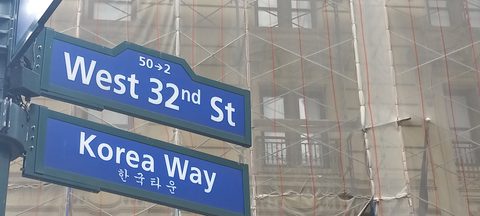
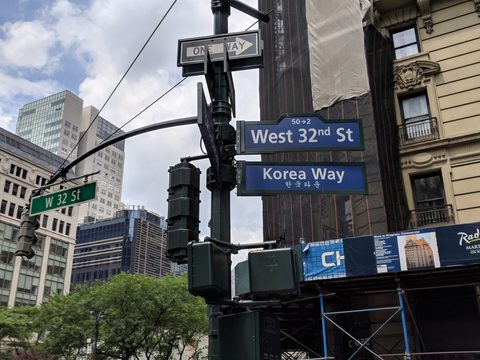
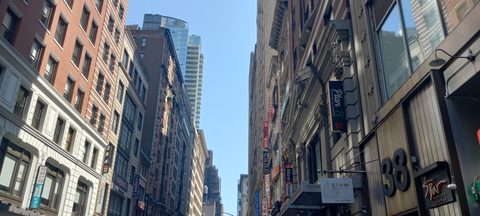
Koreatown emerged in the 1980s, when a Korean bookstore and a handful of Korean restaurants opened on what had been part of the Garment District; their success, aided by tourist traffic from the nearby Empire State Building and Macy's Herald Square, drew more Korean-owned businesses. The neighborhood's heart is Korea Way — West 32nd Street between Fifth and Sixth Avenues — known for its vertical, Seoul-like commerce, with restaurants, karaoke bars, and salons stacked on multiple floors of the same buildings, some running 24/7 to keep up with rents and foot traffic. Manhattan's Korean population nearly doubled between 2000 and 2010, to roughly 20,000 residents, part of a New York metro Korean population of 218,764 — the second-largest concentration of ethnic Koreans outside Korea — and since around 2015 the neighborhood has been expanding eastward toward Madison Avenue into Murray Hill, Kips Bay, and Rose Hill. Koreatown has also held an annual Korean Pride Festival each October since 2022.
-
The Art Deco skyscraper's observatories, open 365 days a year at Koreatown's edge.
-
walk
A triangle plaza named for newspaper publisher Horace Greeley, with an 1890 statue.
-
Free exhibitions and film screenings run by Korea's Ministry of Culture, Sports and Tourism.
-
food
Homemade tofu made fresh each morning, walk-ins only.
-
food
Korean BBQ on Korea Way, open nearly around the clock.
-
food
A modern Korean gastropub with weekend brunch and late hours.
-
food
Shoes-off, plant-based Korean temple cuisine.
-
stay
A hotel directly on Korea Way, within walking distance of Midtown landmarks.
-
food
Second floor, 22 West 32nd Street. Ribeye, skirt steak, short rib and chuck are grilled tabletop, with the staff working the tongs.
-
food
First floor, 39 West 32nd Street. Guests do the grilling at the table on an all-you-can-eat price; open to 1 a.m. Friday and Saturday.
-
food
10 West 32nd Street, across three floors. A hood hangs over the grill at every table.
-
food
37 West 32nd Street. The cuts come out raw and the meat is grilled at the table; the kitchen runs to 1 a.m. Friday and Saturday.
-
food
Third floor, 315 Fifth Avenue. The operator's line reads "The grill is only one part of the table", and staff cook the sliced meat over the fire.
-
food
319 Fifth Avenue. Meat and vegetables go on the grill at the table, with an all-you-can-eat option at $100 per person.
-
food
307 Fifth Avenue. A Cap-Style grill imported from Korea drains the fat as the meat cooks at the table.
-
food
Second floor, 312 Fifth Avenue. Staff crisp the beef intestine on the grill at the table.
-
food
1 East 32nd Street. A slotted circular grate is recessed flush into the tabletop, with banchan set around its rim.
-
food
7 East 31st Street. A grill is set into the center of the table, and several rounds of food arrive before the beef reaches it.
-
17 East 32nd Street. Tabletop grills sit beside floor-level seating and an open kitchen, with a two-order minimum on the barbecue.
-
food
39th floor, 1250 Broadway, entrance on West 32nd Street. Tabletop grilling is the focus of the room.
A Newspaper Rivalry, Then Korea Way
The neighborhood's Wikipedia profile describes it as home to over 150 businesses of various types and sizes, while the NYC Korean Chamber of Commerce estimates more than 100 small businesses on Korea Way itself. At the neighborhood's northwest corner, Greeley Square is named for New York Tribune publisher Horace Greeley, a rival of the New York Herald that named adjacent Herald Square; an 1890 bronze statue of Greeley by Alexander Doyle stands in the square, which the 34th Street Partnership business-improvement district has maintained since 1992, restoring its public restrooms in 2020.
Getting there by subway
Koreatown sits one block from 34th Street–Herald Square (B/D/F/M and N/Q/R/W), with an out-of-system transfer to PATH's 33rd Street station. The 1/2/3 and A/C/E at 34th Street–Penn Station are about a 5-minute walk west, so nearly every trunk line lands within a couple of blocks of Korea Way.
Frequently asked questions
- How do I get to Koreatown by subway?
- 34th Street–Herald Square (B/D/F/M, N/Q/R/W) is one block away, with an out-of-system PATH transfer at 33rd Street. The 1/2/3 and A/C/E at 34th Street–Penn Station are about a 5-minute walk west.
- Why is it called Korea Way?
- West 32nd Street between Fifth and Sixth Avenues became the commercial spine of Koreatown after Korean-owned businesses took root here in the 1980s, drawing on tourist traffic from the Empire State Building and Macy's Herald Square nearby.
- What is Greeley Square named for?
- New York Tribune publisher Horace Greeley — a rival of James Gordon Bennett's New York Herald, for which neighboring Herald Square is named. An 1890 bronze statue of Greeley by Alexander Doyle stands in the square.
- Where can I stay in Koreatown?
- Hotel Stanford, at 43 W 32nd Street, sits directly on Korea Way with major Midtown landmarks within walking distance.
- Can you still go up the Empire State Building from here?
- Yes — the observatory at 20 West 34th Street borders Koreatown, with 86th- and 102nd-floor decks open 365 days a year, 9 a.m. to midnight.
Connected pages
Nearby
- Murray Hill, Manhattan: Tea, Timing, and a Private Library · Murray Hill, New York
- NoMad, Manhattan: North of Madison Square · NoMad, New York
- Midtown, Manhattan: Terminal City and the Tallest Tower · Midtown, New York
- Garment District, Manhattan: Where Fashion Avenue Was Sewn · Garment District, New York
Shared history
-
Garment District, Manhattan: Where Fashion Avenue Was Sewn
· Garment District, New York
Koreatown grew in the 1980s on what had been part of the Garment District, when Korean businesses opened on West 32nd Street.
Same region
-
Korean BBQ in Manhattan: West 32nd Street, Fifth Avenue and Five Rooms Beyond Koreatown
· Manhattan Korean BBQ, New York
Thirteen of the eighteen sit in Koreatown: six on West 32nd Street between Fifth and Broadway, seven on Fifth Avenue and the cross streets east of it.
See also
-
Kips Bay, Manhattan: The Bay That Became Blocks
· Kips Bay, New York
Since around 2015 Koreatown has been expanding eastward toward Madison Avenue into Murray Hill, Kips Bay, and Rose Hill.
-
Garment District, Manhattan: Where Fashion Avenue Was Sewn
· Garment District, New York
Greeley Square Park, a block south of Herald Square, is covered under this series' Koreatown entry.
What travelers think
Log in to react.
No reviews yet.