
Murray Hill, Manhattan: Tea, Timing, and a Private Library
Murray Hill, New York
Pictures from Murray Hill
See all 3 photos →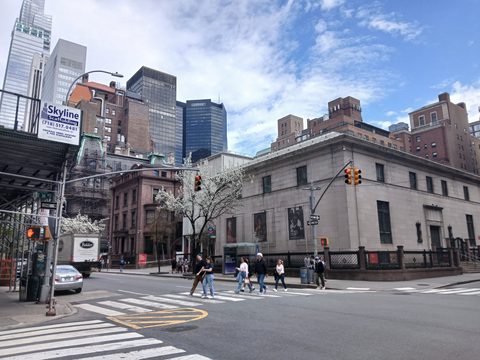
Murray Hill takes its name from Robert Murray, a Scottish-born Quaker merchant who arrived in New York from Philadelphia in 1753 and, by 1762, leased the hill then still known by its Dutch name, Inclenberg — 'fire beacon hill' — for his house and farm. The neighborhood's signature story dates to September 15, 1776: after the British landed at nearby Kip's Bay, Mary Lindley Murray reputedly invited British officers to tea at the Murray mansion, delaying them long enough for American troops to retreat, though later scholars have doubted the tale's military impact. In 1847, Murray's descendants registered the 'Murray Hill Restriction,' deed covenants barring commercial activity and requiring brick or stone residential dwellings that held the area's character for over a century. That calm drew Gilded Age elites — the Havemeyers, Rhinelanders, Belmonts, and above all J.P. Morgan, whose private library at Madison Avenue and 36th Street became a public institution in March 1924.
-
J.P. Morgan's private library, a public institution since 1924, marking its centennial in 2024.
-
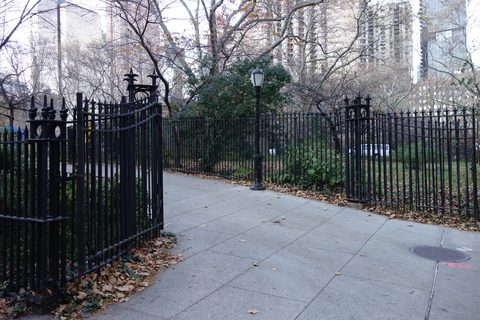
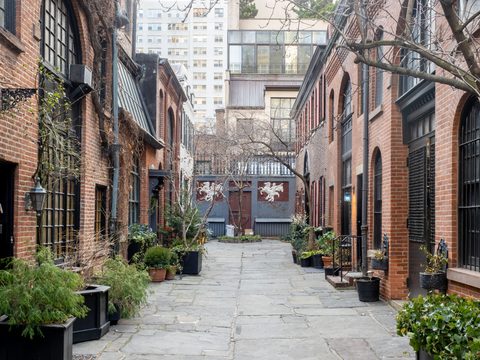
Ten 1863-64 brick stables viewable through the gate, famous from The Doors' 'Strange Days' cover.
-
walk
A neighborhood park open since 1906, with courts, a playground, and a 2021 turf field.
-
sight
Nordic exhibitions, films, and a cafe at the American-Scandinavian Foundation's headquarters.
-
An 1860s landmark church with Tiffany and La Farge stained glass.
-
A classic Jewish deli open daily on Third Avenue.
-
A kosher deli institution serving New York since 1954.
-
Steaks under a landmarked Guastavino-tile ceiling in the former Vanderbilt Hotel.
-
A boutique hotel with a rooftop garden bar and Empire State Building views.
Grid, Grit, and Landmark Protections
The hill itself was cut down 20 to 40 feet in the winter of 1808 by out-of-work dock laborers, then folded into the Commissioners' Plan grid of 1811; by the mid-19th century the upper middle class filled the brownstone rowhouses that lined its streets. A 1926 Daughters of the American Revolution plaque near the old Murray mansion site, on the Park Avenue mall, still commemorates Mary Lindley Murray's tea. Sniffen Court, an alley of ten 1863-64 brick stables off East 36th Street, was designated a city historic district on June 21, 1966 — its gate famously appears on the cover of The Doors' 1967 album 'Strange Days' — and the wider Murray Hill Historic District followed in 2002.
Getting there by subway
Murray Hill's own stop is the 6 (plus rush-hour <6> and late-night 4) at 33rd Street on Park Avenue, an original 1904 IRT station. Grand Central-42nd Street, with the 4/5/6/7/S plus Metro-North and LIRR, sits at the neighborhood's northern edge, putting most of Murray Hill a short walk from the Lexington Avenue line.
Frequently asked questions
- How do I get to Murray Hill by subway?
- The 6 (plus weekday peak <6> and late-night 4) stops at 33rd Street on Park Avenue. Grand Central-42nd Street, with the 4/5/6/7/S, sits at the neighborhood's northern edge.
- Where does Murray Hill's name come from?
- From Robert Murray, a Quaker merchant who leased the hill for his house and farm before 1762; it was known by its Dutch name, Inclenberg ('fire beacon hill'), before that.
- Is the Mary Lindley Murray tea story true?
- It's a long-standing tradition — that she delayed British officers with tea on September 15, 1776, buying time for American troops to retreat — but later scholars have doubted its actual military impact. A 1926 DAR plaque on the Park Avenue mall commemorates it regardless.
- Can you visit Sniffen Court?
- It's a private alley, but the ten 1863-64 brick stables are viewable through the gate from East 36th Street at any time.
- Where can I stay in Murray Hill?
- The Shelburne Sonesta New York, at 303 Lexington Avenue, offers rooms, suites, and a rooftop garden bar with Empire State Building views.
Connected pages
Nearby
- Kips Bay, Manhattan: The Bay That Became Blocks · Kips Bay, New York
- NoMad, Manhattan: North of Madison Square · NoMad, New York
- Midtown, Manhattan: Terminal City and the Tallest Tower · Midtown, New York
- Koreatown, Manhattan: Thirty-Two Blocks Called Korea Way · Koreatown, New York
Shared history
-
Kips Bay, Manhattan: The Bay That Became Blocks
· Kips Bay, New York
This guide's founding story turns on the British landing at nearby Kip's Bay on September 15, 1776, before Mary Lindley Murray's tea.
Same region
-
NoMad, Manhattan: North of Madison Square
· NoMad, New York
Another Manhattan neighborhood covered in this series.
-
Steakhouses in Manhattan: Twenty-Three Rooms on the Midtown Spine
· Manhattan Steakhouses, New York
Wolfgang's original room at 4 Park Avenue belongs to Murray Hill. The Times Square and Tribeca rooms are on this page.
See also
-
East Village, Manhattan: From Kleindeutschland to CBGB
· East Village, New York
The 2nd Ave Deli listed here, serving NY since 1954, relocated from its original East Village home.
-
Kips Bay, Manhattan: The Bay That Became Blocks
· Kips Bay, New York
The nearest verified hotel to Kips Bay is The Shelburne Sonesta at 303 Lexington Avenue, just west in Murray Hill; Banc Cafe sits on the line.
What travelers think
Log in to react.
No reviews yet.