
Marina District, San Francisco: the Palace of Fine Arts, Fort Mason and the exposition ground
Marina District, California
Pictures from Marina District
See all 1 photos →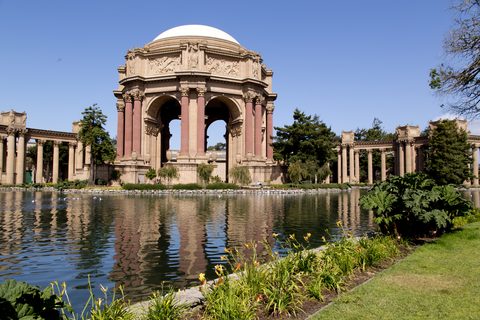
The Marina District sits on the site of the 1915 Panama-Pacific International Exposition, the world's fair San Francisco staged after the 1906 earthquake. Aside from the Palace of Fine Arts, all other buildings were demolished to make the current neighborhood. Much of the Marina is built on former landfill and is susceptible to soil liquefaction during strong earthquakes, which caused extensive damage to the neighborhood during the 1989 Loma Prieta earthquake. The name comes from the municipal boat harbour, and the park beside it is Marina Green. Fort Mason, an Army post fortified in 1864 and renamed in 1882, holds an arts campus with theatres, a vegetarian restaurant and a cafe in its former port buildings. Chestnut Street carries the shops, and the blocks around Gough, Green and Union Streets hold houses and civic buildings designated under Article 10 of the Planning Code.
-
sight
A rotunda and colonnade built for the 1915 Panama-Pacific International Exposition; San Francisco Landmark No. 88, designated in 1977, and rebuilt in poured-in-place concrete between 1964 and 1974.
-
sight
Twenty-five pipes of PVC and concrete set into a jetty built from the granite and marble of a demolished cemetery; what you hear changes with the tide.
-
walk
The lawn beside the municipal boat marina from which the neighborhood takes its name, filed by Rec & Park with the harbour as one 165.47-acre property.
-
walk
Stretching from Fillmore Street down to Lyon Street, Chestnut is lined with a collection of stores, restaurants, bakeries, coffee shops and bars.
-
sight
The post on Black Point, fortified in 1864 and renamed in 1882 for Colonel Richard Barnes Mason; listed on the National Register of Historic Places on 25 April 1972, reference number 72000109.
-
A breast-high brick wall with mounts for six 10-inch Rodman cannons and six 42-pounder guns, excavated in the early 1980s and restored to its Civil War condition.
-
Thirteen acres of former port buildings with 11 venue options; Wikipedia records that lower Fort Mason became the Fort Mason Center, a nonprofit organization, in 1976.
-
sight
A 437-seat house with a proscenium stage, at 2 Marina Boulevard with the rest of the Fort Mason Center venues.
-
food
Vegetarian cooking with menus tied to the Green Gulch farm: lunch Tuesday to Friday, brunch on Saturday and Sunday, dinner Tuesday to Sunday.
-
A cafe and bar run by the Long Now Foundation, opening at 10am Tuesday to Friday and later at the weekend; it does not otherwise accept reservations.
-
food
An Italian delicatessen at 2120 Chestnut Street, open daily from 9am to 6pm.
-
An eight-sided house on Gough Street: San Francisco Landmark No. 17, designated in 1969, and on the National Register since 23 February 1972, reference number 72000250.
-
Designated under Article 10 of the Planning Code as San Francisco Landmark No. 262 in 2010, and open until 8 on Wednesday and Thursday.
The exposition ground
The neighbourhood stands on the site of the 1915 Panama-Pacific International Exposition. The fair opened on 20 February 1915 and closed on 4 December 1915, covering 636 acres and recording 18,876,438 visitors. Aside from the Palace of Fine Arts, all other buildings were demolished to make the current neighborhood. Much of the Marina is built on former landfill and is susceptible to soil liquefaction during strong earthquakes, which caused extensive damage to the neighborhood during the 1989 Loma Prieta earthquake. That is worth knowing before you read a single street here as ordinary flat ground.
The Palace of Fine Arts is San Francisco Landmark No. 88, designated in 1977, and was listed on the National Register of Historic Places on 5 December 2005, reference number 04000659. The architects of record are William Gladstone Merchant and Bernard Maybeck, and the structure was built for the 1915 Panama-Pacific International Exposition. The colonnade and rotunda were framed in wood and then covered with staff, a mixture of plaster and burlap-type fiber; between 1964 and 1974 they were rebuilt in permanent, lightweight, poured-in-place concrete, and steel I-beams were hoisted into place for the dome of the rotunda. The exhibit hall behind the colonnade has had two lives since: in 1970 it also became the home of the 966-seat Palace of Fine Arts Theatre, and it became home to the Exploratorium in 1969, the museum closing there in January 2013 before moving to the Embarcadero. On 6 October 1976 the Palace of Fine Arts hosted the second presidential debate between Gerald Ford and Jimmy Carter.
The water side of the neighbourhood is one Rec & Park holding. The department files the yacht harbour and the park together as property 112, "Yacht Harbor and Marina Green", a regional park of 165.47 acres at 1 Marina Green Drive; Wikipedia describes the Marina Green as a park adjacent to the municipal boat marina from which the neighborhood takes its name. On the jetty that shelters the small boat harbour, at 83 Marina Green Drive, is the Wave Organ, an acoustic sculpture of 25 organ pipes made of PVC and concrete whose sound depends on the tide. Chestnut Street carries the neighbourhood's civic buildings: Moscone Recreation Center, 12.73 acres at 1800 Chestnut Street, and the Marina Branch Library at 1890 Chestnut Street.
Fort Mason
The bluff at Black Point was called Punta Medanos and Punta de San Jose by the Spanish settlers, and was renamed Black Point after 1849, for the abundance of dark-colored California bay laurel trees that grew on it. In the 1850s it carried a civilian community whose residents included John Fremont, Jessie Benton Fremont and Leonides Haskell. The National Park Service records that the outbreak of the Civil War forced the army to take back possession of Black Point, evict the civilian residents, and re-establish the original name, Point San Jose; that in 1864 the army fortified Point San Jose with more guns; and that in 1882 the post was renamed Fort Mason to honor Colonel Richard Barnes Mason, the second military governor and commander of California. Two of the private houses built on the north end of Black Point still stand, and are now called Quarters 3 and Quarters 4. Of the 1864 work, a breast-high wall of brick and mounts for six 10-inch Rodman cannons and six 42-pounder guns were built on the site; excavation in the early 1980s uncovered the well-preserved remains of the western-half of the temporary battery, and it has now been restored to its condition during the Civil War.
The Fort Mason Historic District was listed on the National Register of Historic Places on 25 April 1972, reference number 72000109, and a boundary increase was listed on 23 April 1979, reference number 79000530. The San Francisco Port of Embarkation was listed on 4 February 1985, reference number 85002433, as a National Historic Landmark with 14 contributing buildings; Wikipedia records it as operating from 1932 to 1955. During the Second World War, Fort Mason became the headquarters of the San Francisco Port of Embarkation, controlling a network of shipping facilities across the Bay Area.
The lower post is now the Fort Mason Center for Arts & Culture, at 2 Marina Boulevard: a 13-acre campus with 11 venue options ranging from 500 to 50,000 square feet and more than 100,000 square feet of rentable space, reporting approximately 1.5 million visitors annually. It describes itself as the nonprofit steward of the former San Francisco Port of Embarkation, and Wikipedia records that lower Fort Mason became the Fort Mason Center, a nonprofit organization, in 1976. The Festival Pavilion covers 50,000 square feet and holds up to 3,840 people; the Gateway Pavilion covers 40,000 square feet and holds up to 2,000; the Herbst Pavilion housed a San Francisco Art Institute graduate campus from 2017 until its closure in 2022. The Magic Theatre, the 437-seat Cowell Theater, Greens Restaurant and The Interval at Long Now all take the same 2 Marina Boulevard address.
Getting there
Steer by street addresses instead, and note that the waterfront and the inland blocks are two different sets of them.
On the water: the Palace of Fine Arts at 3301 Lyon Street, the Wave Organ at 83 Marina Green Drive, Marina Green at 1 Marina Green Drive, and Fort Mason Center for Arts & Culture at 2 Marina Boulevard, which is also the address for the Magic Theatre, the Cowell Theater, Greens Restaurant and The Interval at Long Now. Inland: Moscone Recreation Center at 1800 Chestnut Street, the Marina Branch Library at 1890 Chestnut Street, Lucca Delicatessen at 2120 Chestnut Street, the San Francisco Gas Light Company building at 3640 Buchanan Street, the Ladies' Protection and Relief Society building at 3400 Laguna Street, the Colonial Dames Octagon House at 2645 Gough Street, Allyne Park at 2609 Gough Street, Cow Hollow Playground at 1 Miley Street, the North End Police Station and Garage at 2475 Greenwich Street, the Sherman House at 2160 Green Street, the Golden Gate Valley Carnegie Library at 1801 Green Street, the Metro Theater at 2055 Union Street and the Burr House at 1772 Vallejo Street. Chestnut Street runs from Fillmore Street down to Lyon Street.
Few things here publish hours. San Francisco Public Library gives the Marina Branch as Sunday 1 to 5, Monday and Tuesday 10 to 6, Wednesday 1 to 8, Thursday 10 to 8, Friday 1 to 6 and Saturday 10 to 6, on 415-355-2823. Greens serves lunch Tuesday to Friday 11.30am to 2.30pm, brunch Saturday and Sunday 10.30am to 2.30pm and dinner Tuesday to Sunday 5.00pm to 9.00pm. The Interval at Long Now opens Monday 5pm to 10pm, Tuesday to Friday 10am to 11pm, Saturday 5pm to 11pm and Sunday 3pm to 10pm. Lucca Delicatessen opens daily from 9am to 6pm. For everything else in the neighbourhood no source states opening hours, so none are given here.
Frequently asked questions
- What is the Palace of Fine Arts, and can you go inside?
- It is a domed rotunda and a curved colonnade around a lagoon at 3301 Lyon Street, built for the 1915 Panama-Pacific International Exposition. The architects of record are William Gladstone Merchant and Bernard Maybeck. It is San Francisco Landmark No. 88, designated in 1977, and was listed on the National Register of Historic Places on 5 December 2005, reference number 04000659. The colonnade and rotunda were framed in wood and then covered with staff, a mixture of plaster and burlap-type fiber, and were rebuilt between 1964 and 1974 in permanent, lightweight, poured-in-place concrete. Behind them, the exhibit hall in 1970 became the home of the 966-seat Palace of Fine Arts Theatre, and it had housed the Exploratorium from 1969 until the museum closed there in January 2013. No source states opening hours for the site or a programme for the theatre, so neither is given here.
- Why is the neighbourhood called the Marina?
- Because of the boat harbour. Wikipedia describes the Marina Green as a park adjacent to the municipal boat marina from which the neighborhood takes its name. Rec & Park files the two together as property 112, "Yacht Harbor and Marina Green", a regional park of 165.47 acres at 1 Marina Green Drive. On the jetty that shelters the small boat harbour, at 83 Marina Green Drive, is the Wave Organ, an acoustic sculpture whose 25 organ pipes are made of PVC and concrete and set at varying elevations, so what you hear changes with the tide.
- What is at Fort Mason?
- An Army post that became an arts campus. The Fort Mason Historic District was listed on the National Register of Historic Places on 25 April 1972, reference number 72000109, with a boundary increase listed on 23 April 1979, reference number 79000530. The San Francisco Port of Embarkation was listed on 4 February 1985, reference number 85002433, as a National Historic Landmark with 14 contributing buildings, and Wikipedia records it as operating from 1932 to 1955. The lower post is now Fort Mason Center for Arts & Culture, 13 acres at 2 Marina Boulevard with 11 venue options, holding the Magic Theatre, the 437-seat Cowell Theater, Greens Restaurant and The Interval at Long Now. The remains of the 1864 brick battery at Point San Jose stand on the same ground, restored to their Civil War condition after excavation in the early 1980s.
- Where can you eat and drink?
- Greens Restaurant, at Fort Mason Center, is vegetarian, with menus tied to the Green Gulch farm; its own site gives lunch Tuesday to Friday 11.30am to 2.30pm, brunch Saturday and Sunday 10.30am to 2.30pm and dinner Tuesday to Sunday 5.00pm to 9.00pm. The Interval at Long Now, run by the Long Now Foundation at the same address, opens Monday 5pm to 10pm, Tuesday to Friday 10am to 11pm, Saturday 5pm to 11pm and Sunday 3pm to 10pm, and states that it does not otherwise accept reservations. Lucca Delicatessen, an Italian delicatessen at 2120 Chestnut Street, opens daily from 9am to 6pm on 415-921-7873. Chestnut Street itself runs from Fillmore Street down to Lyon Street and is lined with a collection of stores, restaurants, bakeries, coffee shops and bars; no source states hours for those, so none are given here.
- Which buildings here carry a city or federal designation?
- The Palace of Fine Arts is San Francisco Landmark No. 88, designated in 1977, and was listed on the National Register of Historic Places on 5 December 2005, reference number 04000659. The Marina Branch Library at 1890 Chestnut Street is San Francisco Landmark No. 262, designated in 2010; the Ladies' Protection and Relief Society building at 3400 Laguna Street is San Francisco Landmark No. 320, designated in 2024; the San Francisco Gas Light Company building at 3640 Buchanan Street is San Francisco Landmark No. 58, designated in 1974. Inland, the Colonial Dames Octagon House at 2645 Gough Street is San Francisco Landmark No. 17, designated in 1969, and was listed on the National Register on 23 February 1972, reference number 72000250; the Sherman House at 2160 Green Street is San Francisco Landmark No. 49, designated in 1972; the North End Police Station and Garage at 2475 Greenwich Street is San Francisco Landmark No. 218, designated in 1996; the Metro Theater at 2055 Union Street is San Francisco Landmark No. 261, designated in 2009; the Golden Gate Valley Carnegie Library at 1801 Green Street is San Francisco Landmark No. 300, designated in 2022; and the Burr House at 1772 Vallejo Street is San Francisco Landmark No. 31, designated in 1970, and was listed on the National Register on 8 June 2015, reference number 14000967.
- Are the Marina's residential districts protected?
- No. San Francisco's historic-districts dataset carries a group of districts in and around the neighbourhood — the Marina Historic District, the Marina Corporation Residential Historic District and its Extension, the Baker Street Historic District, the Baker Street Period Revival Bungalows Historic District, the Cow Hollow First Bay Tradition Historic District and the Lombard Street Historic District — and every one of them has the status eligible, under a planning case number rather than a register identifier. Eligible is not a designation and carries no protection, so none of those districts has any.
Connected pages
Nearby
-
Pacific Heights, San Francisco: the Haas-Lilienthal House, two twelve-acre parks and a ridge of numbered houses
· Pacific Heights, California
The neighbour up the hill: the Haas-Lilienthal House, the Casebolt House on Pierce Street and the Lyon Street Steps.
-
Fisherman's Wharf, San Francisco: Pier 39, the sea lions, Aquatic Park and Ghirardelli Square
· Fisherman's Wharf, California
Further along the same waterfront: Ghirardelli Square, the Hyde Street Pier and the Aquatic Park Historic District.
-
The Presidio, San Francisco: Fort Point, Crissy Field, the Main Post and the coast batteries
· The Presidio, California
The neighbour across Lyon Street, holding Fort Mason and the Palace of Fine Arts.
Same region
-
Russian Hill, San Francisco: Lombard Street's crooked block, three National Register districts and the hilltop parks
· Russian Hill, California
East of Van Ness Avenue: the crooked block of Lombard Street and three National Register districts named for the hill.
What travelers think
Log in to react.
No reviews yet.