New Canaan, Connecticut: A Glass House and the Harvard Five
New Canaan, Connecticut
Part of The Merritt Parkway
Pictures from New Canaan
See all 3 photos →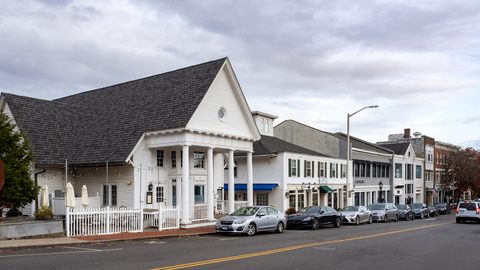
Connecticut's General Assembly established Canaan Parish in 1731 out of northwestern Norwalk and northeastern Stamford, though European settlement had begun around 1715; the name comes from the Biblical Canaan, the "promised land." New Canaan was incorporated as a town in May 1801. Shoemaking, introduced in 1818, became the dominant industry by 1850, until a railroad spur from Stamford, built in 1866, brought wealthy New Yorkers who built summer estates and then settled year-round; the first train reached New Canaan on July 4, 1868. In the 1940s, five modernist architects who became known as the "Harvard Five" — Philip Johnson, Marcel Breuer, Landis Gores, John M. Johansen and Eliot Noyes — built more than 80 houses here, making New Canaan a center of American modernist design. Sculptor John Rogers also lived and worked in town; his studio, a National Historic Landmark, survives on the New Canaan Museum & Historical Society's campus.
-
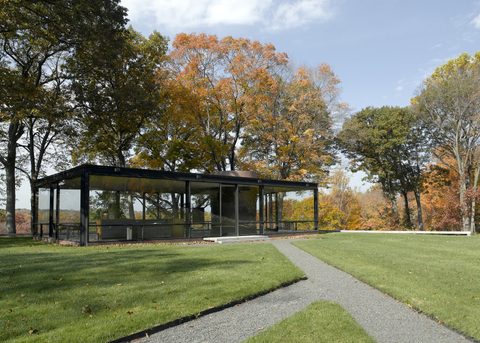
Johnson's 1949 house, tour-only.
-
sight
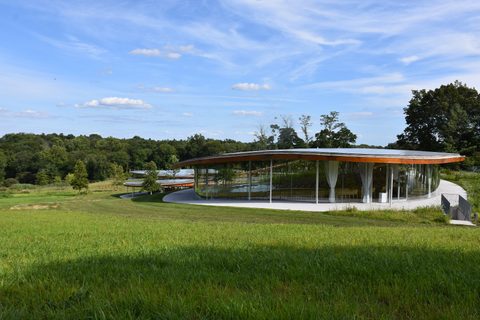
SANAA's serpentine River building on restored meadows.
-
A five-building campus including a National Historic Landmark studio.
-
sight
A 450-acre Olmsted Brothers-designed estate landscape.
-
sight
Galleries and a School of Art.
-
sight
A boxwood maze and birds of prey.
-
sight
A restored twin-screen movie theater.
-
food
New American cooking downtown.
-
food
Italian from an established Greenwich kitchen.
-
food
A historic restaurant and event venue.
Shoemakers, a railroad and the Harvard Five
New Canaan's shoemaking industry, introduced in 1818, peaked around 1850 before declining after the trade failed to adopt automatic sewing machines ahead of the Civil War; the last shoemaker closed in 1913. The 1866 railroad spur from Stamford, merged into the New York, New Haven & Hartford Railroad in 1890, remade the town by bringing New York money. The New Canaan Museum & Historical Society, founded in 1889, keeps a two-acre campus of five buildings including the 1764 Hanford-Silliman House, the 1825 Town House — the town's original town hall — and John Rogers's 1875 sculpture studio, a National Historic Landmark and one of only two in New Canaan, alongside the Philip Johnson Glass House.
Getting there
Most visitors drive in on the Merritt Parkway and then take Route 123, 124 or 106 into the village, but New Canaan is one of the easiest Connecticut towns to reach car-free. Metro-North's New Canaan Branch, 8.2 miles and fully electrified, runs from a junction east of downtown Stamford to New Canaan station in the middle of the village, with Talmadge Hill the only other in-town stop; many weekday trains run direct to and from Grand Central without a change at Stamford. No Amtrak, Shore Line East or CTrail Hartford Line service reaches New Canaan.
Frequently asked questions
- How do I get to New Canaan?
- By car via the Merritt Parkway and Routes 123, 124 or 106, or by train — Metro-North's New Canaan Branch runs from Stamford to New Canaan station downtown, with Talmadge Hill the only other in-town stop.
- Is there a direct train to Grand Central from New Canaan?
- Many weekday trains run through without a change at Stamford; check the timetable, since not every train does.
- What is the Philip Johnson Glass House?
- Philip Johnson's 1949 house, now a National Trust for Historic Preservation site. Access is by shuttle tour only from the downtown Visitor Center at 199 Elm Street; the 2026 season runs April 16-December 14.
- Is Grace Farms free to visit?
- Yes, though advance registration is requested. Open Tuesday-Saturday 10 a.m.-5 p.m., Sunday noon-5 p.m., closed Monday.
- Is there a hotel in New Canaan?
- No overnight lodging could be verified in town. The nearest option is in Stamford, about 8 miles away, near the New Canaan Branch's junction with the New Haven Line.
Foliage
Still green this week · estimated peak Nov 4–10
Derived from the Connecticut DEEP fall foliage map. DEEP's map is a climatological estimate last published in 2023; it describes a normal year, not this one. Stage names are ours. See the statewide forecast.
Connected pages
Nearby
-
Norwalk, Connecticut: Oyster Town and a Second Empire Mansion
· Norwalk, Connecticut
New Canaan's parish was carved from northwestern Norwalk and northeastern Stamford land in 1731.
-
Stamford, Connecticut: Typewriters, Shavers, and a Rail Junction
· Stamford, Connecticut
New Canaan's parish was carved from northeastern Stamford land in 1731, and the New Canaan Branch still meets the New Haven Line at Stamford.
-
Wilton, Connecticut: An Impressionist's Farm on Two Rail Stops
· Wilton, Connecticut
The two towns share a border
-
Darien, Connecticut: Two Stations and a Park Service Founder
· Darien, Connecticut
The two towns share a border
Same region
-
Darien, Connecticut: Two Stations and a Park Service Founder
· Darien, Connecticut
Route 124 reaches the Merritt Parkway at the same New Canaan exit that also serves Darien.
What travelers think
Log in to react.
No reviews yet.