
Orientation
Plumb Beach, Brooklyn: Dunes, Horseshoe Crabs and a Filled Creek
Plumb Beach, New York
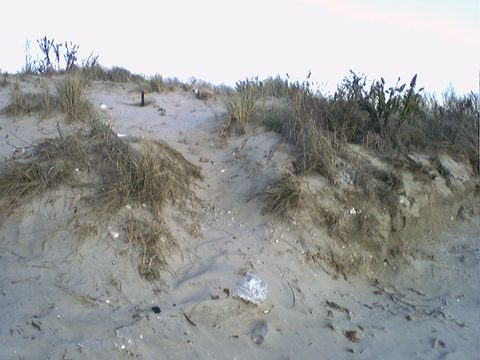

Plumb Beach takes its name from the beach plums that once grew on what was an island — Plumb Island — and sailors are recorded visiting it as early as the 1800s. In the 1890s the federal government bought roughly a third of the island's 150 acres, meaning to build a coastal mortar battery on the eastern end, and abandoned the plan when the soil proved quicksand-like. New York City acquired the former reservation for parkland in 1924 but for decades leased parts of it to a contracting company that parcelled and rented the land out. Hog Creek, which had separated the island from the rest of Brooklyn, was filled in during the late 1930s as the Belt Parkway went through, joining Plumb Beach to the mainland for good.
Prizefights, squatters and a hurricane
In May 1907 the War Department, under Secretary of War William Howard Taft, leased the vacant reservation to Winfield S. Overton on a five-year term. Overton ran illegal prizefights on it. The bouts of August 15 and August 22, 1908 drew a crowd of over 400 on the second week, more than double the roughly 200 of the first. The War Department revoked the lease in January 1909, and when Overton tried to return that May the 12th Infantry was sent to keep him out.
The island had a civilian life alongside that. Reid's Ferry served a stop here by 1900, George Ayen built a hotel in 1907, and by the First World War most of the people living on the island were squatters. The 1938 New England hurricane destroyed most of the shanties they had built, and Belt Parkway construction forced out those who remained.
The National Park Service took control in 1972, when Plumb Beach was incorporated into the newly created Gateway National Recreation Area; it is co-managed with NYC Parks today. The site takes in shoreline, tidal mudflat, low saltmarsh, a tidal lagoon, a dune system and woodland thickets at the entrance to Gerritsen Creek, and is important habitat for horseshoe crabs, which come ashore to mate in May and June. Storm surge pushing through Rockaway Inlet into Jamaica Bay makes the shoreline prone to heavy erosion.
Getting there
There is no subway station at Plumb Beach. The National Park Service's own access guidance names driving and the bus.
By road, the entrance is off the eastbound lane of the Belt Parkway, after Exit 9 and before Exit 11 — there is no Exit 10. There is a parking lot on site.
By bus, the NPS directs visitors to the B4 or the B44 to Knapp Street and Shore Parkway, the service-road stop beside the Belt Parkway, and to walk in from there.
What's here
-
Plumb Beach
The Gateway National Recreation Area shoreline off the Belt Parkway, with a kayak launch and a dune system.
Questions
How do I get to Plumb Beach?
By the B4 or B44 bus to Knapp Street and Shore Parkway, the service-road stop beside the Belt Parkway, and then on foot. By car, the entrance is off the eastbound lane of the Belt Parkway after Exit 9 and before Exit 11, with no Exit 10 in between, and there is a parking lot. No subway line serves Plumb Beach.
Can you swim at Plumb Beach?
It is not a designated swimming beach. The National Park Service lists only three lifeguarded swimming beaches in Gateway National Recreation Area — Jacob Riis Park, Sandy Hook and Great Kills Park — and Plumb Beach is not among them. It is documented for windsurfing, kiteboarding and kayak launching.
When do the horseshoe crabs come ashore?
In May and June. Plumb Beach is important horseshoe-crab mating habitat, and the site's shoreline, tidal mudflat, saltmarsh, lagoon and dune system sit at the entrance to Gerritsen Creek.
Connected pages
Same region
-
Sheepshead Bay, Brooklyn: A Fishing Fleet and a Lost Racetrack
· Sheepshead Bay, New York
The B4, which the National Park Service names as bus access to Plumb Beach, terminates at Knapp Street and Voorhies Avenue in Sheepshead Bay.
-
Gerritsen Beach, Brooklyn: Bungalows, Vollies and the Point
· Gerritsen Beach, New York
Plumb Beach sits at the entrance to Gerritsen Creek, the tidal creek that gave Gerritsen Beach its name.
-
Marine Park, Brooklyn: A Tide Mill on Gerritsen Creek
· Marine Park, New York
Plumb Beach and Floyd Bennett Field both became part of Gateway National Recreation Area, created in 1972.