
Forest Hills, Queens: The Gardens, the Tennis Club and Queens Boulevard
Forest Hills, New York
Pictures from Forest Hills
See all 1 photos →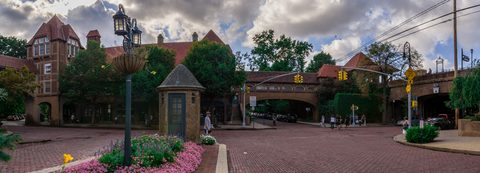
Forest Hills is a Queens neighborhood, carried by the Department of City Planning as the 2020 tabulation area QN0602, under the Community District 6 approximation it shares with Rego Park. In 1906 the developer Cord Meyer bought the land of six farms in the Hopedale section of Whitepot and, in the Landmarks Preservation Commission's account, changed the name to Forest Hills for its high ground and its proximity to Forest Park, which the neighborhood borders. South of the railroad line is Forest Hills Gardens: the commission's reports credit the Russell Sage Foundation with buying 160 acres there, while the neighborhood's Wikipedia article has Margaret Sage buying 142 acres from the Cord Meyer Development Company in 1908. The West Side Tennis Club bought its site here in 1912. The Ridgewood Savings Bank, Forest Hills Branch, at 107-55 Queens Boulevard, and the firehouse of Engine Company 305 and Hook & Ladder 151, at 111-02, are individual New York City landmarks.
-
sight
1 Tennis Place. The site was bought in 1912 and the Tudor-style clubhouse built the next year; the championship arrived in 1915 and left after 1977.
-
sight
The horseshoe-shaped stadium on the club's site, denied landmark status by the Landmarks Preservation Commission in 2011.
-
walk
Laid out south of the railroad line, and called by the commission the collaborative creation of Frederick Law Olmsted, Jr. and Grosvenor Atterbury.
-
sight
1 Station Square, with the Long Island Rail Road's Forest Hills station above 71st (Continental) Avenue between Austin and Burns Streets.
-
50 Ascan Avenue, listed on the National Register of Historic Places on December 11, 2009 under 09001086.
-
85 Greenway South, listed on the National Register of Historic Places on November 10, 2010 under 10000900.
-
107-55 Queens Boulevard, designated an individual New York City landmark under LP-2066.
-
111-02 Queens Boulevard, designated under LP-2522. The design is attributed to John R. Sliney; the Fire Department's own reports say no architect was employed.
-
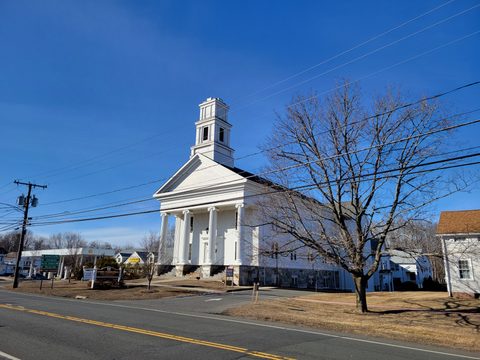
110-06 Queens Boulevard, modeled on Durham Cathedral by the parish's own account.
-
walk
Wikipedia calls it the area's main commercial street, with many restaurants and chain stores. The 112th Precinct stationhouse is at 68-40 Austin Street.
-
sight
The park Forest Hills is named after and borders. Its Park Lane address is in ZIP 11415, and the city files the park in no neighborhood tabulation area.
-
sight
68-01 Yellowstone Boulevard, whose NYC Parks sign records the Backus and Squires farmland and the name's derivation.
-
sight
Designated in 2017 at 67th Avenue and 110th Street, in front of Forest Hills High School.
-
Stop G08, served by the E, F, M and R, and recorded by the MTA as fully accessible — unlike 75 Av, recorded as not accessible.
Forest Hills Gardens and the tennis club
The Landmarks Preservation Commission's designation report for the Ridgewood Savings Bank branch records the neighborhood's founding: "In 1906, developer Cord Meyer who had previously been active in the Elmhurst section of Queens, purchased 600 acres (comprising the land of six farms) in the area known as the Hopedale section of Whitepot. Changing the name to Forest Hills because of its high ground and its proximity to the beautiful terrain of Forest Park, he began to lay out streets, install utilities, and construct the first houses." Where the commission's reports give Meyer 600 acres and the Russell Sage Foundation 160 acres south of the railroad line, the neighborhood's Wikipedia article gives Meyer 660 acres and has Margaret Sage buying 142 acres from the Cord Meyer Development Company in 1908.
The commission's 2012 report calls Forest Hills Gardens "the collaborative creation of landscape architect and planner Frederick Law Olmsted, Jr. and the architect and housing reform activist Grosvenor Atterbury." Wikipedia credits Atterbury's construction system with approximately 170 standardized precast concrete panels. By 1921, the 2000 report records, Meyer's company had constructed 200 homes, "some designed by architects Robert Tappan and William Patterson"; the 2012 report gives "some 200 homes, and several apartment buildings." The Gardens is not a New York City historic district. Station Square is at 1 Station Square, and the Long Island Rail Road's Forest Hills station stands in it. The Church-in-the-Gardens, at 50 Ascan Avenue, and St. Luke's Episcopal Church, at 85 Greenway South, are both listed on the National Register of Historic Places, in 2009 and 2010.
The West Side Tennis Club is at 1 Tennis Place. A site in Forest Hills was purchased in 1912 and the club's Tudor-style clubhouse was built the next year; in 1915 the United States Lawn Tennis Association National Championship, later renamed the U.S. Open, moved to West Side. The club's last tournament was in 1977. By 1978 the tournament had outgrown West Side and the USTA moved it to Flushing Meadows under USTA President William Hester. Forest Hills Stadium, the horseshoe-shaped outdoor tennis stadium and concert venue on the same site, fell into disrepair after the tournament left and was denied landmark status by the New York City Landmarks Preservation Commission in 2011.
Queens Boulevard, Austin Street and the parks
The Ridgewood Savings Bank, Forest Hills Branch, at 107-55 Queens Boulevard, is an individual New York City landmark, designated under LP-2066. So is the firehouse of Engine Company 305 and Hook & Ladder 151, at 111-02 Queens Boulevard — also given as 111-02 to 111-04 Queens Boulevard and as 111-50 75th Avenue, one building — designated under LP-2522, whose summary places it "in Forest Hills, Queens." The commission lists "John R. Sliney, architect (attributed)" and says the building "has been attributed to" him, while the Fire Department's own annual reports, quoted inside the same report, say "there will be no architect employed in connection with the erection of these buildings" and "thus the fees of architects were saved." Arbor Close and Forest Close, completed in 1925 and 1927, abut the firehouse site. Our Lady Queen of Martyrs, at 110-06 Queens Boulevard, is modeled on Durham Cathedral by the parish's own account. The US Post Office–Forest Hills Station, at 106-28 Queens Boulevard, was listed on the National Register of Historic Places on November 17, 1988 under reference number 88002503.
Wikipedia describes Austin Street as "the area's main commercial street" with "many restaurants and chain stores." The NYPD's 112th Precinct, which patrols Forest Hills and Rego Park, is at 68-40 Austin Street, and the Ehrenreich-Austin Playground is at 76-10 Austin Street; NYC Parks names the playground for a man it calls "the unofficial mayor of Kew Gardens," whose advocacy covered "Kew Gardens and Forest Hills" and who died on December 8, 1962. Forest Hills High School, at 67-01 110 Street, opened in 1941; Simon and Garfunkel were in its class of 1958, and Ramones Way was designated in 2017 at 67th Avenue and 110th Street, in front of the school. The Trylon Theater stood at 98-81 Queens Boulevard; demolition permits were issued to Trylon LLC in 2022, and city property records now carry a building completed that year on the merged lot.
Yellowstone Park, at 68-01 Yellowstone Boulevard, carries an NYC Parks sign: "Forest Hills was once farmland owned by Frederick Backus, George Backus, and Horatio N. Squires. The Cord Meyer Development Company bought much of the land. Its name is derived from its proximity to Forest Park." MacDonald Park runs along Queens Boulevard between Yellowstone Boulevard and 70th Road. Russell Sage Playground, on Booth Street between 68th Avenue and 68th Drive, is named by NYC Parks after the Russell Sage School, J.H.S. 190, at 68-17 Austin Street. Annadale Playground is at 64-35 102 Street, with P.S. 175 The Lynn Gross Discovery School; Willow Lake Playground is at 71-25 113 Street; the Underbridge Dog Run, a Neighborhood Park in the parks properties record, is at 64-02 Grand Central Parkway; Barrier Playground lies along the Horace Harding Expressway service road south and 62nd Avenue between 102nd Street and Yellowstone Boulevard; and Project Eden, a GreenThumb garden, is on Kessel Street between Yellowstone Boulevard and Selfridge Street.
Forest Park is not administratively part of Forest Hills: the Department of City Planning gives it its own tabulation area, QN8291, a joint interest area in no neighborhood at all, and its address, 80-30 Park Lane, geocodes to a neighborhood the city's own geocoder calls Forest Park, in ZIP 11415. Forest Hills is named for it and borders it, and the ZIP codes NYC Parks lists on the park's record include 11375 alongside 11385, 11415 and 11421.
Getting there
Forest Hills–71 Av, the MTA's stop G08 on Queens Boulevard at 71st (Continental) Avenue, is served by the E, F, M and R and is recorded in the MTA's station file as fully accessible. The 75 Av station, stop F07, at 75th Avenue and Queens Boulevard, is served by the E and F and is recorded as not accessible: its northbound and southbound accessibility fields are both zero. The 67th Avenue station, at 67th Avenue and Queens Boulevard, sits on a lot inside the Forest Hills tabulation area, and Wikipedia describes it as on the border of Forest Hills and Rego Park.
On December 31, 1936, the IND Queens Boulevard Line was extended by eight stops, and 3.5 miles (5.6 km), from its previous terminus at Roosevelt Avenue to Union Turnpike, and the 71st Avenue station opened as part of this extension.
The Long Island Rail Road's Forest Hills station, station code FHL, stands in Station Square, above 71st (Continental) Avenue between Austin and Burns Streets.
Frequently asked questions
- How do I get to Forest Hills?
- By subway, Forest Hills–71 Av is on Queens Boulevard at 71st (Continental) Avenue and is served by the E, F, M and R; the MTA's station file records it as fully accessible. The 75 Av station, at 75th Avenue and Queens Boulevard, is served by the E and F, and the same file records it as not accessible. The 67th Avenue station is at 67th Avenue and Queens Boulevard. By rail, the Long Island Rail Road's Forest Hills station, code FHL, stands in Station Square, above 71st (Continental) Avenue between Austin and Burns Streets.
- Why is it called Forest Hills?
- For Forest Park, which the neighborhood borders. The Landmarks Preservation Commission's designation report records that Cord Meyer, having bought the land of six farms in the Hopedale section of Whitepot in 1906, changed the name to Forest Hills "because of its high ground and its proximity to the beautiful terrain of Forest Park." An NYC Parks sign in Yellowstone Park gives the same derivation: "Its name is derived from its proximity to Forest Park."
- Is Forest Park in Forest Hills?
- No. The Department of City Planning gives Forest Park its own 2020 tabulation area, QN8291, a joint interest area that sits in no neighborhood tabulation area at all, and the city's own geocoder returns the neighborhood "Forest Park" for its address at 80-30 Park Lane, in ZIP 11415. Forest Hills is the neighborhood the park is named after and borders: NYC Parks lists 11375 among the park's ZIP codes, alongside 11385, 11415 and 11421.
- Where was the U.S. Open played in Forest Hills?
- At the West Side Tennis Club, 1 Tennis Place. The club bought a site in Forest Hills in 1912 and built its Tudor-style clubhouse the next year, and in 1915 the United States Lawn Tennis Association National Championship — later renamed the U.S. Open — moved to West Side. The last tournament played at the club was in 1977; by 1978 it had outgrown West Side and the USTA moved it to Flushing Meadows under USTA President William Hester. Forest Hills Stadium fell into disrepair afterwards and was denied landmark status by the Landmarks Preservation Commission in 2011.
- What in Forest Hills is on the National Register of Historic Places?
- The Church-in-the-Gardens at 50 Ascan Avenue, listed on December 11, 2009 under reference number 09001086; St. Luke's Episcopal Church at 85 Greenway South, listed on November 10, 2010 under 10000900; and the US Post Office–Forest Hills Station at 106-28 Queens Boulevard, listed on November 17, 1988 under 88002503. Those are federal listings. The New York City landmarks here are the Ridgewood Savings Bank, Forest Hills Branch (LP-2066) and the firehouse of Engine Company 305 and Hook & Ladder 151 (LP-2522).
- Is Forest Hills Gardens a landmark district?
- No. Forest Hills Gardens is not a New York City historic district, and Forest Hills Stadium was denied landmark status by the New York City Landmarks Preservation Commission in 2011. The designations in the neighborhood are individual ones on Queens Boulevard: the Ridgewood Savings Bank, Forest Hills Branch at 107-55 Queens Boulevard, under LP-2066, and the firehouse of Engine Company 305 and Hook & Ladder 151 at 111-02 Queens Boulevard, under LP-2522.
Connected pages
Nearby
-
Rego Park, Queens: REal GOod, the Crescents and the Remsen Cemetery
· Rego Park, New York
Forest Hills borders Rego Park to the east and south. The two make up Queens Community District 6, and the NYPD's 112th Precinct patrols both.
-
Kew Gardens, Queens: Lefferts Boulevard, Borough Hall and Maple Grove
· Kew Gardens, New York
The Kew Gardens–Union Turnpike station sits on the border of Kew Gardens and Forest Hills, with entrances in each neighborhood.
Shared history
-
Elmhurst, Queens: Newtown's Village, Four Landmarks and the Whitney Avenue Grid
· Elmhurst, New York
The Landmarks Preservation Commission records that Cord Meyer, who bought the Forest Hills land in 1906, had previously been active in the Elmhurst section.
-
Glendale, Queens: Myrtle Avenue, the Cemetery Belt and a Fight Over a ZIP Code
· Glendale, New York
Forest Hills is named for Forest Park, which Glendale borders and which the Department of City Planning treats as its own tabulation area, QN8291.
Same region
-
Rego Park, Queens: REal GOod, the Crescents and the Remsen Cemetery
· Rego Park, New York
Both are in Queens Community District 6. The NYPD's 112th Precinct, at 68-40 Austin Street, patrols Forest Hills and Rego Park.
See also
-
Citi Field: The Ballpark and Flushing Meadows–Corona Park
· Flushing, New York
The West Side Tennis Club's last U.S. Open was in 1977; by 1978 the tournament had outgrown the club and the USTA moved it to Flushing Meadows.
-
Ridgewood, Queens: Myrtle Avenue, the County Line and the Onderdonk House
· Ridgewood, New York
Ridgewood Savings Bank's branch at 107-55 Queens Boulevard carries Ridgewood's name but stands in Forest Hills, not in Ridgewood.
What travelers think
Log in to react.
No reviews yet.