
Orientation
New Lots, Brooklyn: A Church Raised Without Nails
New Lots, New York

The New Lots were laid out by Dutch colonists in the seventeenth and eighteenth centuries as an eastward extension of the Town of Flatbush, one of eastern Brooklyn's original towns alongside Bushwick. New Lots seceded from Flatbush in 1852, ran its own town hall at 109-111 Bradford Street, was annexed into the City of Brooklyn in 1886 as the 26th Ward, and joined New York City at the 1898 consolidation. In 1835 the Connecticut merchant John Pitkin had bought land in the northern part of the town and named his development East New York; that name spread across the old township over the twentieth century, while New Lots persists as the residential neighborhood centered on New Lots Avenue. No authoritative source fixes the line between the two.
The church on New Lots Avenue
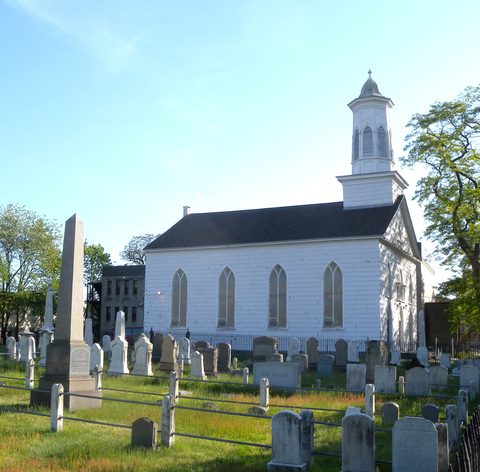
Local farming families built the New Lots Reformed Church at 630 New Lots Avenue themselves. They seasoned oak timber felled by a hurricane for nearly two years, then raised the wood-frame building in a communal building bee in May 1823 at a cost of about $35. It is assembled entirely with notched, pegged timber joinery rather than nails.
The adjoining two-acre cemetery holds an older section dating to the seventeenth century, with Revolutionary War soldiers and enslaved people among the burials; the present section was established in 1841. The church was designated a New York City Landmark on July 19, 1966 and listed on the National Register of Historic Places on May 19, 1983.
The building has not been a museum piece. In 1990 a large truss beam cracked and the church was declared unusable; the congregation raised the repair money and resumed services in 1991. It remains an active house of worship under the African Methodist Episcopal Zion denomination, operating as New Lots Community Church.
Further along New Lots Avenue, African Burial Ground Square was officially designated in 2013 after human remains were discovered on the block bounded by New Lots and Livonia Avenues and Barbey and Schenck Streets. It marks a burial ground associated with the neighborhood's early Black and enslaved population, and shares its block with the New Lots branch of the Brooklyn Public Library.
Getting there
Both nearby subway stations are named for New Lots Avenue, and neither is placed in New Lots by the sources consulted.
New Lots Avenue on the IRT New Lots Line is the eastern terminal of the line, served by the 3 at all times except late nights, the 4 late nights, and the 2, 4 and 5 at limited rush hours; Wikipedia's own neighborhood tag for it reads East New York. It was built elevated because the water table made a tunnel prohibitively expensive, opening for shuttle service on October 16, 1922, with through service to Manhattan from October 31, 1924.
New Lots Avenue on the BMT Canarsie Line, at Van Sinderen Avenue, carries the L at all times and is recorded as sitting on the border of Brownsville and East New York. It opened on July 28, 1906 under the name New Lots Road.
Because no station is documented inside the neighborhood itself, the bus matters here: the B15 runs along New Lots Avenue and Linden Boulevard, the two streets that frame the neighborhood core, and currently ends at the Lefferts Boulevard AirTrain station in Queens, where riders transfer to AirTrain JFK.
The nearest Long Island Rail Road station is East New York on the Atlantic Branch, at Atlantic Avenue and Havens Place, described by its source as serving East New York and Ocean Hill rather than New Lots.
What's here
-
New Lots Reformed Church and Cemetery
Raised in a building bee in May 1823 with pegged joinery and no nails; still an active AME Zion congregation.
-
African Burial Ground Square
Designated in 2013 on the block where human remains were found, beside the New Lots branch library.
-
Boulevard Houses
An occupied NYCHA development on the National Register as part of a survey of historic public housing.
Questions
How do I get to New Lots?
The 3, and at some hours the 2, 4 and 5, terminate at New Lots Avenue on the IRT New Lots Line, and the L stops at the separate New Lots Avenue station on the BMT Canarsie Line at Van Sinderen Avenue. Sources place the first in East New York and the second on the Brownsville-East New York border, so the B15 bus along New Lots Avenue and Linden Boulevard is the route that runs through the neighborhood core.
What is the New Lots Reformed Church?
A wood-frame church at 630 New Lots Avenue, raised by local farming families in a communal building bee in May 1823 using notched and pegged timber joinery rather than nails. It was designated a New York City Landmark in 1966 and listed on the National Register of Historic Places in 1983, and is still an active AME Zion congregation known as New Lots Community Church.
What is African Burial Ground Square?
A memorial square designated in 2013 after human remains were discovered on the block bounded by New Lots and Livonia Avenues and Barbey and Schenck Streets. It marks a burial ground associated with the neighborhood's early Black and enslaved population and shares its block with the New Lots branch of the Brooklyn Public Library.
Connected pages
Shared history
-
Bushwick, Brooklyn: Eleven Breweries in Fourteen Blocks
· Bushwick, New York
Dutch colonists settling eastern Brooklyn in the 1650s formed the towns of Flatbush, Bushwick and New Lots.
-
East New York, Brooklyn: John Pitkin's Rival Metropolis
· East New York, New York
Both grew out of the Town of New Lots, ceded from Flatbush in 1852 and annexed by the City of Brooklyn in 1886.
Same region
-
Highland Park, Brooklyn: A Park Built Around a Reservoir
· Highland Park, New York
Both are among the seven neighborhoods that make up Brooklyn Community District 5.
-
Starrett City, Brooklyn: Towers in the Park on Jamaica Bay
· Starrett City, New York
Both are among the seven neighborhoods that make up Brooklyn Community District 5.
-
Brownsville, Brooklyn: A Movie Palace and a WPA Pool
· Brownsville, New York
The L's New Lots Avenue station, named for the avenue this neighborhood centers on, sits on the border of Brownsville and East New York.
-
City Line, Brooklyn: A Border That No Longer Exists
· City Line, New York
Both are among the seven neighborhoods that make up Brooklyn Community District 5.
- Cypress Hills, Brooklyn: Cemeteries Along Jamaica Avenue · Cypress Hills, New York
- Ocean Hill, Brooklyn: A Hill With No Ocean · Ocean Hill, New York