
Brownsville, Brooklyn: A Movie Palace and a WPA Pool
Brownsville, New York
Pictures from Brownsville
See all 2 photos →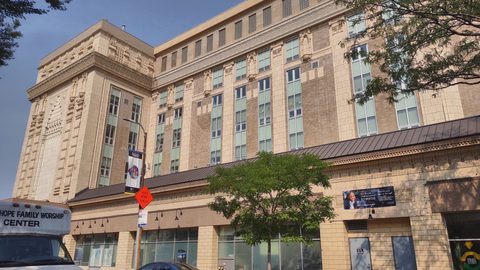
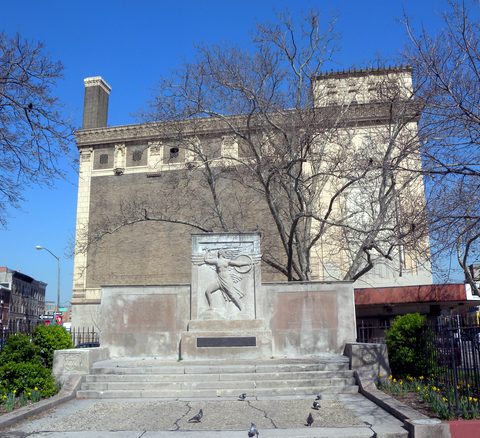
Brownsville was farmland parceled out by William Suydam in 1858, and it takes its name from Charles S. Brown, a judge and developer who bought the land in 1866, cut it into small lots, and advertised its open space to Jewish residents of Manhattan's Lower East Side. They came, and from the 1880s through the 1950s Brownsville was a dense, working-class Jewish garment neighborhood. Margaret Sanger opened the first American birth-control clinic on Amboy Street here in 1916, and the crime syndicate remembered as Murder, Inc. is traced to these blocks in the 1930s. By 1970 the population was roughly 77% Black and 19% Puerto Rican, after a decade that included the 1967 riot following the death of 11-year-old Richard Ross and the 1968 teachers' strike over community control of schools, fought alongside adjoining Ocean Hill.
-
walk
A 1915 park paid for by a British stranger's bequest, with a WPA pool and a 1939 Art Moderne bathhouse.
-
sight
A 2,827-seat movie palace of 1929, now a charter school and shops behind a preserved facade.
-
Opened in 1914 as one of the world's first libraries with a dedicated children's room, and still lending.
-
A branch since 1905, in the same building on Glenmore Avenue since 1908.
-
walk
Twenty-one acres straddling the Crown Heights and Brownsville border, also known as Arthur S. Somers Park.
-
walk
A small park at Livonia Avenue and Powell Street, under the elevated line.
-
A city recreation center open since 1953 on Linden Boulevard.
-
The street-basketball court inside the Brownsville Houses.
Small lots, libraries and a pool
Charles S. Brown's subdivision worked because it was cheap and because it was sold as air: wide-open space, advertised to families packed into Lower East Side tenements. What followed was a garment-trade neighborhood that stayed predominantly Jewish and working class for some seventy years.
Two library buildings survive from that period and still operate. The Brownsville branch of the Brooklyn Public Library opened in 1905 and has occupied its building at 61 Glenmore Avenue since 1908. The Stone Avenue branch, now at 581 Mother Gaston Boulevard, opened in 1914 and is described as one of the world's first libraries built with a dedicated children's room.
Betsy Head Park came from an unlikely bequest. Betsy Head, a wealthy British resident, died in 1907 and left $190,000 for New York City park facilities; Brownsville residents petitioned for the money, the city approved the land acquisition in July 1913, the architect Henry Beaumont Herts finished his plans in May 1914, and the park opened on September 30, 1915. The Works Progress Administration rebuilt the pool in 1935-1936. Fire destroyed the original bathhouse on August 17, 1937, and the Art Moderne bathhouse that stands today opened on May 27, 1939.
The 1960s and 1970s were hard on the neighborhood: the 1967 riot, the 1968 teachers' strike, sanitation-protest riots in 1970, and a wave of arson and abandonment through the disinvestment years. The Loew's Pitkin Theatre, an 85-foot-high, 2,827-seat movie palace built in 1929, came through it and was redeveloped in 2008 into a charter school and retail space.
Getting there
The elevated IRT New Lots Line runs through the middle of the neighborhood, and the 3 stops at Rockaway Avenue, Junius Street and Saratoga Avenue, all three of which sources place in Brownsville.
The L on the BMT Canarsie Line adds two more: Livonia Avenue and Sutter Avenue, both recorded as sitting on the border of Brownsville and East New York.
There is no Long Island Rail Road station in Brownsville. The nearest Atlantic Branch stop, East New York, is placed by its own source in the East New York and Ocean Hill neighborhoods.
Frequently asked questions
- How do I get to Brownsville?
- Take the 3 on the IRT New Lots Line to Rockaway Avenue, Junius Street or Saratoga Avenue, all in Brownsville, or the L on the BMT Canarsie Line to Livonia Avenue or Sutter Avenue, both on the border of Brownsville and East New York. There is no Long Island Rail Road station in the neighborhood.
- Where does the name Brownsville come from?
- From Charles S. Brown, a local judge and developer who acquired the land in 1866, subdivided it into small lots and advertised the area's wide-open spaces to Jewish residents of Manhattan's Lower East Side. The farmer William Suydam had first parceled out the land in 1858.
- What is Betsy Head Park?
- A 10.55-acre park that opened on September 30, 1915, paid for out of a $190,000 bequest from Betsy Head, a British resident who died in 1907. Its outdoor pool complex, with a main pool 330 by 165 feet, was rebuilt by the WPA in 1935-1936, and the Art Moderne bathhouse beside it opened on May 27, 1939 after fire destroyed the original.
- Can you still see a film at the Loew's Pitkin Theatre?
- No. The 2,827-seat movie palace, built in 1929 and 85 feet high, was redeveloped in 2008 into a charter school and retail space. The building is preserved but it is not a working performance venue.
- Are there hotels in Brownsville?
- No hotel is listed here, and the neighbouring East Brooklyn pages list none either. Plan on staying elsewhere in the city.
Connected pages
Nearby
-
Remsen Village, Brooklyn: A 1990s Name for Rugby
· Remsen Village, New York
Sutter Avenue-Rutland Road, the station sources give for this area, sits on the border of Brownsville and East Flatbush.
-
Rugby, Brooklyn: An 1890s Name on Utica Avenue
· Rugby, New York
Sutter Avenue-Rutland Road sits at Sutter Avenue, Rutland Road and East 98th Street, on the East Flatbush and Brownsville border.
-
East Flatbush, Brooklyn: Little Caribbean and Holy Cross
· East Flatbush, New York
Sutter Avenue-Rutland Road, at Sutter Avenue, Rutland Road and East 98th Street, sits on the border of East Flatbush and Brownsville.
-
East New York, Brooklyn: John Pitkin's Rival Metropolis
· East New York, New York
The L's New Lots Avenue, Livonia Avenue and Sutter Avenue stations sit on the border of the two neighborhoods.
Shared history
-
Ocean Hill, Brooklyn: A Hill With No Ocean
· Ocean Hill, New York
The 1968 teachers' strike over community control of schools was fought in Brownsville and adjoining Ocean Hill together.
Same region
-
Canarsie, Brooklyn: The Pier Where Golden City Burned
· Canarsie, New York
The B60 runs between Williamsburg Bridge Plaza and Canarsie, and lists Brownsville among the communities it serves.
- City Line, Brooklyn: A Border That No Longer Exists · City Line, New York
-
Bushwick, Brooklyn: Eleven Breweries in Fourteen Blocks
· Bushwick, New York
The B60 runs the Wyckoff and Bushwick Avenue corridor through Bushwick, and Brownsville is listed among the communities it serves.
- Starrett City, Brooklyn: Towers in the Park on Jamaica Bay · Starrett City, New York
- Highland Park, Brooklyn: A Park Built Around a Reservoir · Highland Park, New York
-
New Lots, Brooklyn: A Church Raised Without Nails
· New Lots, New York
The L's New Lots Avenue station, named for the avenue this neighborhood centers on, sits on the border of Brownsville and East New York.
What travelers think
Log in to react.
No reviews yet.