

Orientation
East New York, Brooklyn: John Pitkin's Rival Metropolis
East New York, New York
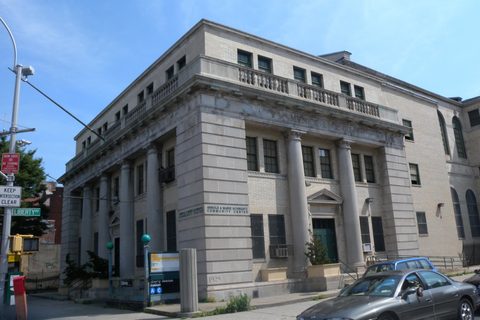

East New York carries the name a speculator gave it. In 1835 the Connecticut merchant John Pitkin bought land here and built a shoe factory, calling the development East New York in a deliberate bid to make it a rival metropolis to Manhattan. Dutch colonists had settled the ground in the 1650s as part of the Town of New Lots, one of eastern Brooklyn's original towns alongside Flatbush and Bushwick. New Lots was ceded from the Town of Flatbush in 1852, annexed into the City of Brooklyn in 1886 as the 26th Ward, and folded into New York City at consolidation in 1898. By the 1930s the population was largely Italian, Jewish, German and Russian; postwar Puerto Rican and African American migration reshaped it again.
From the Town of New Lots to the Nehemiah houses
The oldest event recorded here predates the name. In 1776, during the Battle of Long Island, British and Hessian troops used Jamaica Pass, in the vicinity of present-day East New York and Cypress Hills, to outflank George Washington's forces.
The Dutch Reformed congregation at what is now 630 New Lots Avenue raised its wood-frame church on a burial ground whose oldest graves date to the seventeenth century and hold Revolutionary War soldiers and enslaved people. The building was designated a New York City Landmark on July 19, 1966 and listed on the National Register of Historic Places in 1983.
The railroad left its own mark on American law. A 1924 accident involving a locker of fireworks at the Long Island Rail Road's East New York station produced Palsgraf v. Long Island Railroad Co., the foundational American tort case on proximate cause.
After the disinvestment and arson of the 1970s, the faith-based coalition East Brooklyn Congregations organized the Nehemiah Program, which built thousands of affordable single-family rowhouses on the neighborhood's vacant lots through the 1980s. In the Spring Creek section, Starrett City had already opened on October 13, 1974 with 5,881 apartments across 46 buildings, described as the largest federally assisted rental housing complex in the United States; its on-site cogeneration plant kept it lit through the 1977 blackout.
Getting there
East New York is served by the subway on four lines and by the Long Island Rail Road.
On the IRT New Lots Line, New Lots Avenue is the terminal: the 3 stops at all times except late nights, the 4 late nights, and the 2, 4 and 5 at limited rush hours. Pennsylvania Avenue and Van Siclen Avenue on the same line are served by the 2, 3, 4 and 5.
The IND Fulton Street Line runs beneath the neighborhood. The A and C both call at Shepherd Avenue and at Euclid Avenue, and at Liberty Avenue and Van Siclen Avenue, where the C runs at all times except late nights and the A covers late nights.
The L calls at Atlantic Avenue, and at New Lots Avenue, Livonia Avenue and Sutter Avenue on the border with Brownsville. Broadway Junction, on the border of Bedford-Stuyvesant, Bushwick and East New York, carries the A, C, J and Z.
The Long Island Rail Road's East New York station stands at Atlantic Avenue and Havens Place, on the Atlantic Branch, described by its source as serving the East New York and Ocean Hill neighborhoods. It is served by City Terminal Zone and West Hempstead Branch trains, and the MTA has scheduled it for a station-wide ADA accessibility renewal under the 2025-2029 Capital Program.
What's here
-
Spring Creek Park
Landfilled salt marsh on the Jamaica Bay shoreline; the Brooklyn side is a wetland preserve rather than a developed park.
-
Gateway Center
An open-air shopping center on a former landfill, built in two phases in 2002 and 2014.
-
Public School 73 (former)
A landmarked former school building on Macdougal Street, designated in 1984 and best seen from the street.
Questions
How do I get to East New York?
By subway on the 2, 3, 4 and 5 along the IRT New Lots Line, the A and C on the IND Fulton Street Line, or the L; Broadway Junction, on the border of Bedford-Stuyvesant, Bushwick and East New York, joins the A, C, J and Z. The Long Island Rail Road's East New York station, on the Atlantic Branch, is at Atlantic Avenue and Havens Place, served by City Terminal Zone and West Hempstead Branch trains.
Why is it called East New York?
The Connecticut merchant John Pitkin bought land here in 1835, built a shoe factory, and named the development East New York in a deliberate bid to make it a rival metropolis to Manhattan. The wider area had been settled by Dutch colonists in the 1650s as part of the Town of New Lots.
Is Highland Park in East New York?
Not squarely. Sources describe Highland Park as bordering Cypress Hills, in Community District 5, on its south side while being centered on the Brooklyn-Queens line and abutting Glendale and Ridgewood in Queens. Neighborhood boundaries here are not authoritatively fixed, so the park is best treated as adjacent to East New York rather than inside it.
Connected pages
Nearby
-
Brownsville, Brooklyn: A Movie Palace and a WPA Pool
· Brownsville, New York
The L's New Lots Avenue, Livonia Avenue and Sutter Avenue stations sit on the border of the two neighborhoods.
-
Bushwick, Brooklyn: Eleven Breweries in Fourteen Blocks
· Bushwick, New York
Broadway Junction is recorded as sitting at the border of Bedford-Stuyvesant, Bushwick and East New York.
Shared history
-
New Lots, Brooklyn: A Church Raised Without Nails
· New Lots, New York
Both grew out of the Town of New Lots, ceded from Flatbush in 1852 and annexed by the City of Brooklyn in 1886.
-
Starrett City, Brooklyn: Towers in the Park on Jamaica Bay
· Starrett City, New York
Starrett City opened in 1974 in the Spring Creek section of East New York.
-
City Line, Brooklyn: A Border That No Longer Exists
· City Line, New York
City Line is a sub-section of East New York, named for the former City of Brooklyn's border with Queens County.
-
Cypress Hills, Brooklyn: Cemeteries Along Jamaica Avenue
· Cypress Hills, New York
Cypress Hills is a subsection of East New York; British and Hessian troops used Jamaica Pass, in the vicinity of both, in 1776.
Same region
-
Highland Park, Brooklyn: A Park Built Around a Reservoir
· Highland Park, New York
Both are among the seven neighborhoods that make up Brooklyn Community District 5.
-
Ocean Hill, Brooklyn: A Hill With No Ocean
· Ocean Hill, New York
The Long Island Rail Road's East New York station is recorded as serving both neighborhoods.