.jpg)
Bushwick, Brooklyn: Eleven Breweries in Fourteen Blocks
Bushwick, New York
Pictures from Bushwick
See all 3 photos →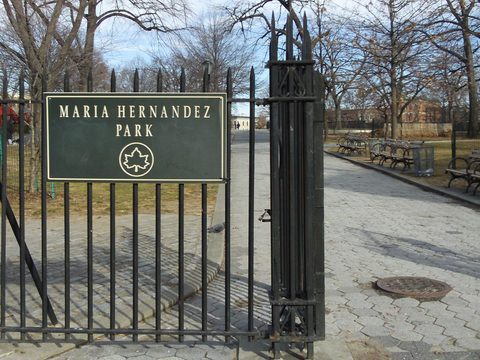
The Dutch founded Bushwick as Boswijck — heavy woods, or little town in the woods — and Governor Peter Stuyvesant chartered it in 1661. It became part of the City of Brooklyn in 1854. What made the place in the nineteenth century was beer. German immigrants built a brewing district so concentrated that an NYC Parks historical sign counts at least eleven breweries operating within a fourteen-block area, and a second account puts the number at 14 breweries by 1890. Prohibition ended that between 1920 and 1933, and Sicilian families followed the Germans into the neighborhood; by 1950 Bushwick was one of New York City's largest Italian American neighborhoods. Two more turns of population and one catastrophic night have reshaped it since.
-
Murals on building walls around Troutman Street and St. Nicholas Avenue, free and open to the sidewalk, rotating since 2012.
-
walk
Six and a half acres that P.T. Barnum once used for circus storage, opened as Bushwick Park by 1896 and renamed in 1989.
-
sight
The first brewery building in the city to be landmarked, in 2010. Built 1872-1890, closed by Prohibition in 1920, still standing.
-
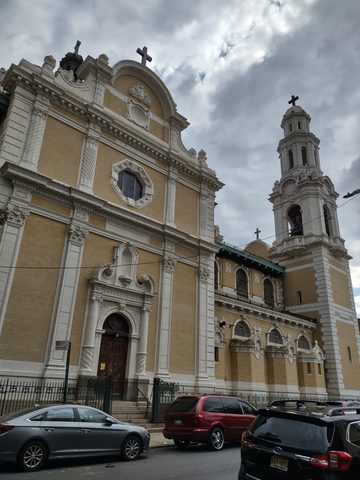
Helmle and Huberty's 1910 Spanish Baroque Revival parish church on Bleecker Street, built for German Catholic immigrants.
-
walk
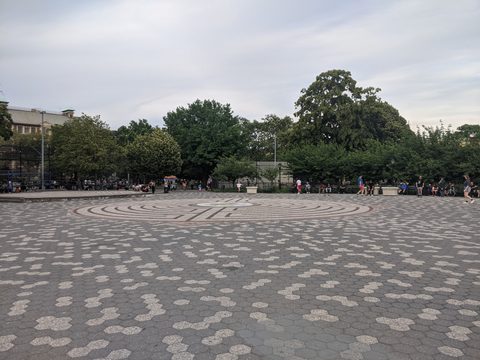
A full city block that NYC Parks calls Bushwick's town square, with antique-style gates and a performance space added in the 2000s.
-
walk
A softball field and playground on the ground the Rheingold Brewery once occupied.
-
sight
A nonprofit Off-Off-Broadway house on Eldert Street putting on new and experimental work.
-
sight
A performance-driven nightclub on Wyckoff Avenue with shows every Friday and Saturday. The door is at 408 Jefferson Street.
-
food
Wood-fired pizza on Moore Street since January 2008, at the address that started the rest of the Roberta's locations.
Beer, the blackout, and what came after
The brewers left their buildings behind. The William Ulmer Brewery at 31 Belvidere Street, built between 1872 and 1890 in the German round-arch style — the main buildings by the architect Theobald Engelhardt, the stable-storage building by Frederick Wunder — was designated a New York City Landmark on May 10, 2010, the first brewery building in the city to receive that status, and listed on the National Register of Historic Places on February 20, 2024. It closed in 1920 under Prohibition; the complex was adaptively reused rather than demolished and now holds residential and mixed-use space.
The brewers also left a church. St. Barbara's Roman Catholic Church at 138 Bleecker Street, completed in 1910 in the Spanish Baroque Revival style by the architects Helmle and Huberty, was founded as a national parish for German Catholic immigrants; the local brewer Leonard Eppig contributed to it, and the parish's name is tied to his daughter Barbara. Its congregation shifted from German to Italian to Hispanic across the twentieth century, and it remains an active parish under the Diocese of Brooklyn.
Bushwick's population was almost 90% white in 1960 and less than 40% white by 1970, as Puerto Rican and other Caribbean families became the predominant population amid the economic decline that followed the brewery closures. Then came the July 1977 blackout, when Bushwick suffered severe looting and arson damage; the business vacancy rate on Broadway reached 43% afterward, and the damage lingered for years.
Since the 2000s, rent pressure in Manhattan and northern Brooklyn has drawn young professionals and artists into converted warehouse lofts and the existing brownstone and limestone rowhouses. One product of that period is visible from the sidewalk: the Bushwick Collective, founded in 2012 by a neighborhood resident who donated his own wall and then coordinated with other building owners to open more walls to artists. Work by Buff Monster, Phlegm, Blek le Rat and Olek has gone up on those walls, and the collective runs an annual block party.
Getting there
Bushwick's stations sit on three lines.
On the L, Jefferson Street sits at Jefferson Street and Wyckoff Avenue, DeKalb Avenue and Morgan Avenue are both recorded as being in Bushwick, and Morgan Avenue sits at Morgan Avenue and Harrison Place.
Myrtle-Wyckoff Avenues is served by both the L and the M, and serves Bushwick and Ridgewood, Queens together — Wyckoff Avenue forms the Brooklyn-Queens border at that point.
On the M alone, Central Avenue sits at Myrtle Avenue and Cedar Street and Knickerbocker Avenue at Myrtle and Knickerbocker Avenues, both in Bushwick.
On the elevated BMT Jamaica Line, four stations sit on or near the Bedford-Stuyvesant boundary. Myrtle Avenue, at Myrtle Avenue and Broadway, carries the J, M and Z. Chauncey Street carries the J and Z. Halsey Street carries the J. Gates Avenue is served by the J at all times except peak-direction rush hours and by the Z in the peak direction at rush hours only. Flushing Avenue, further west, is served by the J and M with the Z skipping it; its source places it in Bedford-Stuyvesant while noting that it also serves adjacent parts of Williamsburg and Bushwick.
No NYC Ferry landing is recorded for the neighborhood, and there is no Long Island Rail Road station in Bushwick.
Where to stay
No hotel is listed here; the lodging list is left empty rather than reaching into a neighboring neighborhood. The nearest verified lodging is in Williamsburg: the Wythe Hotel at 80 Wythe Avenue, in a converted 1901 brick industrial building, and The William Vale at 111 N 12th St.
Frequently asked questions
- How do I get to Bushwick?
- By subway, and by several. The L calls at Jefferson Street, DeKalb Avenue and Morgan Avenue; the L and M share Myrtle-Wyckoff Avenues; the M alone calls at Central Avenue and Knickerbocker Avenue; and the J, M and Z serve the elevated Jamaica Line stations at Myrtle Avenue, Chauncey Street, Halsey Street, Gates Avenue and Flushing Avenue.
- Where does the name Bushwick come from?
- From the Dutch Boswijck, meaning heavy woods or little town in the woods. Governor Peter Stuyvesant chartered the area under that name in 1661.
- Is there anything left of the breweries?
- Yes. The William Ulmer Brewery complex at 31 Belvidere Street still stands, adaptively reused as residential and mixed-use space; it was the first brewery building in the city designated a New York City Landmark, on May 10, 2010. Green Central Knoll was built on the former site of the Rheingold Brewery.
- Who was Maria Hernandez?
- A local anti-drug activist who was shot in her Starr Street home in August 1989. The City Council renamed the park — opened as Bushwick Park by 1896 — in her honor that year.
- Where can I see the Bushwick Collective murals?
- The collective is centered on Troutman Street and St. Nicholas Avenue, and the murals are on building walls, viewable from the street at any hour. Note that the organization's own website currently carries unrelated injected content and is not a reliable source of information.
- Is there a hotel in Bushwick?
- No hotel is listed here. The nearest verified lodging is in Williamsburg — the Wythe Hotel at 80 Wythe Avenue and The William Vale at 111 N 12th St.
Connected pages
Nearby
-
East New York, Brooklyn: John Pitkin's Rival Metropolis
· East New York, New York
Broadway Junction is recorded as sitting at the border of Bedford-Stuyvesant, Bushwick and East New York.
-
East Williamsburg, Brooklyn: Cripplebush and the Third District
· East Williamsburg, New York
Where East Williamsburg ends and Bushwick begins is genuinely contested; the L's Morgan Avenue station is recorded as being in Bushwick.
-
Bedford-Stuyvesant, Brooklyn: Victorian Blocks and Restoration Plaza
· Bedford-Stuyvesant, New York
Halsey Street and Gates Avenue on the Jamaica Line both sit at the border of Bedford-Stuyvesant and Bushwick.
Shared history
-
New Lots, Brooklyn: A Church Raised Without Nails
· New Lots, New York
Dutch colonists settling eastern Brooklyn in the 1650s formed the towns of Flatbush, Bushwick and New Lots.
-
Williamsburg, Brooklyn: Sugar, Shipyards, and a Bridge
· Williamsburg, New York
The Village of Williamsburgh was incorporated within the Town of Bushwick in 1827 and split off as its own town in 1840.
-
Greenpoint, Brooklyn: Where the Monitor Was Built
· Greenpoint, New York
The cities of Brooklyn, Williamsburgh and Bushwick — which then included Greenpoint — merged in 1854.
-
South Williamsburg, Brooklyn: The South Side and Los Sures
· South Williamsburg, New York
The land here was annexed from the town of Bushwick by the Village of Williamsburgh in 1835.
Same region
-
Brownsville, Brooklyn: A Movie Palace and a WPA Pool
· Brownsville, New York
The B60 runs the Wyckoff and Bushwick Avenue corridor through Bushwick, and Brownsville is listed among the communities it serves.
-
Stuyvesant Heights, Brooklyn: A 577-Building Historic District Inside Bed-Stuy
· Stuyvesant Heights, New York
The Jamaica Line stations listed here, Halsey Street, Gates Avenue and Chauncey Street, all sit on the Bedford-Stuyvesant and Bushwick line.
What travelers think
Log in to react.
No reviews yet.