North Stonington, Connecticut: The Town That Wasn't Named Jefferson
North Stonington, Connecticut
Pictures from North Stonington
See all 3 photos →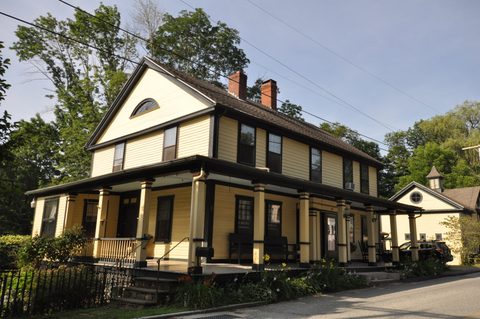
Europeans first settled this area around 1667, when Ezekiel Main and Jeremiah Burch established homesteads that became North Stonington village and Clark's Falls; the land had been part of Stonington, founded in 1649 under Massachusetts and brought under Connecticut by the 1662 Charter. Voters chose to divide the town in April 1807; the new town was to be named "Jefferson," but the General Assembly rejected that name — likely from Federalist opposition to the president — and designated it North Stonington instead, a name used locally since 1724. From the early 1800s, water power from the Shunock and Assekonk rivers drove gristmills, sawmills and woolen mills, and the town became a well-known mercantile center producing fine silk, satin, wools and thread lace. The Civil War and the rise of larger city mills ended the cottage industries, and North Stonington turned primarily agricultural, with dairy farming its principal trade — a rural character it retains today.
-
sight
Walk-in tastings at a hilltop winery, seven days a week.
-
A 105-acre National Register district with 72 contributing buildings.
-
sight
A Richardsonian Romanesque library lending museum passes.
-
A four-day fair that opens Connecticut's fair season each July.
-
Twelve preserves with trail networks open dawn to dusk.
-
The public clubhouse restaurant at the Lake of Isles golf resort.
-
Northern Italian dining since 2011.
-
A 164-room hotel just off I-95 Exit 92.
A village on the National Register
North Stonington Village was listed on the National Register of Historic Places on March 17, 1983: a 105-acre district of 72 contributing buildings, mostly from the late 18th and early 19th centuries, in Federal, Greek Revival and Italianate styles, including an 1809 Federal commercial building that once held town offices. Three figures with North Stonington roots reached national prominence: Ellen Fitz Pendleton, president of Wellesley College from 1911 to 1936; Samuel Prentice, Chief Justice of Connecticut from 1913 to 1920; and Otis Randall, a Brown University mathematics professor and dean from 1913 to 1930.
Getting there
North Stonington sits in Connecticut's southeastern corner on I-95: Exit 92 (Route 2 / Route 49) and Exit 93 (Route 216, the last exit before Rhode Island) are both inside the town. There is no rail station in North Stonington; the closest Amtrak Northeast Regional stops are Mystic, Connecticut, reached via I-95 or Route 1, and Westerly, Rhode Island, just across the state line. CTrail Shore Line East's eastern terminus is New London and does not reach North Stonington, Mystic or Westerly.
A winery, a fair and twelve preserves
Jonathan Edwards Winery pours tastings from a hilltop tasting room open seven days a week, no reservations required — though it frequently closes early on Saturdays in season for private events. The North Stonington Agricultural Fair, which traditionally opens Connecticut's fair season each July, added a new covered livestock pulling ring in 2026, billed as the state's first. Wheeler Library, a Richardsonian Romanesque building on Main Street, lends museum passes and runs an Arts Corridor exhibition program. The Avalonia Land Conservancy maintains twelve preserves across town, all open dawn to dusk, including the Tri-town Ridgeline Forest Preserve's 9.4 miles of trail. For food and lodging, Matches Tavern at the Lake of Isles golf resort and Buon Appetito Ristorante both serve year-round, and the Bellissimo Grande Hotel offers 164 rooms just off I-95 Exit 92.
Frequently asked questions
- How do I get to North Stonington?
- By car — I-95 Exit 92 (Route 2/49) and Exit 93 (Route 216) are both inside the town. There is no rail station in North Stonington; the nearest Amtrak stops are Mystic, CT, reached via I-95 or Route 1, and Westerly, RI, just across the state line.
- Is there a train to North Stonington?
- No. CTrail Shore Line East terminates at New London and does not reach North Stonington, Mystic or Westerly. The nearest Amtrak Northeast Regional stops are Mystic and Westerly.
- Why isn't the town called Jefferson?
- In 1807 the newly divided town was proposed to be named Jefferson, but the Connecticut General Assembly rejected the name — likely from Federalist opposition to the president — and designated it North Stonington instead, a name already used locally since 1724.
- Is there a hotel in North Stonington?
- The Bellissimo Grande Hotel, a 164-room Italian-themed hotel just off I-95 Exit 92, offers a complimentary shuttle to Foxwoods.
- What is North Stonington Village Historic District?
- A 105-acre National Register district listed in 1983, with 72 contributing buildings from the town's pre-Civil War prosperity, in Federal, Greek Revival and Italianate styles. It is a public, freely walkable streetscape.
Foliage
Turning this week · most advanced Oct 21–27
This town never reaches full colour on the state's map — DEEP's eight weeks run out before it turns.
On the Connecticut Heritage foliage driving route.
Derived from the Connecticut DEEP fall foliage map. DEEP's map is a climatological estimate last published in 2023; it describes a normal year, not this one. Stage names are ours. See the statewide forecast.
Connected pages
Nearby
-
Preston, Connecticut: Three Villages Between Norwich and Stonington
· Preston, Connecticut
The Avalonia Mitchell Preserve & Reed Woodlands straddles the North Stonington-Preston line.
-
Stonington, Connecticut: A Borough That Defied the British Navy
· Stonington, Connecticut
The two towns share a border
-
Voluntown, Connecticut: A Volunteer Town on the Rhode Island Line
· Voluntown, Connecticut
The two towns share a border
-
Ledyard, Connecticut: Farm Town Turned Resort Destination
· Ledyard, Connecticut
The two towns share a border
-
Griswold, Connecticut: Jewett City and the Slater Mills
· Griswold, Connecticut
The two towns share a border
Shared history
-
Stonington, Connecticut: A Borough That Defied the British Navy
· Stonington, Connecticut
North Stonington separated from Stonington and was incorporated as its own town in 1807.
Same region
-
Mystic, Connecticut: 600 Ships and a Village Split in Two
· Mystic, Connecticut
Mystic, CT, reached via I-95 or Route 1, is the nearest Amtrak Northeast Regional stop for North Stonington travelers.
-
Stonington, Connecticut: A Borough That Defied the British Navy
· Stonington, Connecticut
Both on the Connecticut Heritage foliage route
-
Groton, Connecticut: From Fort Griswold to the Submarine Capital
· Groton, Connecticut
Both on the Connecticut Heritage foliage route
-
Voluntown, Connecticut: A Volunteer Town on the Rhode Island Line
· Voluntown, Connecticut
Both on the Connecticut Heritage foliage route
-
Sterling, Connecticut: A Dye House and the Birthplace of Dow Jones
· Sterling, Connecticut
Both on the Connecticut Heritage foliage route
What travelers think
Log in to react.
No reviews yet.