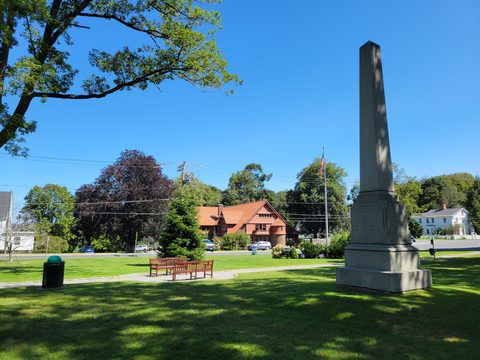

Sunnyside, Queens: Sunnyside Gardens, Queens Boulevard and the 7 Train
Sunnyside, New York
Pictures from Sunnyside
See all 1 photos →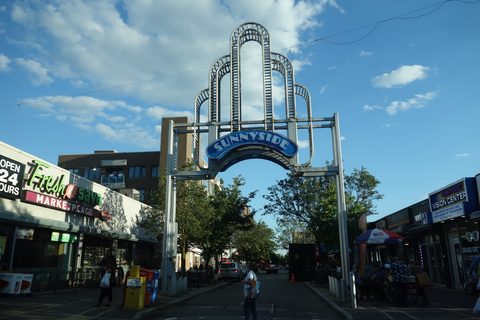
Sunnyside is a neighborhood in northwestern Queens and a standalone 2020 neighborhood tabulation area, QN0202, grouped for planning purposes under Long Island City-Sunnyside-Woodside, the approximation of Community District 2. It contains Sunnyside Gardens, designated a historic district by the Landmarks Preservation Commission under LP-2258 and listed on the National Register of Historic Places on September 7, 1984 under reference number 84002919, roughly bounded by Queens Boulevard, 43rd and 52nd Streets, Barnett and Skillman Avenues. The commission's designation report calls it the first attempt to create a Garden City in the United States, and divides its buildings into twelve courts plus two Phipps Garden Apartment complexes, covering all or part of sixteen city blocks. Sunnyside Gardens Park lies inside that boundary, and the Flushing Line carries the 7 train to four stations within the neighborhood.
-
Designated under LP-2258 and listed on the National Register on September 7, 1984; twelve courts plus two Phipps complexes over all or part of sixteen city blocks.
-
sight
48-21 39th Avenue. About three acres, created with the original development and called the largest privately held park in New York City by the LPC report.
-
sight
Two complexes on 39th Avenue at 50th Street, contributing property inside the historic district and counted alongside its twelve courts.
-
sight
A nine-acre, 756-unit complex spanning 42nd to 44th Streets between 48th and 50th Avenues, converted to cooperative ownership in May 1986.
-
walk
41-15 Skillman Avenue. Built in the 1950s for George F. Torsney; it contains the Lou Lodati Playground, named by council resolution in 1999.
-
walk
A NYC Parks property on Queens Boulevard between 48th Street, Greenpoint Avenue and 50th Street.
-
sight
41-17 Greenpoint Avenue. The theatre's own site counts over 255 world and American premieres and 252 awards.
-
sight
A gantry over Queens Boulevard at 46th Street, erected in 1983 and carrying the neighborhood's name.
-
sight
44-11 Queens Boulevard. It held about 2,500 spectators and operated until June 24, 1977; part of 45th Street was co-named for it in 2014.
-
43-06 Greenpoint Avenue. The library prints the address with the mailing designation Long Island City, NY 11104; the City's address database gives Sunnyside.
The garden city and its courts
Sunnyside Gardens is a designated New York City historic district, LP-2258, listed on the National Register of Historic Places on September 7, 1984 under reference number 84002919. The designated boundary runs easterly along the southern curbline of Barnett Avenue and southerly along the western curbline of 52nd Street, historically Dickson Street, to the southern curbline of 39th Avenue, historically Middleburg Avenue. The city's GIS boundary for the designated district measures about 54 acres.
The buildings, constructed between 1924-28, 1931-2 and 1935, are divided by the designation report into twelve courts — Carolin Gardens, Colonial Court, Hamilton Court, Hamilton Court Apartments, Harrison Place, Jefferson Court, Lincoln Court, Madison Court North and South, Monroe Court Apartments, Roosevelt Court, Washington Court and Wilson Court Apartments — and two Phipps Garden Apartment complexes, covering all or part of sixteen city blocks. The report calls Sunnyside Gardens "the first attempt to create a Garden City in the United States," and records that the City Housing Corporation purchased 76.67 acres of land in 1924, most from the Long Island Rail Road with smaller amounts from other landowners. In 1974 the New York City Planning Commission designated the area a "Special Planned Community Preservation District," one of four in the city.
Sunnyside Gardens Park, at 48-21 39th Avenue, was created as part of the original development and is included inside the designated district; the designation report calls it the largest privately held park in New York City and gives its size as about three acres. Celtic Park Apartments spans 42nd to 44th Streets between 48th and 50th Avenues, a nine-acre complex of 756 units converted to cooperative ownership in May 1986.
The name, the yard and Queens Boulevard
The local historian Vincent F. Seyfried records that Richard Bragaw built a gambrel-roofed house "in the English style atop Sunnyside Hill" in 1790, on the line of present-day 32nd Place between Northern Boulevard and Skillman Avenue, and that the house was demolished in July 1903 after the Pennsylvania Railroad acquired the property as part of the land assembly for the Sunnyside Yard. The Encyclopedia of New York City alternatively traces the modern neighborhood's name to a roadhouse built on Jackson Avenue in the 1850s and 1860s for visitors to the Fashion Race Course in Corona. The yard itself is split by the Department of City Planning into Sunnyside Yards (North), QN0161, which falls under the Astoria-Queensbridge community district equivalent, and Sunnyside Yards (South), QN0261, under the Long Island City-Sunnyside-Woodside approximation of Community District 2. A 2006 Landmarks Preservation Commission report on a Hunter's Point firehouse describes the historic city of Long Island City as "comprised of five separate neighborhoods: Ravenswood, Astoria, Steinway, Sunnyside, and Hunter's Point."
Along Queens Boulevard, a gantry carrying the neighborhood's name was erected at 46th Street in 1983. The Sunnyside Garden Arena stood at 44-11 Queens Boulevard, held about 2,500 spectators and operated until June 24, 1977; a portion of 45th Street was co-named in its honor in 2014. At 47-03 Queens Boulevard was the Coventry, a small live-music venue earlier called the Popcorn Pub: according to Ultimate Classic Rock and contemporaneous reporting, the rock band Kiss played its first concert there on January 30, 1973, and the Ramones also played early shows at the venue.
Thalia Spanish Theatre is at 41-17 Greenpoint Avenue, the Sunnyside branch of Queens Public Library at 43-06 Greenpoint Avenue, and Sunnyside Community Services at 43-31 39th Street. Sunnyside Shines is the business improvement district that carries the neighborhood's name. Sunnyside Reformed Church is at 48-03 Skillman Avenue, Mimar Sinan Mosque at 45-06 Skillman Avenue and Queen of Angels Church at 44-04 Skillman Avenue; The Episcopal Mission in Sunnyside is at 43-12 46th Street, the Sunnyside Muslim Center at 39-18 47th Avenue and Mosaic West Church at 46-01 43rd Avenue. The 45th St Composters and Community Garden, also known as Resistance is Fertile, is at 41-12 45th Street. The St. Pat's for All parade, founded in 2000 by Brendan Fay and Ellen Duncan, starts at 43rd Street and Skillman Avenue and its route continues into Woodside.
Getting there
Four stations of the Flushing Line, served by the 7 train, stand inside the Sunnyside neighborhood tabulation area: 33 St-Rawson St, 40 St-Lowery St, 46 St-Bliss St and 52 St. MTA station records give all four an ADA value of 0. The nearest express stop is 61 St-Woodside, in Woodside, one stop beyond the neighborhood's easternmost station; the MTA record gives that station an ADA value of 1.
The "International Express" National Millennium Trail is described in its own designation as running from Sunnyside to Flushing, with Sunnyside as the named terminus.
Frequently asked questions
- How do I get to Sunnyside?
- By subway, the 7 train on the Flushing Line calls at four stations inside the Sunnyside neighborhood tabulation area: 33 St-Rawson St, 40 St-Lowery St, 46 St-Bliss St and 52 St. MTA station records give all four an ADA value of 0. The nearest express stop is 61 St-Woodside, in Woodside, one stop beyond the neighborhood's easternmost station, and the MTA record gives that station an ADA value of 1.
- What is the Sunnyside Gardens Historic District?
- A New York City historic district designated by the Landmarks Preservation Commission under LP-2258, and a National Register of Historic Places listing of September 7, 1984, reference number 84002919. Its buildings cover all or part of sixteen city blocks, and Sunnyside Gardens Park lies inside it. The designation report calls Sunnyside Gardens "the first attempt to create a Garden City in the United States."
- How large is Sunnyside Gardens?
- The city's GIS boundary for the designated historic district measures about 54 acres. The Landmarks Preservation Commission's report separately records that the City Housing Corporation purchased 76.67 acres of land in 1924, most of it from the Long Island Rail Road with smaller amounts from other landowners. The report divides the district's buildings into twelve courts plus two Phipps Garden Apartment complexes, covering all or part of sixteen city blocks.
- Why is it called Sunnyside?
- The local historian Vincent F. Seyfried records that Richard Bragaw built a gambrel-roofed house "in the English style atop Sunnyside Hill" in 1790, on the line of present-day 32nd Place between Northern Boulevard and Skillman Avenue; the house was demolished in July 1903 after the Pennsylvania Railroad acquired the property for the land assembly that became the Sunnyside Yard. The Encyclopedia of New York City alternatively traces the modern neighborhood's name to a roadhouse built on Jackson Avenue in the 1850s and 1860s for visitors to the Fashion Race Course in Corona.
- What is Sunnyside Gardens Park?
- A park at 48-21 39th Avenue, created as part of the original Sunnyside Gardens development and included inside the Landmarks Preservation Commission's designated historic district. The designation report calls it the largest privately held park in New York City and gives its size as about three acres.
- Where was the Sunnyside Garden Arena?
- At 44-11 Queens Boulevard. It held about 2,500 spectators and operated until June 24, 1977, and a portion of 45th Street was co-named in its honor in 2014.
Connected pages
Nearby
-
Jackson Heights, Queens: Garden Apartments, 37th Avenue and a Landmarked District
· Jackson Heights, New York
The National Millennium Trail named International Express runs from Sunnyside to Flushing along the IRT Flushing Line, passing through Jackson Heights.
Same region
-
Woodside, Queens: The Doughboy, Windmuller's Hill and Little Manila
· Woodside, New York
Both sit in Queens Community District 2. The St. Pat's for All parade starts at 43rd Street and Skillman Avenue and its route continues into Woodside.
-
Long Island City, Queens: the East River Waterfront, Vernon Boulevard and Court Square
· Long Island City, New York
Sunnyside Yards (South), QN0261, falls under the Long Island City-Sunnyside-Woodside approximation of Community District 2.
-
Jackson Heights, Queens: Garden Apartments, 37th Avenue and a Landmarked District
· Jackson Heights, New York
The International Express National Millennium Trail is designated as running from Sunnyside to Flushing, passing through Jackson Heights on the way.
What travelers think
Log in to react.
No reviews yet.