
Woodside, Queens: The Doughboy, Windmuller's Hill and Little Manila
Woodside, New York
Pictures from Woodside
See all 1 photos →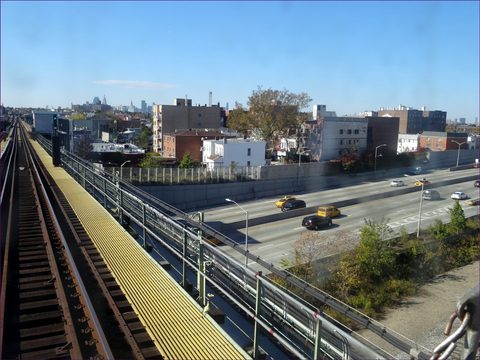
Woodside is a neighborhood in the New York City borough of Queens, covered by ZIP code 11377 and threaded by Roosevelt Avenue with the elevated 7 line above it. The City does not file it as one unit. The Department of City Planning's 2020 tabulation areas give most of it as QN0203 Woodside, inside the Long Island City-Sunnyside-Woodside approximation of Community District 2, while the northern edge falls under QN0104 Astoria (East)-Woodside (North), inside Community District 1. NYC Parks lists Community Board 2 and Council Member Julie Won for the parks here. The Dutch gave Father John Doughty a charter for 13,000 acres in 1642, and in 1867 the builder Benjamin Hitchcock bought John Kelly's estate, divided it into lots and renamed it Woodside. Nineteenth-century German landowners gave way to the Irish settlement that earned the nickname "Irishtown", and Filipino businesses now line Roosevelt Avenue from 63rd Street to 71st Street.
-
sight
Burt W. Johnson's bronze and granite World War I soldier in Doughboy Park, dedicated on Memorial Day in 1923 and inscribed LEST WE FORGET / 1917-1918.
-
3.01 acres on 52nd Street and Woodside Avenue, named for Louis Windmuller (1835-1913), who summered on this Woodside hill. Parkland joined it to Doughboy Park in 1959.
-
sight
Woodside Avenue between 54th and 56th Streets. Newtown acquired the land in 1893 as a play area for P.S. 11; the plaza was repaved in bluestone in 2021.
-
Laurel Hill Boulevard between 61st and 64th Streets. Ground was broken on July 13, 1971, and Commissioner Stern named the grounds Bush Park on June 18, 1987.
-
Broadway and 37th Avenue between 65th and 69th Streets, named in 1964 for Brigadier General Joseph T. Hart (1902-1962) and reconstructed in 2020.
-
A 0.25-acre plaza on 43rd Avenue and Roosevelt Avenue, honoring "a Woodside resident killed in action during World War I."
-
walk
The Filipino district along Roosevelt Avenue from 63rd Street to 71st Street. The corner of 70th Street was co-named "Little Manila Avenue" on June 12, 2022.
-
sight
49-02 Laurel Hill Blvd. Wikipedia says it was founded in 1845 by trustees of St. Patrick's Cathedral, and that Calvary and New Calvary hold over three million burials.
-
sight
Founded in 1880 and in its present building since 1914. Wikipedia calls it "the oldest Taiwanese church established in North America."
-
54-22 Skillman Avenue. Its own listings include an ESOL Conversation Group, a "Pathway to U.S. Citizenship" series and two book clubs.
-
51-23B Queens Boulevard. Its listings put a Windmuller Park element of the St. Pat's for All Parade, which starts in Sunnyside, at 52nd Street and 39th Drive.
-
food
57-24 Roosevelt Avenue. Its own site dates the pub to 1966, when firefighter Joe Donovan bought the Clover Leaf Bar; new owners took over on January 20, 2013.
-
food
64-13 39th Avenue. Its own site says it was established in 1990 and grew out of Sripraphai Tipmanee's small bakery in Elmhurst.
-
food
62-29 Roosevelt Avenue. Wikipedia says the Philippine chain "opened its first branch in New York in February 2009, selecting Woodside, Queens."
-
The 7 train and the Long Island Rail Road meet here, with elevators from the central mezzanine to every subway and railroad platform.
Windmuller's hill, the Doughboy and the neighborhood parks
Lawrence Virgilio Playground, whose Historical Signs page is headed Lawrence Virgilio Playground / Windmuller Park, runs along 52nd Street and Woodside Avenue between 39th Road and 39th Drive, a neighborhood park of 3.01 acres under Park ID Q031. It is named for Louis Windmuller (1835-1913), whom NYC Parks describes as "a civic leader and businessman who summered on this Woodside hill until his death in 1913." Born in Westphalia in 1835, Windmuller emigrated to the United States at the age of 18 and helped found the German-American Insurance Company in response to the fire that destroyed Chicago in 1871. He established the "Pedestrian Club," which counted Mayor William Jay Gaynor as a member, and in summer he walked from his Woodside home to his Title Guaranty and Trust office downtown by way of a ferry at Hunter's Point. The land was acquired from the Windmuller family in 1936 and the park opened to the public in 1937. In 2002 the playground was named for Lawrence Virgilio (1962-2001), a New York City Firefighter with the Greenwich Village-based Squad 18 who died in the World Trade Center on September 11, 2001, and who had used the playground as a youth growing up in the neighborhood; he served 12 years with the Fire Department and received two unit citations for bravery. A $2.1 million project in 2007 added an open-air stage, a renovated ADA-accessible public restroom, a mini-pool, an exercise track, pathways, fencing, basketball courts and new exercise equipment, funded with $1.6 million from Council Member Eric Gioia and $485,000 from State Assembly Member Margaret Markey. The park has basketball courts, eateries, fitness equipment, handball courts, outdoor pools, playgrounds, public restrooms, running tracks, spray showers and Wi-Fi hot spots.
Doughboy Park lies on Woodside Avenue between 54th Street and 56th Street, a triangle and plaza of 1.71 acres under Park ID Q031A. The Town of Newtown acquired the land in 1893 as a play area for P.S. 11, and it passed into the City of New York's ownership in 1898 when Newtown and other Queens municipalities were consolidated. Eventually deemed too steep and overgrown for children's use, it was assigned to NYC Parks in 1957 and opened as a new park the following year, "transformed from a children's play area into a sitting area for adults, in keeping with the dignity of the park's doughboy monument." The park was named in 1971; the bronze and granite monument has stood on the site since 1923. Before the statue was erected, local soldiers gathered here at the "mustering ground" before departing to fight in World War I, and ten men who left from this site died in combat. A restoration completed in 2021 gave the monument plaza bluestone paving, removed high fences, and added seating, lighting and planting beds. In 1959 the section of 54th Street that ran between Doughboy Park and Windmuller Park was closed to traffic and converted to parkland, joining the two parcels.
The Woodside Doughboy, alternately known as "Lest We Forget" or the "Returning Soldier," was sculpted by Burt W. Johnson (1890-1927) and dedicated on Memorial Day in 1923. Its granite pedestal was designed by C. N. Kent, its materials are bronze and granite, and its inscription reads LEST WE FORGET / 1917-1918. The Woodside Community Council commissioned it at a cost of $5,000. Johnson was born in Flint, Ohio, lived for a time in Flushing, and studied with the sculptors James Earle Fraser and Louis Saint-Gaudens. Unlike more active war memorial figures, his doughboy is "a somber World War I soldier, with a downcast bandaged head, holding his helmet in front and his gun to the side," and the sculptor's health was failing as the piece was completed, so he supervised the final work from his wheelchair. The dedication ceremony included music by St. Mary's Military Band, a rendition of the "Star Spangled Banner" by the children of P.S. 11, the unveiling by Gold Star Relatives, and blessings by ministers from St. Paul's and St. Sebastian's Churches. In 1928 the American Federation of Arts selected the Woodside Doughboy as the best war memorial of its kind. In April 2007, with the efforts of the Woodside Civic Association, a stone marker was placed at the foot of the statue listing the names of the 13 servicemen from Woodside who gave their lives during World War I.
Big Bush Playground, headed Bush Park on its Historical Signs page, runs along Laurel Hill Boulevard between 61st Street and 64th Street, a community park of 2.50 acres under Park ID Q205A. NYC Parks calls it "a hub of recreation for Woodside families, and a delightful play space for kids." Mayor Fiorello H. LaGuardia designated the land as parkland in 1936, but construction on the future Brooklyn-Queens Expressway interrupted those plans. The Kosciuszko Bridge over Newtown Creek, built in 1939, was the first piece of what became the expressway, and the final bit of its Queens section, including the segment that runs through Woodside, was completed in 1964. Parks Commissioner August Heckscher and Queens Borough President Sidney Leviss broke ground for the $460,000 project on July 13, 1971, and Commissioner Stern named the grounds Bush Park on June 18, 1987. As the agency puts it, "The BQE, Bush Park, and Little Bush Park now share the land that was once Bush Street."
General Hart Playground stands at Broadway and 37th Avenue between 65th Street and 69th Street, 0.90 acres under Park ID Q067A. NYC Parks acquired it in 1954 as part of Brooklyn-Queens Expressway construction and opened it in 1956; new play equipment and benches followed in 1996, and in 2020 the playground was completely reconstructed with colorful play equipment and pavement treatments, a spray shower and basketball courts. The City Council named the park in 1964 for Brigadier General Joseph T. Hart (1902-1962), whom the agency describes as a resident of Elmhurst. Hart joined the National Guard in 1920 and enlisted in the 69th Regiment, which later became the 165th Infantry; he was named brigadier general in 1940, served with the 165th in the South Pacific during World War II in the battles of Makin and Saipan, and commanded the unit at the Battle of Okinawa in April 1945. He was awarded the Silver Star with a Cluster, the Purple Heart, the American Defense Force Medal and the New York State Conspicuous Service Medal.
Nathan Weidenbaum Playground sits on Laurel Hill Boulevard and 48th Avenue between 63rd Street and 64th Street, 0.73 acres under Park ID Q205B, and is named for "longtime Woodside resident Nathan Weidenbaum (1908-1983)." John Vincent Daniels Jr. Square occupies 43rd Avenue and Roosevelt Avenue between 50th, 51st and 52nd Streets, a triangle and plaza of 0.25 acres under Park ID Q065, and honors "a Woodside resident killed in action during World War I." High Hopes Triangle, Park ID QZ22, lies between 66th Street and 67th Street.
Irishtown, Little Manila and the institutions between
The Historical Signs text NYC Parks posts at General Hart Playground opens the neighborhood's story: "Once home to the Canarsie and Matinecock tribes, Woodside was known as 'suicide's paradise' for its snake-infested swamps and wolf-ridden woodlands in the colonial era. The Dutch gave Massachusetts colonist Father John Doughty a charter for 13,000 acres in 1642. In the mid-1800s, several mansions were built by a contingent of wealthy men from Charleston, South Carolina. Developer Benjamin Hitchcock bought the estate of John Kelly in 1867, which was divided into lots and renamed Woodside." Wikipedia adds the water: Native American inhabitants called this a place of "bad waters", and early European settlers knew it as a place of "marshes, muddy flats and bogs", where "wooded swamps" and "flaggy pools" were fed by flowing springs. One of those wet woodlands was called Wolf Swamp after the predators that infested it until it was drained in the nineteenth century, and one of the oldest recorded locations in Woodside was Rattlesnake Spring, on the property of a Captain Bryan Newton, whose vicinity came to be called Snake Woods.
A great chestnut tree, hundreds of years old when it came down in the last decade of the 19th century, stood on high ground near a junction of three dirt roads, "of great diameter, some 8 or 10 feet" — perhaps 30 feet in circumference. In 1802 a Sackett heir inherited a farm of 115 acres including much of what is now Woodside, and in 1826 his heirs sold much of the property to John A. Kelly, the son of a German immigrant, and his sister-in-law Catherine B. (Friedle) Buddy. "During the nineteenth century, Germans largely took over from these first settlers," Wikipedia says, naming the Kellys — whose name was originally Kölle — along with Riker, Schroeder, Schmidt, Sussdorf and Windmuller, and noting that the first purchasers of Hitchcock's little plots bore names like Eberhardt, Groeber and Schlepergrel. Woodside was first developed on a large scale from 1867 by the speculative residential builder Benjamin W. Hitchcock, who also founded Corona and Ozone Park, and by John Andrew Kelly.
By Wikipedia's account, large-scale residential development in the 1860s made Woodside the largest Irish American community in Queens; it was approximately 80% Irish in the early 1930s and "eventually became Irish enough to earn the nickname 'Irishtown'." A subsequent influx came during the 1980s and into the early 1990s, when many Irish immigrated to New York because of poor economic conditions in Ireland. Transit drove the growth: the Long Island Rail Road's Main Line was electrified in 1908, the joint IRT/BRT Corona and Woodside Line opened in 1917, and electrified trolleys ran from the Newtown Railway Company in 1895 and the New York and Queens County Line in 1896. The same article calls Woodside the only village in Queens then to have both railroad and rapid transit stations in addition to trolley lines. Apartment building followed — Woodside Apartments in 1913, the Metropolitan Life Insurance Company's project of 1922, and the projects of the Woodside Development Corporation in 1923, ten five-story buildings with space for four hundred families, at rents that initially ranged from $18 to $20 a month.
The Woodside Houses, a New York City Housing Authority development, were completed on December 30, 1949: 20 residential buildings of six stories, 1,357 apartments of which 1,353 are current, a population of 2,648, 22.04 acres, and a development cost of $13,777,000 under the federal program. NYCHA bounds the site by 49th Street, 51st Street, 31st Avenue and Newtown Road, gives the mailing city as WOODSIDE with ZIP 11377, and at the same time tags every building QN0104, Astoria (East)-Woodside (North), Community District 1. Big Six Towers, whose management office is at 60-10 Queens Boulevard on the basement level of the shopping center, describes itself as "a Mitchell-Lama cooperative housing company that is home to almost 1,000 families." The Bulova Corporation had its headquarters at 26-15 Brooklyn-Queens Expressway, in northern Woodside along Interstate 278, from 1986 until 2014, when it sold the two-story office building for $30 million and relocated to the Empire State Building.
Along Roosevelt Avenue the Filipino district known as Little Manila, or Filipinotown, runs from 63rd Street to 71st Street; the Little Manila article calls the 69th Street station "the gateway" to it and says that "Filipino cafés and restaurants dominate the area, as well as several freight and remittance centers scattered throughout the neighborhood," alongside professional services, driving schools, beauty salons and immigration services. Wikipedia records that the intersection of 70th Street and Roosevelt Avenue was co-named "Little Manila Avenue" on June 12, 2022, with a sign-unveiling ceremony, and that Jollibee, which it calls "a famous fast-food chain in the Philippines," "opened its first branch in New York in February 2009, selecting Woodside, Queens."
The Winfield Reformed Church carries the name of Winfield, an adjacent area largely incorporated into the post office serving Woodside, which cost it much of its identity distinct from Woodside. It is a Protestant congregation of the Reformed Church in America, founded in 1880, originally on Queens Boulevard and moved to its present location in 1910, with the current building put up in 1914. Wikipedia says the church "began in 1880 as a Dutch Calvinist church and in 1969 became the first Taiwanese congregation in America" and calls it "the oldest Taiwanese church established in North America"; the congregation was mainly white and historically Dutch-speaking until a wave of Taiwanese immigrants arrived in the 1960s, after which preaching continued in both English and Taiwanese.
Calvary Cemetery is at 49-02 Laurel Hill Blvd, Woodside, NY 11377, though the Department of City Planning files it under a tabulation area of its own, QN0271 Calvary & Mount Zion Cemeteries. Wikipedia says it was founded in 1845 by trustees of Manhattan's St. Patrick's Cathedral for Roman Catholic burials and was later expanded by three sections comprising New Calvary, and that Calvary and New Calvary's combined 300 acres contain over three million burials. The cemetery's own site lists recurring Saturday Masses. Elsewhere in the neighborhood, the Queens Public Library's Woodside branch at 54-22 Skillman Avenue runs an ESOL Conversation Group, a "Pathway to U.S. Citizenship" series, the Woodside Graphic Novel Book Club and the Woodside Book Club; Woodside on the Move, at 51-23B Queens Boulevard, describes itself as "Rooted in Woodside. All About Queens."; P.S. 11 Kathryn Phelan is at 54-25 Skillman Avenue; the Islamic Institute of New York is at 55-11 Queens Boulevard; and Wikipedia records that the United States Post Office operates the Woodside Station at 39-25 61st Street. Among the residents Wikipedia lists is Charlotte E. Ray (1850-1911), the first Black American female lawyer in the United States, whose Woodside connection the article footnotes to Henry Louis Gates, Life Upon These Shores, p. 173: "In 1897, she moved to Woodside in Queens."
Getting there
The 61st Street-Woodside station is where the 7 train and the Long Island Rail Road meet. MTA's own station record gives it the stop name 61 St-Woodside, daytime routes 7, structure type Elevated, and ADA status 1. It opened on April 21, 1917 as Woodside, part of an extension of the IRT Flushing Line to Alburtis Avenue, now 103rd Street-Corona Plaza. A mezzanine sits at the center, underneath the platforms, with an ADA-accessible elevator to each subway platform as well as another to each Long Island Rail Road platform. The accessible entrances are an elevator at the northeast corner of Roosevelt Avenue and 61st Street, a ramp to the westbound Port Washington Branch platform from 63rd Street and Trimble Road, and a ramp to the eastbound Main Line platform from the dead end at 62nd Street near Woodside Avenue.
The Long Island Rail Road's Woodside station opened on November 15, 1869 under the Flushing and North Side. It has two side platforms and one island platform over six tracks, and it carries both Main Line and Port Washington Branch services.
The 69th Street station, also known as 69th Street-Fisk Avenue, is at 69th Street and Roosevelt Avenue and is served by the 7 train at all times; MTA gives it daytime routes 7, structure type Elevated, and ADA status 0. On the Queens Boulevard line, MTA's records give both Northern Blvd and 65 St daytime routes M and R and structure type Subway, with ADA status 1 at Northern Blvd and 0 at 65 St. Northern Boulevard's MTA latitude of 40.752885 places it inside QN0104, Astoria (East)-Woodside (North), which the Department of City Planning files under Community District 1.
By bus, Wikipedia lists the Q18, Q32, Q39, Q47, Q53 SBS, Q60 and Q70 SBS as connecting Woodside to the rest of Queens, with the Q32 and Q60 running to Manhattan and the Q70 SBS running to LaGuardia Airport by way of the Jackson Heights-Roosevelt Avenue/74th Street station. By road, the Brooklyn-Queens Expressway (I-278) serves Woodside via exits 39 through 43 and the Long Island Expressway (I-495) via exit 18, while Northern Boulevard (NY 25A) and Queens Boulevard (NY 25) also pass through the neighborhood.
Frequently asked questions
- How do I get to Woodside?
- By subway, the 7 train serves 61 St-Woodside and 69 St, both elevated on Roosevelt Avenue, and the M and R serve Northern Blvd and 65 St on the Queens Boulevard line. MTA lists 61 St-Woodside and Northern Blvd as ADA-accessible and 69 St and 65 St as not. By rail, the Long Island Rail Road's Woodside station carries Main Line and Port Washington Branch services over six tracks, and elevators connect its platforms to the subway mezzanine. By bus, Wikipedia lists the Q18, Q32, Q39, Q47, Q53 SBS, Q60 and Q70 SBS; the Q32 and Q60 run to Manhattan and the Q70 SBS runs to LaGuardia Airport by way of the Jackson Heights-Roosevelt Avenue/74th Street station.
- What is the Woodside Doughboy?
- A bronze and granite World War I memorial in Doughboy Park, on Woodside Avenue between 54th Street and 56th Street. Burt W. Johnson (1890-1927) sculpted it, C. N. Kent designed the granite pedestal, and the Woodside Community Council commissioned it at a cost of $5,000. It was dedicated on Memorial Day in 1923 and is inscribed LEST WE FORGET / 1917-1918. NYC Parks records that local soldiers gathered at this "mustering ground" before departing for the war, and that ten men who left from the site died in combat; a stone marker placed at the foot of the statue in April 2007 lists the names of the 13 servicemen from Woodside who gave their lives in the war.
- Where is Little Manila?
- Along Roosevelt Avenue, from 63rd Street to 71st Street. Wikipedia's Little Manila article calls the 69th Street station "the gateway" to the district and says Filipino cafés and restaurants dominate the area, along with freight and remittance centers, professional services, driving schools, beauty salons and immigration services. The intersection of 70th Street and Roosevelt Avenue was co-named "Little Manila Avenue" on June 12, 2022, with a sign-unveiling ceremony.
- Which parks are in Woodside?
- Some of them: Lawrence Virgilio Playground, whose Historical Signs page is headed Lawrence Virgilio Playground / Windmuller Park, on 52nd Street and Woodside Avenue between 39th Road and 39th Drive; Doughboy Park, on Woodside Avenue between 54th Street and 56th Street; Big Bush Playground, headed Bush Park, on Laurel Hill Boulevard between 61st Street and 64th Street; General Hart Playground, at Broadway and 37th Avenue between 65th Street and 69th Street; Nathan Weidenbaum Playground, on Laurel Hill Boulevard and 48th Avenue between 63rd Street and 64th Street; John Vincent Daniels Jr. Square, on 43rd Avenue and Roosevelt Avenue between 50th, 51st and 52nd Streets; and High Hopes Triangle, between 66th Street and 67th Street.
- Why is Woodside listed under two community districts?
- Because the City's own geography splits it. The Department of City Planning's 2020 neighborhood tabulation areas give QN0203 Woodside under QN02, the Long Island City-Sunnyside-Woodside approximation of Community District 2, while QN0104 Astoria (East)-Woodside (North) sits under QN01, the Astoria-Queensbridge equivalent of Community District 1. NYC Parks lists Community Board 2 for the parks here; NYCHA's rows for the Woodside Houses carry the mailing city WOODSIDE and ZIP 11377 and, in the same row, Community District 1.
- What is the Winfield Reformed Church?
- A Protestant church of the Reformed Church in America, founded in 1880, originally located on Queens Boulevard and moved to its present location in 1910, with the current building put up in 1914. Wikipedia's Woodside article says it "began in 1880 as a Dutch Calvinist church and in 1969 became the first Taiwanese congregation in America," and the church's own article calls it "the oldest Taiwanese church established in North America," describing a historically Dutch-speaking and mainly white congregation that changed after Taiwanese immigrants arrived in the 1960s, after which preaching continued in both English and Taiwanese.
Connected pages
Nearby
-
Jackson Heights, Queens: Garden Apartments, 37th Avenue and a Landmarked District
· Jackson Heights, New York
NYC Parks records Travers Park's namesake as Democratic District Leader for Woodside-Jackson Heights from 1940 until his death in 1958.
Shared history
-
Astoria, Queens: Astor's Name, a WPA Pool and the Studio at 35-11 35th Avenue
· Astoria, New York
Astoria holds the Moore-Jackson Cemetery, which LPC's landmark data tags Woodside, and the Woodside Houses sit in the Astoria (East)-Woodside (North) area.
Same region
-
Sunnyside, Queens: Sunnyside Gardens, Queens Boulevard and the 7 Train
· Sunnyside, New York
Sunnyside shares Community District 2 with Woodside, and the St. Pat's for All Parade starts at 43rd Street and Skillman Avenue in Sunnyside.
-
Jackson Heights, Queens: Garden Apartments, 37th Avenue and a Landmarked District
· Jackson Heights, New York
Roosevelt Avenue and the elevated 7 run on from Woodside into Jackson Heights, and the Q70 SBS to LaGuardia links 61 St-Woodside with Roosevelt Av/74 St.
-
Maspeth, Queens: National Parishes, the Oval and the Expressway Triangles
· Maspeth, New York
Wikipedia puts Woodside on Maspeth's northern border, and Calvary Cemetery is described as a Catholic cemetery in Sunnyside, Maspeth and Woodside.
What travelers think
Log in to react.
No reviews yet.