
Canarsie, Brooklyn: The Pier Where Golden City Burned
Canarsie, New York
Pictures from Canarsie
See all 1 photos →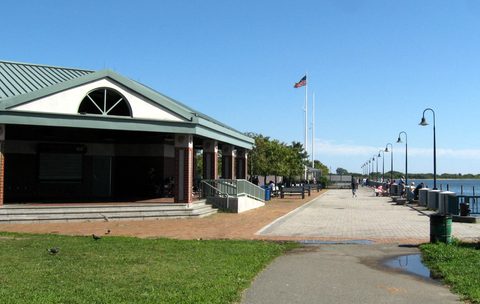
Canarsie takes its name from the Canarsee, a Lenape group who lived in the area. Steam trains reached the shore in 1865, when the Brooklyn and Rockaway Beach Railroad connected Canarsie to a ferry running on to the Rockaways, and for a generation this was a waterfront day trip for the rest of Brooklyn, with hotels to match. The Golden City Amusement Park opened in 1907 on the site of today's Canarsie Pier, an attempt at a Coney Island of one's own; it burned on January 29, 1934. Typhoid outbreaks traced to Jamaica Bay shellfish in 1904 and 1915 had already ended the fishing and oystering that underpinned the local economy. Subway service arrived on July 14, 1928, the eastern marshes were filled in the 1950s for Seaview Village, the Breukelen Houses and the Bay View Houses, and the resort became a dense residential neighborhood.
-
walk
The Jamaica Bay waterfront at the end of Rockaway Parkway, run by the National Park Service on the old Golden City site.
-
walk
About 132 acres of fields, courts, a skate park and a nature trail between Paerdegat Basin and Fresh Creek Basin.
-
sight
A horticultural market on Avenue D selling plants, trees and fruit beside Canarsie Plaza.
-
sight
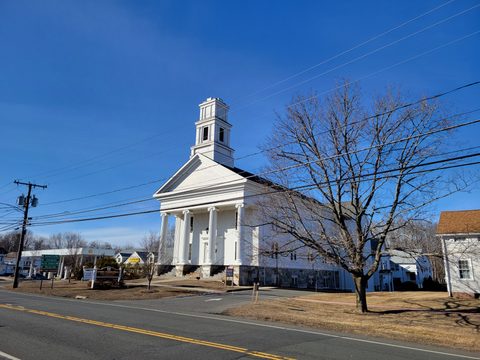
Canarsie's first church, founded 1839; the gambrel-roofed building dates from 1895 and takes in an 1871 structure.
-
Built in 1950-1951; its campanile is the tallest structure in the neighborhood.
-
sight
Roughly 6,400 burials, including Civil War and Spanish-American War veterans, on ground the city has owned since 1898.
-
food
A Rockaway Parkway pizzeria that has been a neighborhood staple since 1960.
-
Trinidadian and Jamaican cooking on Flatlands Avenue: curry goat, jerk chicken, roti.
-
food
A local eat-and-drink spot further along Flatlands Avenue.
Resort, then neighborhood
Canarsie's first economy was the water. Fishing and oystering supported the place until typhoid outbreaks linked to Jamaica Bay shellfish in 1904 and 1915 killed the trade. The excursion business went the same way: Golden City Amusement Park, opened in 1907 where Canarsie Pier now stands, closed with the industry's decline and burned on January 29, 1934.
What replaced it was housing. The BMT Canarsie Line began running on July 14, 1928, and in the 1950s the marshland across eastern Canarsie was filled and built on, with Seaview Village, the Breukelen Houses and the Bay View Houses going up in quick succession.
In 1972 the neighborhood became a national case study. After the local school board was ordered to accept Black students bussed in from Brownsville, Canarsie parents began protesting on October 17 and an organized school boycott ran from October 26 to November 10; of 10,000 students enrolled, only 850 attended on the first boycott day. The sociologist Jonathan Rieder documented the episode in his 1985 book "Canarsie: The Jews and Italians of Brooklyn Against Liberalism." The neighborhood that was predominantly Jewish and Italian through the 1970s is now majority Black and Caribbean.
One consequence of Canarsie's late build-out is that it carries no official landmarks at all: a 2026 survey of the neighborhood found precisely zero locations cited by the New York City Landmarks Preservation Commission. Its oldest buildings stand on their own merits. Grace Methodist Church, founded in 1839 as the first church in Canarsie, was the tallest building here until Holy Family's campanile went up in 1950-1951.
Getting there
The L is the neighborhood's line. Canarsie–Rockaway Parkway, at Rockaway Parkway and Glenwood Road, is the L's southern terminal and sits in Canarsie; East 105th Street, between Foster Avenue and Farragut Road, is the stop before it.
From the terminal, the B42 runs along Rockaway Parkway directly down to Canarsie Pier. It began as a trolley through-service to the subway and remains the direct local link between the two.
There is no Long Island Rail Road station in or serving Canarsie, and no NYC Ferry route lists a Canarsie landing.
Frequently asked questions
- How do I get to Canarsie?
- Take the L to its southern terminal, Canarsie–Rockaway Parkway, at Rockaway Parkway and Glenwood Road, or to East 105th Street between Foster Avenue and Farragut Road. From the terminal the B42 runs down Rockaway Parkway to Canarsie Pier. There is no Long Island Rail Road station serving Canarsie and no NYC Ferry landing here.
- What was Golden City?
- An amusement park that opened in 1907 on the site of today's Canarsie Pier, built as an answer to Coney Island. It closed as the excursion industry declined and burned down on January 29, 1934.
- Are there any landmarks in Canarsie?
- Not officially. A 2026 survey of the neighborhood found that Canarsie has precisely zero locations cited by the New York City Landmarks Preservation Commission. Its historic buildings, including Grace Methodist Church of 1839 and Holy Family Roman Catholic Church of 1950-1951, carry no designation.
- What is Canarsie Pier?
- A public pier and waterfront recreation area on Jamaica Bay at the end of Rockaway Parkway, part of the Jamaica Bay Unit of Gateway National Recreation Area and run by the National Park Service. It is used for fishing, which needs no permit during regular hours, and for waterfront walks and picnicking, and it has a restaurant and visitor facilities.
- Are there hotels in Canarsie?
- No. Canarsie's resort era supported several hotels near the shore in the late 1800s and early 1900s, but none survive, and no lodging is listed here — a tourism-board listing of places to stay carries no Canarsie entries.
Connected pages
Shared history
-
Flatlands, Brooklyn: Nieuw Amersfoort's Old Town Center
· Flatlands, New York
Canarsie Cemetery belonged to the Town of Flatlands from 1888 until it became New York City property in 1898.
Same region
-
Marine Park, Brooklyn: A Tide Mill on Gerritsen Creek
· Marine Park, New York
Both sit in Brooklyn Community District 18, which groups Canarsie with Marine Park, Bergen Beach, Mill Basin, Georgetown and southern Flatlands.
-
Bergen Beach, Brooklyn: An Island, a Resort, a Parkway
· Bergen Beach, New York
Both sit in Brooklyn Community District 18, which groups Canarsie with Bergen Beach, Mill Basin, Marine Park, Georgetown and southern Flatlands.
-
Mill Basin, Brooklyn: The Island That Became a Peninsula
· Mill Basin, New York
Both sit in Brooklyn Community District 18, which groups Mill Basin with Canarsie, Bergen Beach, Marine Park, Georgetown and southern Flatlands.
-
Starrett City, Brooklyn: Towers in the Park on Jamaica Bay
· Starrett City, New York
The L's Canarsie–Rockaway Parkway and East 105th Street stations, the nearest to Starrett City, are in Canarsie.
-
Georgetown, Brooklyn: Named for a Development Half Built
· Georgetown, New York
Both sit in Brooklyn Community District 18, which also covers Bergen Beach, Mill Basin, Marine Park and southern Flatlands.
-
Brownsville, Brooklyn: A Movie Palace and a WPA Pool
· Brownsville, New York
The B60 runs between Williamsburg Bridge Plaza and Canarsie, and lists Brownsville among the communities it serves.
What travelers think
Log in to react.
No reviews yet.