.jpg)
Chinatown, Manhattan: From Park Row to Columbus Park
Chinatown, New York
Pictures from Chinatown
See all 4 photos →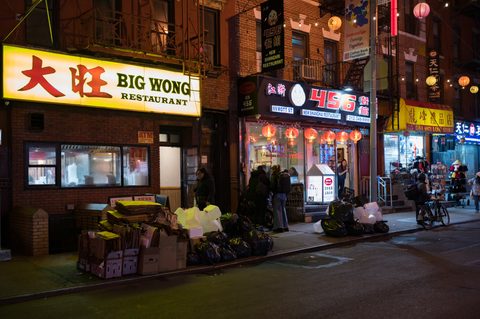
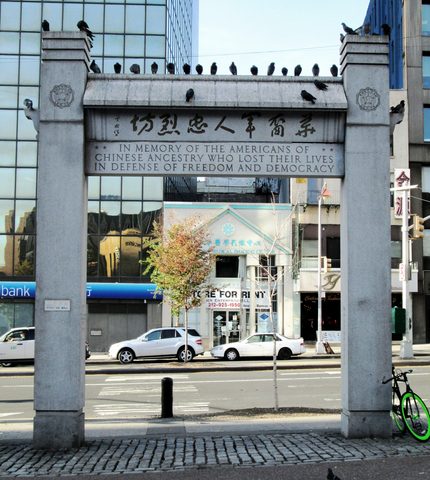
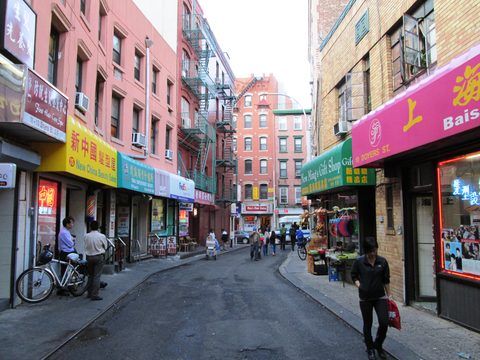
Manhattan's Chinatown began with Ah Ken, a Cantonese businessman who arrived around 1858 and opened a cigar store on Park Row — credited as the first Chinese person to permanently settle in what became the neighborhood. Early Chinatown clustered on Mott, Park (now Mosco), Pell, and Doyers Streets east of the notorious Five Points, its population growing from about 200 in 1870 to 2,000 by 1882. That year, the Chinese Exclusion Act severely restricted immigration and created a 'bachelor society': the 1900 census counted 7,028 Chinese men in the neighborhood but only 142 women. The act wasn't repealed until 1943, and it took the 1965 immigration reform to enable the neighborhood's later growth. Early Chinatown also had a violent chapter — the On Leong and Hip Sing tongs waged open warfare, with affiliated gangs controlling territory into the 1990s. Today it remains one of the largest Chinese enclaves outside Asia, with an estimated 90,000-100,000 residents.
-
walk
Built over a demolished slum in 1897, it's now Chinatown's communal front yard for mahjong and tai chi.
-
A focused museum on Chinese American history and contributions, closed Mondays and Tuesdays.
-
sight
The landmark Canal Street temple at the foot of the Manhattan Bridge, plus the original on Mott Street.
-
food
Chinatown's oldest dim sum parlor, on Doyers Street since 1920.
-
food
A well-known dim sum destination, now settled at its Centre Street address.
-
stay
A 46-room boutique hotel with Manhattan Bridge views, right in the neighborhood.
From Mulberry Bend to Columbus Park
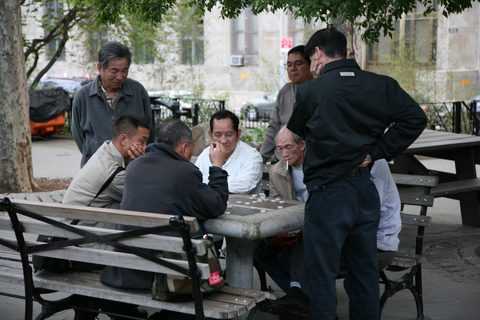
Columbus Park was created in 1897 by demolishing Mulberry Bend — tenements once described as 'the worst tenement-houses in the world' at the core of the Five Points slum — after a campaign by photojournalist Jacob Riis. It was renamed Columbus Park in 1911 and is now Chinatown's communal front yard, hosting mahjong, tai chi, and traditional music every day.
Getting there by subway
Chinatown's hub is the Canal Street complex (6, J/Z, N/Q/R/W), with the B/D at Grand Street and the F at East Broadway covering the neighborhood's eastern side — nearly every corner of Chinatown is within a few blocks of a station.
Frequently asked questions
- How do I get to Chinatown by subway?
- Take the 6, J/Z, or N/Q/R/W to Canal Street, the B/D to Grand Street, or the F to East Broadway — nearly every corner of the neighborhood is a short walk from one of these.
- What is Columbus Park's history?
- It was created in 1897 on the site of Mulberry Bend, a notoriously overcrowded slum at the heart of Five Points, after photojournalist Jacob Riis campaigned for its demolition. Renamed Columbus Park in 1911, it's now a daily gathering spot for mahjong, tai chi, and traditional music.
- Is the Museum of Chinese in America open every day?
- No — it's open Wednesday through Saturday, 11am to 6pm, and Sunday, 11am to 4pm; it's closed Monday and Tuesday.
- Where can I stay in Chinatown?
- The Leon Hotel, a 46-room boutique property at 125 Canal Street between Chrystie Street and the Bowery, is a verified in-neighborhood option with Manhattan Bridge views.
- Why was Chinese immigration to New York restricted for so long?
- The 1882 Chinese Exclusion Act sharply limited immigration, producing a 'bachelor society' — the 1900 census counted 7,028 Chinese men in the neighborhood but only 142 women. The act was repealed in 1943, and the 1965 immigration reform is what enabled the neighborhood's later growth.
Connected pages
Nearby
- Little Italy, Manhattan: Five Blocks and a Hundred Years · Little Italy, New York
- Two Bridges, Manhattan: Little Fuzhou Between the Spans · Two Bridges, New York
- Lower East Side, Manhattan: Tenements, Reform, and Reinvention · Lower East Side, New York
- Tribeca, Manhattan: Triangle Below Canal, Loft by Loft · Tribeca, New York
- Financial District, Manhattan: From Dutch Wall to Wall Street · Financial District, New York
Shared history
-
Little Italy, Manhattan: Five Blocks and a Hundred Years
· Little Italy, New York
Chinatown's northward expansion after 1965 shrank Little Italy to five blocks; in 2010 the two were jointly listed as one historic district.
Same region
-
Little Italy, Manhattan: Five Blocks and a Hundred Years
· Little Italy, New York
Another Manhattan neighborhood covered in this series.
-
Two Bridges, Manhattan: Little Fuzhou Between the Spans
· Two Bridges, New York
Another Manhattan neighborhood covered in this series.
See also
-
Lower East Side, Manhattan: Tenements, Reform, and Reinvention
· Lower East Side, New York
This guide's subway section places the B/D at Grand St on the neighborhood's Chinatown border.
-
NoLIta, Manhattan: North of Little Italy Since 1996
· NoLIta, New York
Nolita sits north of Little Italy and Chinatown, with Broome Street as its southern boundary.
-
Two Bridges, Manhattan: Little Fuzhou Between the Spans
· Two Bridges, New York
The nearest hotel to Two Bridges is the Leon Hotel at 125 Canal Street in adjacent Chinatown.
What travelers think
Log in to react.
No reviews yet.