
Financial District, Manhattan: From Dutch Wall to Wall Street
Financial District, New York
Pictures from Financial District
See all 4 photos →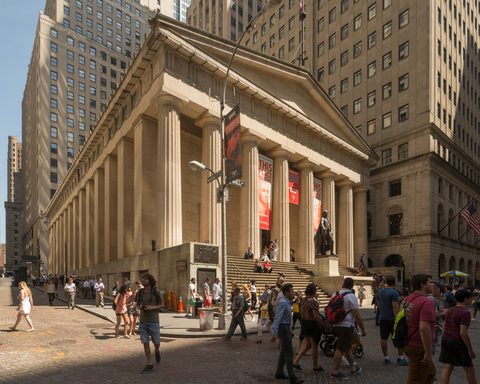
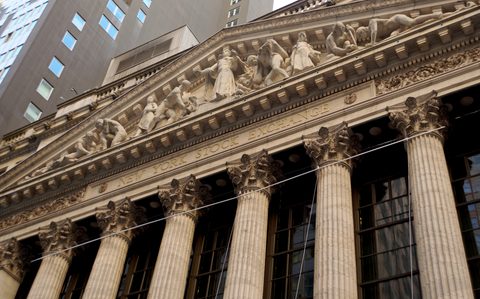
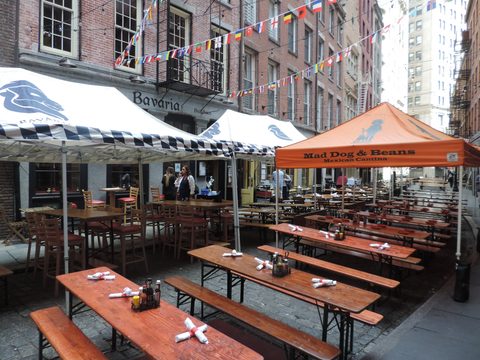
The Financial District occupies the ground where New Amsterdam began: a Dutch outpost founded in 1624, named capital of New Netherland in 1625, and renamed New York when the English took control in 1664. The neighborhood's signature street takes its name from an actual wall — a 2,340-foot palisade of dirt and 15-foot planks that Director General Peter Stuyvesant ordered built in 1653 along what the Dutch called Het Cingel. Wall Street's modern identity dates to 1792, when traders signed the Buttonwood Agreement, founding what became the New York Stock Exchange and turning the street's name into shorthand for American finance. The history here isn't only triumphant: from 1711, city officials ran an official slave market at the foot of Wall Street for more than fifty years, taxing every sale, and in 1920 an unsolved bombing at Wall and Broad Streets killed 38 people.
-
Stand on the steps where Washington took his oath in 1789 — the building was the nation's first capitol. Weekdays only; it's closed on weekends.
-
sight
Manhattan's oldest surviving building, and the room where Washington said goodbye to his officers in 1783.
-
sight
The city's birthplace park, with the Piet Oudolf perennial garden and the SeaGlass Carousel — just confirm Castle Clinton's renovation status before you go.
-
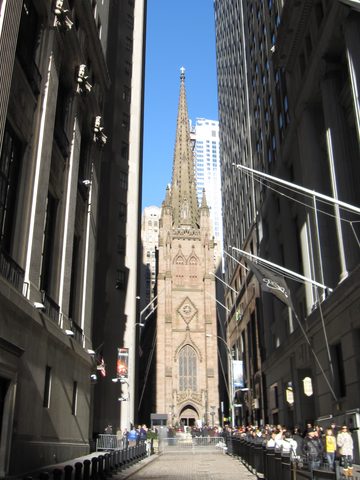
A 1697 parish church with Alexander Hamilton's grave in the open churchyard, right at the head of Wall Street.
-
food
House tradition traces the Delmonico steak to 1850 in this self-described birthplace of American fine dining.
-
food
A downstairs Taproom and an upstairs Parlor cocktail lounge, a few blocks from the harbor.
-
Four bars and dining rooms inside the building where Washington held his 1783 farewell dinner.
-
The district's verified in-neighborhood hotel, set inside the landmarked 1883 Temple Court building.
American Firsts, Under One Roof
At Federal Hall, 26 Wall Street, George Washington took the oath of office as the nation's first president in 1789; the site served as the first US capitol, housing the first Congress, the Supreme Court, and the earliest Executive Branch offices. A short walk away, Fraunces Tavern at 54 Pearl Street is the oldest remaining building in Manhattan — Washington bade farewell to his officers there in 1783, and John Jay negotiated treaties from the same premises during the Revolutionary period. The neighborhood's fuller history includes darker chapters: a city-run slave market operated at the foot of Wall Street from 1711 for more than fifty years, and the unsolved 1920 Wall Street bombing killed 38 people near Wall and Broad Streets.
Getting there by subway
The Financial District is one of the best-connected corners of the city. Fulton Center, which opened in 2014, unites the 2/3/4/5/A/C/J/Z lines at Fulton Street with an R/W connection via Cortlandt Street; nearby, Wall St (4/5), Broad St (J/Z), and South Ferry–Whitehall St (1/N/R/W) are separate stations a short walk apart, and the Chambers St–WTC/Park Place/Cortlandt St complex (2/3/A/C/E) anchors the district's northwest corner. Wherever you're headed downtown, a trunk line is rarely more than a few blocks away.
Where to stay
The Beekman, a Thompson Hotel, is the neighborhood's verified in-district option — a luxury property inside the landmark 1883 Temple Court building at the district's northern edge, with a restaurant from James Beard Award-winning chef Tom Colicchio.
Frequently asked questions
- How do I get to the Financial District by subway?
- Nearly every trunk line reaches the district: take the 4/5 to Wall St, the J/Z to Broad St, the 1/N/R/W to South Ferry–Whitehall St, or the 2/3/A/C/E to the Chambers St–WTC/Park Place/Cortlandt St complex. Fulton Center (opened 2014) ties the 2/3/4/5/A/C/J/Z together at Fulton Street, with an R/W connection via Cortlandt Street.
- Why is Wall Street called Wall Street?
- The name comes from a real wall: in 1653, Director General Peter Stuyvesant ordered a defensive palisade of dirt and 15-foot wooden planks — about 2,340 feet long and 9 feet tall — built along the line the Dutch called Het Cingel (the Belt). The English took the name over after seizing the city in 1664.
- Is Federal Hall open every day?
- No — Federal Hall National Memorial is open Monday through Friday and closed on weekends, so plan a weekday visit if you want to see the site of Washington's 1789 oath of office.
- Can I go inside Castle Clinton at The Battery?
- The Battery Conservancy currently lists its Castle Clinton renovation project as 'in design,' so interior access isn't guaranteed — check the latest status before counting on going inside.
- Where can I stay in the Financial District?
- The Beekman, a Thompson Hotel, at 123 Nassau Street is the district's verified in-neighborhood hotel, set inside the landmark 1883 Temple Court building.
Connected pages
Nearby
- Battery Park City, Manhattan: A Neighborhood Built From Landfill · Battery Park City, New York
- Tribeca, Manhattan: Triangle Below Canal, Loft by Loft · Tribeca, New York
- Two Bridges, Manhattan: Little Fuzhou Between the Spans · Two Bridges, New York
- Chinatown, Manhattan: From Park Row to Columbus Park · Chinatown, New York
Same region
-
Battery Park City, Manhattan: A Neighborhood Built From Landfill
· Battery Park City, New York
Another Manhattan neighborhood covered in this series.
-
Tribeca, Manhattan: Triangle Below Canal, Loft by Loft
· Tribeca, New York
Another Manhattan neighborhood covered in this series.
-
Steakhouses in Manhattan: Twenty-Three Rooms on the Midtown Spine
· Manhattan Steakhouses, New York
Delmonico's at 56 Beaver Street, which reopened in 2023, is published on the Financial District guide.
See also
-
Battery Park City, Manhattan: A Neighborhood Built From Landfill
· Battery Park City, New York
No subway station of its own: the nearest ones are all across West Street in the adjoining Financial District.
-
Dumbo, Brooklyn: A Name Coined to Deter Developers
· Dumbo, New York
The A and C that call at High Street in Dumbo also call at Fulton Street in the Financial District.
-
Brooklyn Heights, Brooklyn: New York's First Historic District
· Brooklyn Heights, New York
The A and C at High Street and the 2, 3, 4 and 5 at Court Street–Borough Hall also call at Fulton Street in the Financial District.
What travelers think
Log in to react.
No reviews yet.