
Crown Heights, Brooklyn: Eastern Parkway and Two Children's Museums
Crown Heights, New York
Pictures from Crown Heights
See all 3 photos →
The Lenape lived on this ground before Europeans reached it, and in 1661 and 1662 Governor Peter Stuyvesant granted several men parcels of free, unoccupied woodland in what is now Crown Heights. The area was formerly known as Crow Hill, with a penitentiary and orphanages on the high ground; the modern name followed the cutting through of Crown Street in 1916. Brownstone rowhouse development peaked in the 1920s. From the 1920s through the 1960s the neighborhood was predominantly Ashkenazi Jewish, and by 1950 an estimated 50 to 60 percent of residents, about 75,000 people, were Jewish; by 1970 it was about 70 percent Black. The boulevard that runs through the middle of it all was laid out by Olmsted and Vaux.
-
walk
Olmsted and Vaux built it between 1870 and 1874; it became a city scenic landmark in 1978.
-
sight
Chabad-Lubavitch world headquarters since 1940, and a working synagogue open to the public.
-
1,019 contributing buildings across 102.86 acres, built between about 1853 and 1942.
-
walk
Roughly four acres between Brooklyn and Kingston Avenues, with the skate park that opened in 2011.
-
Operating since 1899, on the same block as Brower Park at 145 Brooklyn Avenue.
-
sight
On Eastern Parkway at number 792, open Monday to Thursday and Sunday.
-
food
Seasonal American cooking on Franklin Avenue at Prospect Place, open since 2012.
-
food
Mexican food at 736 Franklin Avenue, with the sister bar Altar attached.
Eastern Parkway, 770, and 1991
Eastern Parkway was designed by Frederick Law Olmsted and Calvert Vaux and built between 1870 and 1874. The city's Landmarks Preservation Commission and Parks Department credit it as the world's first parkway designed for recreational rather than commercial traffic. It was designated a New York City scenic landmark on August 22, 1978, and listed on the National Register of Historic Places on September 26, 1983. The West Indian Day Parade, the Labor Day Carnival, has been held along it since approximately 1968 and draws an estimated one to three million participants a year.
At 770 Eastern Parkway stands a building put up in 1920 as a medical office and bought in 1940 by the Chabad-Lubavitch movement as headquarters and residence for Rabbi Yosef Yitzchak Schneersohn. It remains the movement's world headquarters and a working synagogue open to the public, with a yeshiva and the Library of Agudas Chassidei Chabad, and it has carried a continuous livestream of activity since 1999.
In August 1991 the neighborhood was the site of three days of unrest. On the 19th, a car in the motorcade of Rabbi Menachem Mendel Schneerson ran a red light and struck two Guyanese-American children, killing seven-year-old Gavin Cato. In the unrest that followed, over the 19th to the 21st, Yankel Rosenbaum, a 29-year-old Australian Jewish student, was fatally stabbed. The riot left two dead, 152 police officers and 38 civilians injured, 129 arrests and roughly $1 million in property damage, and became a significant factor in Mayor David Dinkins' defeat in 1993.
North of the parkway, the Crown Heights North Historic District was listed on the National Register on March 31, 2014, with a boundary expansion added on March 11, 2016 that brought in roughly 600 more buildings, among them properties associated with Shirley Chisholm, the first African-American woman elected to Congress. The district covers 102.86 acres and 1,019 contributing buildings developed between about 1853 and 1942.
Brower Park, and two museums for children
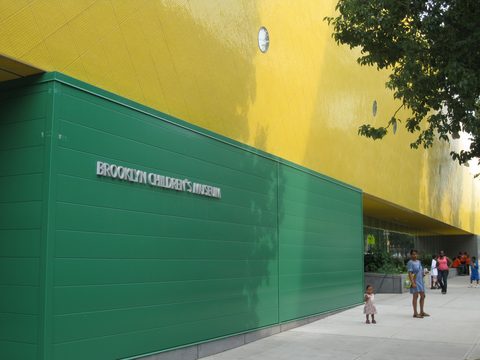
The Brooklyn Children's Museum has been operating since 1899. It sits at 145 Brooklyn Avenue, on the same block as Brower Park, with interactive exhibits, art studios and STEM makerspaces, and is open Wednesday through Sunday from 10am to 5pm.
Brower Park itself is a T-shaped city park of roughly four acres between Brooklyn and Kingston Avenues, running from St. Marks Avenue to Park Place. The city acquired its southern portion in 1892, when it was called Bedford Park, and renamed it in 1921 for George Vanderhoof Brower, a former Brooklyn and Queens parks commissioner. It holds a 1919 World War I memorial, a concrete skate park that opened in September 2011 as the second in Brooklyn, a monarch butterfly garden added in 2014, and the Shirley Chisholm Circle of 2016.
A different children's museum sits on Eastern Parkway. The Jewish Children's Museum, at 792 Eastern Parkway, is closed Fridays and Saturdays, and open Monday to Thursday and Sunday.
On the Franklin Avenue corridor at the western side of the neighborhood, Mayfield has been open at 688 Franklin Avenue since 2012, and Chavela's, at 736 Franklin Avenue, lists hours of 11am to 11pm seven days a week. Both addresses sit close to the line commonly drawn between Crown Heights and Prospect Heights, which no source settles.
Getting there
The IRT Eastern Parkway Line runs beneath the parkway, and its stations are in Crown Heights. Franklin Avenue-Medgar Evers College, at Franklin Avenue and Eastern Parkway, is the largest: the 2, 3, 4 and 5 call there, along with the Franklin Avenue Shuttle on the BMT Franklin Avenue Line. Nostrand Avenue, at Nostrand Avenue and Eastern Parkway, and Kingston Avenue, at Kingston Avenue and Eastern Parkway, are each served by the 3 at all times except late nights, the 4 late nights, and the 2 and 5 with limited rush-hour service. Crown Heights-Utica Avenue, signed simply as Utica Avenue, has the 4 at all times, the 3 at all times except late nights, and the same limited 2 and 5 service.
One caution about that name. A second station called Utica Avenue, on the IND Fulton Street Line and served by the A and C, is a different station at Utica Avenue and Fulton Street, and its source places it in Bedford-Stuyvesant.
On the IRT Nostrand Avenue Line, President Street-Medgar Evers College, at President Street and Nostrand Avenue, is served by the 2 at all times and the 5 on weekdays.
Frequently asked questions
- How do I get to Crown Heights?
- By the IRT Eastern Parkway Line, which runs under Eastern Parkway through the neighborhood. Franklin Avenue-Medgar Evers College carries the 2, 3, 4, 5 and the Franklin Avenue Shuttle. Nostrand Avenue, Kingston Avenue and Crown Heights-Utica Avenue are each served by the 3 and 4, with limited 2 and 5 service at rush hours. On the Nostrand Avenue Line, President Street-Medgar Evers College has the 2 at all times and the 5 on weekdays.
- Why is it called Crown Heights?
- The name followed Crown Street, which was cut through the area in 1916. Before that the area was known as Crow Hill, and a penitentiary and orphanages stood on the high ground here.
- What is 770 Eastern Parkway?
- The world headquarters of the Chabad-Lubavitch movement. The building went up in 1920 as a medical office and was bought by the movement in 1940 as headquarters and residence for Rabbi Yosef Yitzchak Schneersohn. It functions as a working synagogue open to the public, with separate men's and women's sections, a yeshiva and the Library of Agudas Chassidei Chabad.
- When is the West Indian Day Parade?
- It is the Labor Day Carnival, and it has been held along Eastern Parkway since approximately 1968. Estimates put attendance between one and three million participants a year.
- Which Utica Avenue station is the Crown Heights one?
- The one on the IRT Eastern Parkway Line, officially Crown Heights-Utica Avenue and signed as Utica Avenue, served by the 4 and 3. The other Utica Avenue station, on the IND Fulton Street Line with the A and C, is a separate station at Utica Avenue and Fulton Street that its source places in Bedford-Stuyvesant.
- Is there a hotel in Crown Heights?
- No hotel is listed here, and no hotel from a neighboring neighborhood is named in its place.
Connected pages
Nearby
-
Prospect Heights, Brooklyn: Museum, Garden, and Arena
· Prospect Heights, New York
The Brooklyn Museum and Botanic Garden sit at Crown Heights' traditional western edge, more commonly classified as being in adjacent Prospect Heights.
-
Prospect Lefferts Gardens, Brooklyn: Covenanted Blocks and Nostrand Avenue
· Prospect Lefferts Gardens, New York
Prospect Park station, near the border of Crown Heights, is described as serving Flatbush, Prospect Lefferts Gardens and Crown Heights.
Shared history
-
Weeksville, Brooklyn: A Free Black Village and Four Houses
· Weeksville, New York
After the Brooklyn Bridge was completed in 1883, urbanisation caused Weeksville to merge into Crown Heights and its history to be obscured.
Same region
-
Bedford-Stuyvesant, Brooklyn: Victorian Blocks and Restoration Plaza
· Bedford-Stuyvesant, New York
The Franklin Avenue Shuttle calls at Franklin Avenue-Medgar Evers College here and at Franklin Avenue-Fulton Street in Bed-Stuy.
-
Rugby, Brooklyn: An 1890s Name on Utica Avenue
· Rugby, New York
The B44 runs mostly along Nostrand Avenue through Crown Heights and Flatbush, west of the Rugby section.
-
Wingate, Brooklyn: From Pigtown to the Banjo School
· Wingate, New York
Brooklyn Community Board 9 covers Crown Heights, Prospect Lefferts Gardens and Wingate together.
What travelers think
Log in to react.
No reviews yet.