
Prospect Heights, Brooklyn: Museum, Garden, and Arena
Prospect Heights, New York
Pictures from Prospect Heights
See all 3 photos →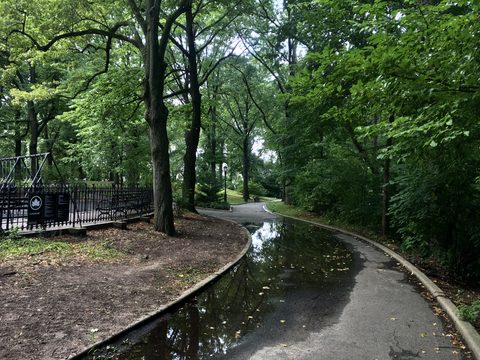
Prospect Heights took a while to settle on its own name. A letter to the Brooklyn Eagle in 1889 complained that the area went by four at once: some called it Park Slope, some Park Hill Side, some Prospect Heights and others Prospect Hill. Earlier still it had shared the name Gowanus Heights with adjacent parts of Brooklyn. From the 1910s through the 1960s it was a mixed neighborhood of Italian, Irish, Jewish, German, Greek and Yankee residents, and from the 2000s onward gentrification brought an influx of new residents, increasingly young and white. Two waves of landmarking and one very large arena have shaped it since: the rowhouse district was listed on the National Register in 1983, and Barclays Center opened in 2012.
-
sight
A McKim, Mead & White building on Eastern Parkway, opened on October 2, 1897.
-
Plant collections and conservatories off Washington Avenue; the Eastern Parkway entrance is temporarily closed.
-
walk
Dedicated in 1939 on the site of a Revolutionary War lookout and a 19th-century reservoir.
-
sight
Olmsted and Vaux designed it in 1867; the Soldiers' and Sailors' Memorial Arch and the Bailey Fountain stand here.
-
sight
The Atlantic Yards arena, opened at 620 Atlantic Avenue on September 21, 2012.
-
The system's main branch on Grand Army Plaza, holding the Brooklyn Collection archives.
-
305 contributing rowhouses built between 1865 and 1900, listed on the National Register in 1983.
-
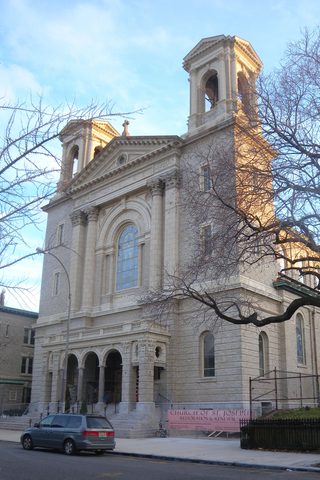
Completed in 1912 on Pacific Street, and raised to co-cathedral status in 2013.
-
sight
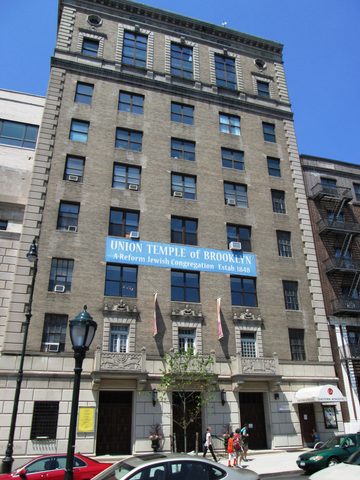
Arnold Brunner's 1929 community house, now a cultural and event space rather than a synagogue.
-
food
A third-generation family diner on Washington Avenue under Jimmy Kokotas.
From Gowanus Heights to Atlantic Yards
The rowhouses came first. A 15-acre section of the neighborhood, roughly bounded by Pacific and Bergen Streets, Flatbush and Vanderbilt Avenues and Park Place, holds 305 contributing buildings built between 1865 and 1900, and was listed on the National Register of Historic Places as the Prospect Heights Historic District on September 15, 1983. A separate and much larger Prospect Heights Historic District was designated by the New York City Landmarks Preservation Commission and approved by the City Council on September 17, 2009; it is described as the fifth-largest historic district in New York City. How the two relate, whether the later district subsumes or merely overlaps the earlier one, is not settled by the sources.
The high ground at the neighborhood's southern end has a longer memory. It served as a Continental Army lookout point in 1776, near the Heights of Guan, which is where the name Mount Prospect comes from. In 1856 Brooklyn built a reservoir on the site. It was left out of the adjoining Prospect Park, laid out by Olmsted and Vaux around 1860, because Flatbush Avenue cut through the proposed area. The reservoir became obsolete once City Water Tunnel No. 2 was finished in 1936, demolition began in 1938, and Mount Prospect Park was dedicated on May 27, 1939.
The most recent transformation was contested from the start. In the late 2000s and early 2010s the neighborhood was the site of the Atlantic Yards development, later renamed Pacific Park. Barclays Center, the project's arena, opened at 620 Atlantic Avenue on September 21, 2012; its first ticketed event was a Jay-Z concert a week later, on September 28.
The Eastern Parkway edge
Grand Army Plaza sits on the neighborhood's traditional southern edge, at the meeting of Flatbush Avenue, Vanderbilt Avenue, Eastern Parkway, Prospect Park West and Union Street. It began as part of an 1861 plan for Prospect Park, and Olmsted and Vaux designed it in 1867 as a grand entrance to the park. It was originally called Prospect Park Plaza and renamed in 1926 for the 60th anniversary of the Grand Army of the Republic. It holds the Soldiers' and Sailors' Memorial Arch and the Bailey Fountain, and became a National Historic Landmark in 1975. Which side of the contested Park Slope line it falls on is not something any source settles.
The Brooklyn Public Library's Central Library stands at 10 Grand Army Plaza, where Flatbush Avenue meets Eastern Parkway. The building opened in 1941 and holds the Brooklyn Collection archives.
East along the parkway, the Brooklyn Museum occupies a McKim, Mead & White building at 200 Eastern Parkway that opened on October 2, 1897, in the Beaux-Arts manner; the institution traces its roots to the Brooklyn Apprentices' Library of 1823. Beyond it the Brooklyn Botanic Garden stands at 990 Washington Avenue, also addressed as 455 Flatbush Avenue, near the contested eastern edge of the neighborhood. The garden's own site notes that its Eastern Parkway entrance is temporarily closed.
Getting there
Eastern Parkway-Brooklyn Museum, in Prospect Heights, is served by the 2 at all times, the 3 at all times except late nights, and the 4 late nights and at limited rush hours.
Atlantic Avenue-Barclays Center is the neighborhood's largest access point and its sources describe the complex as spanning Boerum Hill, Fort Greene, Park Slope and Prospect Heights rather than sitting inside any one of them. It carries the 2, 3, 4 and 5 on the IRT Eastern Parkway Line, the B and Q on the BMT Brighton Line, and the D, N, R and W on the BMT Fourth Avenue Line. The Long Island Rail Road's Atlantic Terminal is reached through the same complex, with service toward Jamaica and points east.
Two more stations sit on the Park Slope side of the neighborhood. Bergen Street, on the border of Park Slope and Prospect Heights, has the 2, 3 and 4 in the same pattern as Eastern Parkway-Brooklyn Museum. Seventh Avenue, which its source places in both Park Slope and Prospect Heights, is served by the Q at all times and the B on weekdays.
Grand Army Plaza station, which its own source places in Park Slope, is served by the 2, 3 and 4.
Frequently asked questions
- How do I get to Prospect Heights?
- Eastern Parkway-Brooklyn Museum, in Prospect Heights, has the 2 and 3, with the 4 late nights and at limited rush hours. Atlantic Avenue-Barclays Center, a complex its sources describe as spanning Boerum Hill, Fort Greene, Park Slope and Prospect Heights, carries the 2, 3, 4, 5, B, Q, D, N, R and W, and connects to the Long Island Rail Road at Atlantic Terminal. Bergen Street sits on the Park Slope border with the 2, 3 and 4, and Seventh Avenue has the Q at all times and the B on weekdays.
- Where does the name Prospect Heights come from?
- It was one of several competing names, and it won. An 1889 letter to the Brooklyn Eagle noted that the area was called Park Slope by some, Park Hill Side by others, Prospect Heights by others again and Prospect Hill by the rest. The area had earlier shared the name Gowanus Heights with adjacent parts of Brooklyn.
- Is Grand Army Plaza in Prospect Heights or Park Slope?
- It sits on Prospect Heights' traditional southern edge, and the Park Slope line here is genuinely contested; the Grand Army Plaza subway station, by contrast, is placed by its own source in Park Slope. This guide covers the plaza itself; the boundary is not one any source settles.
- Can you still attend services at Union Temple?
- No. The congregation merged into Congregation Beth Elohim on March 26, 2021, which ended independent worship in the Eastern Parkway building. The building itself stands and has been repurposed as a cultural and event space, and it was listed on the National Register of Historic Places on May 18, 2015.
- Is there a hotel in Prospect Heights?
- No hotel is listed here. The nearest listed option is in Downtown Brooklyn.
Connected pages
Nearby
-
Park Slope, Brooklyn: The Slope Up to Prospect Park
· Park Slope, New York
Bergen Street sits on the border of Park Slope and Prospect Heights, and Seventh Avenue is placed by its source in both.
-
Crown Heights, Brooklyn: Eastern Parkway and Two Children's Museums
· Crown Heights, New York
The Brooklyn Museum and Botanic Garden sit on Eastern Parkway at the traditional western edge of adjacent Crown Heights.
-
Prospect Park
· park · Park Slope
Mount Prospect Park's ground was excluded from the adjoining Prospect Park because Flatbush Avenue cut through the proposed area.
Same region
-
Fort Greene, Brooklyn: The Martyrs' Monument and BAM
· Fort Greene, New York
The Atlantic Avenue-Barclays Center complex spans Boerum Hill, Fort Greene, Park Slope and Prospect Heights.
-
Prospect Lefferts Gardens, Brooklyn: Covenanted Blocks and Nostrand Avenue
· Prospect Lefferts Gardens, New York
The name was coined in 1968 from Prospect Park, Lefferts Manor and the Brooklyn Botanic Garden, which these guides cover under Prospect Heights.
What travelers think
Log in to react.
No reviews yet.