
Fort Greene, Brooklyn: The Martyrs' Monument and BAM
Fort Greene, New York
Pictures from Fort Greene
See all 4 photos →
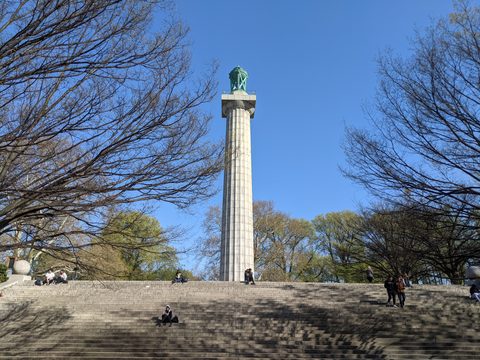
The neighborhood carries the name of a Revolutionary War earthwork built in 1776 under the supervision of General Nathanael Greene — a star-shaped fort that mounted six 18-pound cannons and was the largest fortification on Long Island. The City of Brooklyn acquired the ground from the Cowenhoven family by 1842 and opened it in 1847 as Washington Park, the city's second public park; Frederick Law Olmsted and Calvert Vaux redesigned it in 1867, and it was renamed for Greene. In the park stands the Prison Ship Martyrs' Monument, a 149-foot granite Doric column by Stanford White with a bronze urn by the sculptor Adolph Weinman, dedicated on November 14, 1908 by President-elect William Howard Taft. It marks a crypt holding the remains of more than 11,500 American prisoners of war who died aboard British prison ships in Wallabout Bay.
-
walk
Thirty acres opened in 1847 as Washington Park and redesigned by Olmsted and Vaux in 1867.
-
Stanford White's 149-foot granite column, dedicated in November 1908 over a crypt of Revolutionary War prisoners.
-
1,158 contributing rowhouses of 1840 to 1890, listed on the National Register in 1983 and expanded in 1984.
-
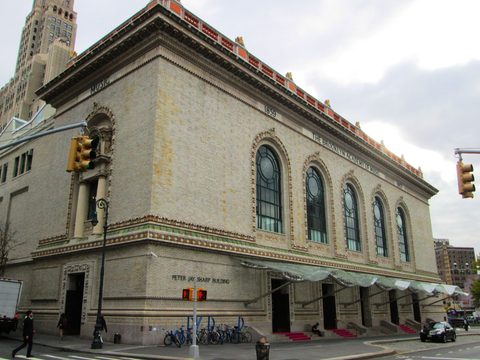
In Fort Greene since 1908, in the Herts & Tallant building on Lafayette Avenue.
-
Designated in September 1978 around Lafayette Avenue and Ashland Place.
-
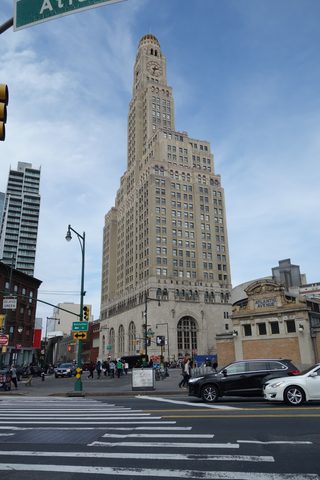
Brooklyn's tallest building until 2009, now condominiums; the exterior is a landmark of 1977.
-
sight
The Mark Morris Dance Group's home on Lafayette Avenue, with public classes for children and adults.
-
sight
The Irondale Ensemble Project's theater on South Oxford Street, producing since 1983.
-
sight
A glass-art nonprofit of 1977, with a public gallery and store in the Strand Theatre building.
-
sight
Exhibitions, performances and free programming at 647 Fulton Street, shared with UrbanGlass.
-
In Fort Greene since 2006, and at Culture Lab II on Lafayette Avenue since January 2025.
-
food
Mediterranean cooking on DeKalb Avenue at Carlton Avenue, open for dinner and weekend brunch.
Rowhouses, an academy, and a bank tower
The residential streets are the reason for the historic district. Listed on the National Register of Historic Places on September 26, 1983 and expanded on September 7, 1984, it takes in 1,158 contributing rowhouses put up between 1840 and 1890, across roughly 137 acres after the expansion, from 105 originally.
The Brooklyn Academy of Music was incorporated by the New York State Legislature in 1859 and first opened in Brooklyn Heights in 1861. After that building burned in 1903, BAM moved here: the cornerstone was laid in 1907 and the Peter Jay Sharp Building, designed by Herts & Tallant, opened in November 1908. The Landmarks Preservation Commission designated the Brooklyn Academy of Music Historic District around it on September 26, 1978, and BAM itself was added to the National Register on May 2, 2006.
The Williamsburgh Savings Bank Tower at 1 Hanson Place was built between 1927 and 1929 and opened on April 1, 1929. It held the title of Brooklyn's tallest building until 2009. Its exterior was designated a New York City landmark on November 15, 1977 and its banking-room interior on June 25, 1996; the building was converted to residential condominiums between 2005 and 2007 and is not open to the public as a visitor attraction.
The arts blocks around Lafayette Avenue
BAM occupies three buildings — the Peter Jay Sharp Building at 30 Lafayette Avenue, BAM Strong at 651 Fulton Street and the Fisher at 321 Ashland Place. The Mark Morris Dance Center, home of the Mark Morris Dance Group, sits at 3 Lafayette Avenue and runs public dance and fitness classes for children and adults alongside the company's own programming. The Museum of Contemporary African Diasporan Arts, founded in Bedford-Stuyvesant in 1999 and in Fort Greene since 2006, reopened in January 2025 at 10 Lafayette Avenue, on the second floor of Culture Lab II, after its previous space closed in March 2024.
On South Oxford Street, the Irondale Center at number 85 is run by the Irondale Ensemble Project, which has been producing theatre since 1983. At 647 Fulton Street, the Strand Theatre building houses two organizations at once: UrbanGlass, a glass-art nonprofit founded in 1977 that reopened in the building in October 2013, and BRIC, which presents exhibitions, performances and free community programming and reopened at the same address in the same month.
Getting there
Two stations sit in Fort Greene itself. Lafayette Avenue, under Lafayette Avenue and Fulton Street, is served by the C at all times except late nights, with the A substituting late nights. Fulton Street, on Lafayette Avenue between South Portland Avenue and Fulton Street, is served by the G at all times.
DeKalb Avenue, at DeKalb and Flatbush Avenues, sits on the Downtown Brooklyn and Fort Greene border: the Q and R serve it at all times, the B on weekdays, the D and N late nights, and the W at rush hours. Clinton–Washington Avenues, on the C except late nights and the A late nights, is in Clinton Hill, near Fort Greene's eastern edge. The Atlantic Avenue–Barclays Center complex is described as sitting at the junction of Boerum Hill, Fort Greene, Park Slope and Prospect Heights; the 2, 4, D, N, Q and R serve it at all times, the 3 at all times except late nights, the 5 and B on weekdays during the day, and the W at rush hours only.
The Long Island Rail Road's Atlantic Terminal, at Atlantic Avenue, Flatbush Avenue and Hanson Place, is in Downtown Brooklyn adjoining Fort Greene's southern edge, and connects underground to the Atlantic Avenue–Barclays Center subway complex.
NYC Ferry's Astoria route calls at the Brooklyn Navy Yard landing, which opened on May 20, 2019 and sits inside the Navy Yard on Fort Greene's north side rather than in the residential neighborhood.
Frequently asked questions
- How do I get to Fort Greene?
- Lafayette Avenue, under Lafayette Avenue and Fulton Street, has the C at all times except late nights and the A late nights. Fulton Street, on Lafayette Avenue between South Portland Avenue and Fulton Street, has the G. DeKalb Avenue, on the Downtown Brooklyn border, has the Q and R at all times, the B on weekdays, the D and N late nights and the W at rush hours. The Long Island Rail Road runs to Atlantic Terminal, in Downtown Brooklyn on Fort Greene's southern edge.
- Where exactly does Fort Greene begin and end?
- There is no official line, and residents disagree. The limits most commonly cited are Flushing Avenue to the north, Flatbush Avenue to the west, Vanderbilt Avenue to the east and Atlantic Avenue to the south, but more recent residents push the northern edge toward Myrtle Avenue and the eastern edge toward Classon Avenue.
- Can I go inside the Williamsburgh Savings Bank Tower?
- Not as a visitor attraction. The tower at 1 Hanson Place was converted to residential condominiums between 2005 and 2007. Its exterior has been a New York City landmark since November 15, 1977 and its banking-room interior since June 25, 1996, and the exterior and former banking hall can be seen from the street and the ground-floor commercial space.
- Where can I stay in Fort Greene?
- No hotel is listed here. The nearest confirmed option is the New York Marriott at the Brooklyn Bridge, a 32-story tower on Adams Street in Downtown Brooklyn, the neighborhood on the other side of the DeKalb Avenue station border.
- What is the Prison Ship Martyrs' Monument?
- A 149-foot granite Doric column in Fort Greene Park, designed by Stanford White of McKim, Mead & White and topped by a bronze urn by the sculptor Adolph Weinman. It was dedicated on November 14, 1908 by President-elect William Howard Taft and marks a crypt holding the remains of more than 11,500 American prisoners of war who died aboard British prison ships in Wallabout Bay during the Revolutionary War.
- Is MoCADA open?
- Yes. The Museum of Contemporary African Diasporan Arts closed its previous Fort Greene space in March 2024 and opened at 10 Lafayette Avenue, second floor, in Culture Lab II, in January 2025. Its posted hours are Wednesday to Saturday, 12 to 8pm, and Sunday, 12 to 5pm.
Connected pages
Nearby
-
Clinton Hill, Brooklyn: The Gold Coast and Pratt
· Clinton Hill, New York
The Clinton–Washington Avenues station on the C and A is in Clinton Hill, near Fort Greene's eastern edge.
-
Downtown Brooklyn, Brooklyn: Borough Hall and the Fulton Mall
· Downtown Brooklyn, New York
No hotel is listed for Fort Greene; the nearest is in Downtown Brooklyn, across the Fort Greene border at the DeKalb Avenue station.
-
Navy Yard, Brooklyn: The Can-Do Shipyard's Second Life
· Navy Yard, New York
The Brooklyn Navy Yard ferry landing sits inside the Navy Yard, immediately adjacent to Fort Greene's north side.
Same region
-
Boerum Hill, Brooklyn: A Name Coined in 1964
· Boerum Hill, New York
The Atlantic Avenue–Barclays Center complex is described as sitting at the junction of Boerum Hill, Fort Greene, Park Slope and Prospect Heights.
-
Prospect Heights, Brooklyn: Museum, Garden, and Arena
· Prospect Heights, New York
The Atlantic Avenue-Barclays Center complex spans Boerum Hill, Fort Greene, Park Slope and Prospect Heights.
-
Park Slope, Brooklyn: The Slope Up to Prospect Park
· Park Slope, New York
Atlantic Avenue-Barclays Center is a shared hub for Fort Greene and Park Slope, at Flatbush and Fourth Avenues with Atlantic Avenue and Pacific Street.
What travelers think
Log in to react.
No reviews yet.