
Greenwich Village, Manhattan: Bohemia Since the 1910s
Greenwich Village, New York
Pictures from Greenwich Village
See all 4 photos →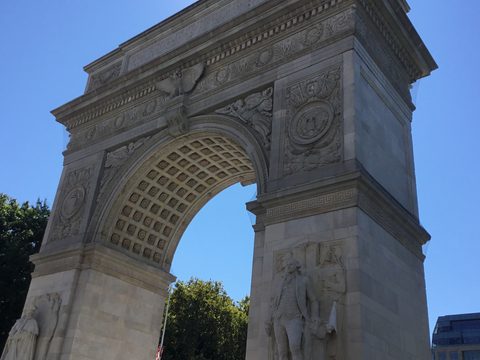
Greenwich Village's name comes from the Dutch Groenwijck, or "Green District" — the earliest written reference to "Greenwich" appears in a 1696 will, and the village shows up in city records by 1713. It began as a rural hamlet the Dutch called Noortwyck, and in 1644 eleven Dutch African settlers were granted "half freedoms" here after what's described as the first Black legal protest in America, receiving land in what became known as the "Land of the Blacks." An 1822 yellow fever epidemic sent Manhattan residents fleeing to the Village's healthier air; many stayed, and by 1850 the growing city had fully absorbed it. What followed was a century as America's bohemian capital — painters at the Tenth Street Studio Building from 1857, the Beat Generation, the 1960s folk revival, and, on June 28, 1969, the Stonewall uprising a few blocks from Washington Square, which sparked the modern LGBTQ+ rights movement.
-
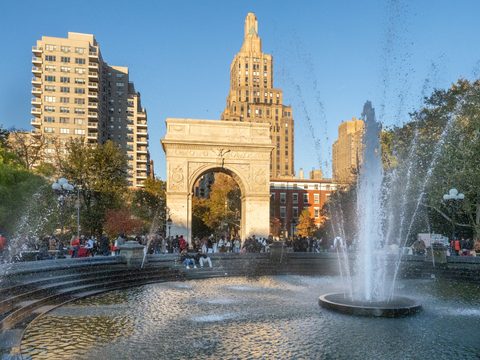
A former potter's field turned Village landmark, anchored by Stanford White's 1892 arch.
-
sight
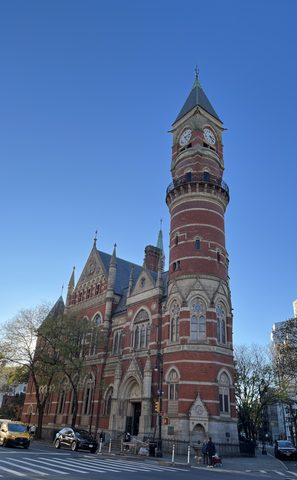
A working library inside a Victorian Gothic former courthouse, its clock tower visible across the Village.
-
sight
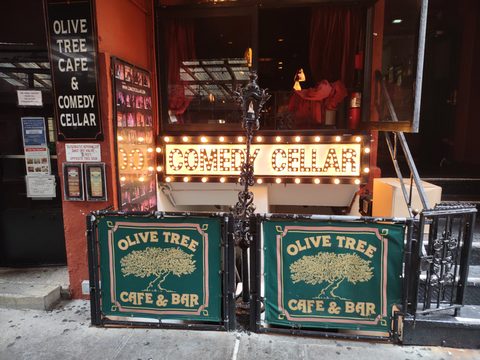
A MacDougal Street stand-up institution known for surprise drop-in sets.
-
food
A MacDougal Street cafe since 1927 that claims America's first cappuccino.
-
food
Keith McNally's steakhouse-bistro in a storied MacDougal Street tavern space.
-
Coal-fired, whole-pies-only pizza at this Bleecker Street address since 1929.
-
food
A Carmine Street slice shop that's been family-run since 1975.
-
A landmark hotel right on the square, operating since 1902.
-
stay
A boutique hotel on West 8th Street with a 2025 Cecily Brown mural in its lobby.
A Century of Bohemia
Greenwich Village's reputation as an artistic haven took root at the Tenth Street Studio Building starting in 1857, drawing painters like Winslow Homer. It deepened through the 20th century: the Beat Generation gathered here in the 1950s, the 1960s folk revival centered on venues like Gerde's Folk City, The Bitter End, and The Gaslight Cafe — where Bob Dylan and Joni Mitchell performed — and the Off-Off-Broadway movement was born in coffeehouses like Caffe Cino starting in 1958. The defining moment came on June 28, 1969, when the Stonewall uprising erupted at the Stonewall Inn on Christopher Street after a police raid, sparking the modern LGBTQ+ rights movement; the site became the first U.S. National Monument dedicated to LGBTQ+ rights in 2016, and its visitor center opened on the uprising's 55th anniversary in 2024. Just north, Washington Square Park has its own buried history — the square was a potter's field from 1797 to 1825, with more than 20,000 bodies still believed to lie beneath it, before Greek Revival rowhouses built around 1832 made it fashionable.
Getting there by subway
The A, C, E, B, D, F, and M trains converge at West Fourth Street-Washington Square, a major transfer point between the IND Sixth and Eighth Avenue lines (B and M run weekdays only; C runs all times except late nights). The 1 train, with the 2 late nights, stops at Christopher Street-Stonewall on Seventh Avenue South. Between the two stations, nearly every corner of the Village is a short walk from a subway entrance.
Frequently asked questions
- How do I get to Greenwich Village by subway?
- The A/C/E/B/D/F/M trains converge at West Fourth Street-Washington Square, and the 1 (with the 2 late nights) stops at Christopher Street-Stonewall on Seventh Avenue South — between the two, most of the Village is a short walk from a station.
- Where does the name Greenwich Village come from?
- It comes from the Dutch Groenwijck, meaning "Green District." The earliest written reference to "Greenwich" is a 1696 will, and the village appears in city records by 1713.
- What happened at Washington Square Park before it was a park?
- From 1797 to 1825 the site was a potter's field — an estimated 10,000 to 22,000 bodies were buried there, and more than 20,000 are believed to remain beneath the park today. Greek Revival rowhouses built around 1832 made the square fashionable afterward.
- Why is Stonewall significant to Greenwich Village's history?
- On June 28, 1969, spontaneous protests against a police raid at the Stonewall Inn on Christopher Street sparked the modern LGBTQ+ rights movement. The site became the first U.S. National Monument dedicated to LGBTQ+ rights in 2016, with a visitor center opening in 2024.
- Where can I stay near Washington Square?
- The Washington Square Hotel, open since 1902 on Waverly Place, sits right on the square; the Marlton Hotel, a few blocks away on West 8th Street, is another boutique option.
Connected pages
Nearby
- Union Square, Manhattan: Where Protest Meets Produce · Union Square, New York
- West Village, Manhattan: Crooked Streets, Stonewall's Legacy · West Village, New York
- East Village, Manhattan: From Kleindeutschland to CBGB · East Village, New York
- NoHo, Manhattan: Astor's Row, Reborn in Lofts · NoHo, New York
- SoHo, Manhattan: Cast-Iron Blocks the Artists Saved · SoHo, New York
Shared history
-
West Village, Manhattan: Crooked Streets, Stonewall's Legacy
· West Village, New York
The name emerged in the 1950s and '60s to distinguish the area west of Seventh Avenue from the part of Greenwich Village around Washington Square.
Same region
-
West Village, Manhattan: Crooked Streets, Stonewall's Legacy
· West Village, New York
Another Manhattan neighborhood covered in this series.
-
NoHo, Manhattan: Astor's Row, Reborn in Lofts
· NoHo, New York
Another Manhattan neighborhood covered in this series.
-
SoHo, Manhattan: Cast-Iron Blocks the Artists Saved
· SoHo, New York
Another Manhattan neighborhood covered in this series.
What travelers think
Log in to react.
No reviews yet.