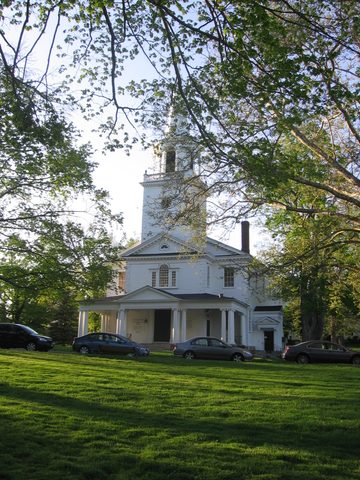

Maspeth, Queens: National Parishes, the Oval and the Expressway Triangles
Maspeth, New York
Pictures from Maspeth
See all 1 photos →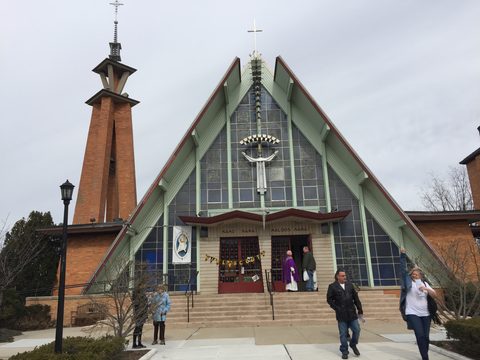
Maspeth is in Queens Community District 5, and its ZIP Code is 11378. It is patrolled by the New York City Police Department's 104th Precinct. English settlers arrived in 1642 under a charter granted to Rev. Francis Doughty, making Maspeth the first English settlement in Queens; conflicts drove many of them to what is now Elmhurst the following year, and settlers returned in 1652 and established the village of Middleburgh. No building here is an individually designated New York City landmark, and none is listed on the National Register of Historic Places. There is no subway station either. What Maspeth has instead is a Lithuanian parish church by Jonas Mulokas, a soccer field that U.S. Soccer calls a four-time U.S. Open Cup Final venue, a converted door factory that now runs concerts, and the cemeteries that NYC Parks says surround the neighborhood on three sides.
-
64-14 Clinton Avenue. Jonas Mulokas's Lithuanian parish church, begun 1956 and consecrated 1962, with a roadside shrine replica on the lawn.
-
61-21 56th Road. A Polish national parish dedicated on November 30, 1913, seating 800, with three marble altars and a belfry chime.
-
sight
60-58 60th Street. A soccer ground U.S. Soccer calls a four-time U.S. Open Cup Final venue; the finals here were in 1951, 1974, 1976 and 1980.
-
tip
52-19 Flushing Avenue. A 1903 glass factory turned door factory turned venue, with a 20,000-square-foot main hall and the Basement club below.
-
sight
73rd Street and 57th Road. Named for the typing pangram, with a statue of a brown fox and benches behind the Long Island Expressway wall.
-
sight
A 0.001-acre triangle where Fresh Pond Road meets 59th Road and 61st Street, named in April 1933 for a printer who died in World War I.
-
sight
Grand Avenue at 57th Avenue and 72nd Place. Paul C. Hunder's 1931 monument to the neighborhood's war dead, with World's Fair benches.
-
walk
Maurice Avenue and 63rd Street. A 7.46-acre WPA park opened in 1940 as Maurice Park and renamed for the man NYC Parks calls "Mr. Maspeth."
-
sight
59-25 Fresh Pond Road. Parkland designated in 1964 after residents defeated the Board of Education's plan for an intermediate school here.
-
sight
Planned in 1850 and 71 acres after an 1878 purchase; established as an Episcopal cemetery, with that restriction lifted in 1851.
-
69-70 Grand Avenue. Its own directions page states "NO TRAINS STOP HERE" and names the Q18, Q58, Q59 and Q67 buses.
-
53-37 72nd Street. A community center running COMPASS and SONYC after-school programs, toddler, senior and adult programs and job services.
Cemeteries, the expressway and the triangles it left
Maspeth's Wikipedia article splits the neighborhood by land use: "The area consisting of 43rd Street through 58th Street, including the former Furman Island, is mostly industrial lowlands," while "the blocks from 60th Street to 74th Street are mostly residential, but there is a small industrial presence on Grand Avenue." It adds that "much of the area's commerce is situated along Grand Avenue." The same article calls the neighborhood "nearly isolated by the industrial areas and cemeteries surrounding it" and reports that it "is described by some residents as having a small-town feeling." An NYC Parks sign text names a different isolating agent: "The region is fairly isolated from the rest of Queens because of the Long Island Expressway, which serves as one of its borders." The same sign says Maspeth's "residential areas have remained suburban; most of its streets are lined with single-family houses."
NYC Parks sign texts state that Maspeth "is surrounded on three sides by cemeteries," and they give the reason. After repeated outbreaks of yellow fever, "an 1830 ordinance forbade burials in Manhattan below Canal Street," and "the construction of suburban cemeteries, consequently, quickly increased." Newtown, the region straddling Brooklyn and Queens, "was the site of so many cemeteries that it was often called 'the city of the dead.'" Mount Olivet Cemetery is in Maspeth. It was planned in 1850 on land acquired from George Fash and the estate of James Waterbury, reached 71 acres after an 1878 purchase, and was originally established as an Episcopal cemetery; that restriction was lifted in 1851, and its type is recorded as non-sectarian. Former U.S. Congressman James Maurice was one of its founders and is interred there, as are Georges V. Matchabelli, Helena Rubinstein and Legs Diamond. Calvary Cemetery is a Catholic cemetery in Sunnyside, Maspeth and Woodside; 71 acres of land for it were bought from John McMenoy and John McNolte in Maspeth on October 29, 1845, and its Fourth Calvary section lies south of the Long Island Expressway, bounded by 55th Avenue, 50th Street and 58th Street.
The Long Island Expressway runs through Maspeth. NYC Parks records that the Queens-Midtown Expressway, the branch reaching from the Queens-Midtown Tunnel approach to Queens Boulevard, cost $32.5 million, and that "on June 28, 1972, the Long Island Expressway was finally completed, after decades of construction work." Parcels condemned for the road were handed to the Parks Department, and the leftovers are triangles wedged against the service roads. Hull Triangle, at 55th Drive, 64th Street and Hull Avenue, was built in conjunction with the expressway; the City acquired the property in 1953 and transferred it to Parks, and it holds shaded benches, landscaping and "two miniature white horse sculptures that serve as children's seats." It is named, with the adjacent avenue, for Isaac Hull (1773-1843), the American naval officer best known for his command of the frigate Constitution during the War of 1812. Quick Brown Fox Triangle, at 73rd Street and 57th Road, is named for the pangram used to demonstrate typefaces and is "home, appropriately, to a statue of a brown fox"; it was reconstructed in May 2001. Peter Chahales Park, at 69th Street and 58th Avenue, was also built in conjunction with the expressway, acquired by the City in 1953 and assigned to Parks in 1957; NYC Parks titles the site "Horse Car Rest Stop" and its sign remembers the Grand Street and Newtown Railroad, which laid a double-track railroad in August 1860 and opened the Grand Street line along the old stagecoach route to Calvary Cemetery that October at three cents per ride.
Several of these triangles carry more than one name in the agency's own records. NYC Open Data's sign name for Q360G is Whitefish Triangle; the NYC Parks page for the same property is headed Oliver Hazard Triangle, and its sign says it was "originally known as Hamilton Place Triangle." It was renamed in 1998 after the adjacent Perry Street and its namesake, Captain Oliver Hazard Perry (1785-1819), rebuilt between 1998 and 1999 with $529,000 from Council Member Walter L. McCaffrey, and taken into the Greenstreets program; the fences around its jungle gym are adorned with cutouts of geese. Q360F is the Technical Sergeant Thomas J. Davey Triangle in Open Data and Cowbird Triangle on the NYC Parks page, and its sign records that it "was once named Alexander Triangle." Commissioner Henry J. Stern named it on July 21, 1997 after nearby Borden and Jay Streets — Borden Street for the Borden Milk Company, "which at one time had a plant here," and Jay Street for the bird. Its parcel was acquired in 1945 as part of the condemnation proceeding for the expressway, and the park opened on December 29, 1953. Federalist Triangle, at 55th Avenue, Jay Avenue and 65th Place and headed Federalist North Triangle on its own page, was acquired by Parks in February 1927; its name was inspired by the adjacent Hamilton Place and the Federalist movement.
Other parkland here carries the neighborhood's civic arguments. Frank Principe Park, at Maurice Avenue and 63rd Street, was built by the Works Progress Administration and opened in 1940 as Maurice Park, after the bordering street named for James Maurice. In 1937 the City had acquired the property for a pumping station and only permitted it to Parks in 1939, on condition that no garage or gas station be built and that a twelve-foot fence go up. Its southern border was modified in the 1960s for the Queens Midtown Expressway, and it was renovated in 1996. Frank Principe (1909-2004) lobbied for the park in the 1930s, sat on Community Board Five for 25 years, and by the time he died had earned the appellation "Mr. Maspeth"; the park's Virginia Principe Playground is named for his wife. Reiff Playground, at 59-25 Fresh Pond Road, sits on land bounded by Mount Olivet Crescent, 59th Avenue, 63rd Street and Fresh Pond Road, and came out of a fight over what should be built there: the Board of Education wanted an intermediate school and argued it would foster "better ethnic distribution of children," while local residents were "opposed to the substantial influx of people a new intermediate school would bring, fearing community disruption" and wanted ball fields instead. The Board of Education was denied the land, which was designated as a park in 1964, and the City Council named it in 1969 for Andrew J. Reiff (1887-1963), whom NYC Parks describes as a community activist and president of the Ridgewood-Metropolitan Civic Association of Queens for over 30 years who "played a leading role in disputes over land development in his neighborhood of Maspeth." Frontera Park, at 58th Avenue and Brown Place, was named by the City Council in 1958 for Frank Frontera (1858-1952), who emigrated from Italy and settled in Maspeth with his wife and infant son in 1883, served in the Volunteer Fire Department until the age of 91, and kept a barber shop; his son Alexander founded the Maspeth Federal Savings and Loan Association. The site had been the Maspeth Bus Garage, surrendered to the City in 1955. Luke J. Lang Square, a 0.001-acre triangle where Fresh Pond Road meets 59th Road and 61st Street, is a war memorial: Lang (c.1894-1917) worked as a printer at J.E. Hetsch on Duane Street in Manhattan, enlisted in June 1917, and "the details of his death are unknown." NYC Parks places the triangle in Maspeth and says Lang himself lived on Bleecker Street in Ridgewood. Garlinge Triangle, at Grand Avenue, 57th Avenue and 72nd Place, holds a monument built in 1931 by the architect Paul C. Hunder honoring the soldiers and sailors of the neighborhood who died in combat; its namesake, Private Walter A. Garlinge, was killed in action on September 2, 1918.
National parishes, the Oval and the church that came apart
Transfiguration and Holy Cross were founded as national parishes — parishes "founded for Catholics of a specific nationality: e.g., German, Italian, Polish, Lithuanian, Spanish-speaking" — as distinct from the territorial parishes that covered a geographical area. Transfiguration Catholic Church, at 64-14 Clinton Avenue, was organized in 1908 as a Lithuanian parish serving immigrants who had settled in Maspeth and the Blissville section of Long Island City. Its first church, built in 1909 on Hull Avenue, burned in 1925; the parish moved to the former site of St. Stanislaus Kostka's old church building on Clinton Avenue, with its rear facade abutting Perry Avenue, and built a church there in 1935. The present building was designed by the Lithuanian architect Jonas Mulokas, begun in 1956 and consecrated in 1962, with the 1935 structure turned into a parish hall. Above the doors is the Lithuanian phrase Mano Namai Maldos Namai ("My house is a house of prayer"), a replica of a Lithuanian roadside shrine stands on the front lawn, the steeple echoes the shrine, and the interior decoration draws on Lithuanian folk art. The design won awards from the American Society of Registered Architects and the Queens Chamber of Commerce and was featured on the front page of the New York Times on December 2, 1962. The parish is now part of the merged Parish of Saint Stanislaus Kostka - Transfiguration.
Holy Cross Roman Catholic Church, at 61-21 56th Road, was established in 1912 to provide spiritual services to early immigrants from Poland; its parish had been organized in 1908 as the Society of St. Joseph, and its first pastor was Reverend Adalbert Nawrocki. Its first parishioners "had to visit their then bishop 26 times before their wish to erect a church building was granted," at a cost of around US$75,000. The cornerstone was laid on June 22, 1913, the first mass was held that October 1, and the church was dedicated on November 30, 1913. It seats 800, has three marble altars, stained-glass windows and two sacristies, and carries a tower belfry with a chime of bells. Its pipe organ was built by George H. Ryder of Boston, Opus 63, in circa 1878 for the Bethel AME Church in New Bedford, Massachusetts, and was rebuilt by Bozeman-Gibson of Deerfield, New Hampshire, in 1973. The parish runs a Polish School and CCD classes on weekends.
The Metropolitan Oval, at 60-58 60th Street, is a soccer field. U.S. Soccer headlined its 2023 account of the ground "The Oval & the Open Cup: Making History in Maspeth, Queens," calling it a four-time U.S. Open Cup Final venue and writing that "the field has occupied the site for almost a century"; the Oval's own site says it "can legitimately claim to be one of the oldest continually used fields in the country." The finals it hosted were in 1951, when the New York German-Hungarians overturned a 4-2 first-leg deficit with a 6-2 home win; in 1974, when a New York Times report described 2,000 spectators watching New York Greek-Americans beat Chicago Croatian 2-0; in 1976, when San Francisco IAC beat New York Inter-Giuliana; and in 1980, when the New York Pancyprian-Freedoms beat Los Angeles Maccabee SC 3-2 after extra time on a goal by Nick Kritikos. In 1948 the ground's owners, Kollsman Sport Club, told the German-Hungarians they were selling; the club raised the $30,000 asking price and another $20,000 for improvements, and built a cinder block concession stand and bathrooms that remain. The surface was a rocky sandlot until the first artificial surface was installed in 2001 — the former Blau Weiss Gottschee player Ricky Kren called it "The Dust Bowl," and, according to Kren, the caretaker in the 1960s and 1970s dragged a metal mattress box spring behind an old Ford to clear the stones. The Oval sits "hemmed in by row homes to the South and East and the Long Island Railroad tracks to the North," with a view of midtown Manhattan to the west. The organization's own history records how the neighborhood received the teams that rented the ground: when Latin American teams began renting the field for night games, "the Maspeth neighbors began complaining about the noise and the people," and metropolitanoval.org writes that a 1994 New York Times article "described how the mostly white community of Maspeth was simply uncomfortable with and unwelcoming to people from a different culture in their neighborhood," with complaints forcing an end to night games and costing the club rental and concession income. Visit today, the same site says, and "you're also likely to hear animated cheering in Greek, Italian, Polish, Portuguese, Russian, Spanish and English."
Knockdown Center, at 52-19 Flushing Avenue, is a cultural space, performance venue and art center whose features include a 20,000-square-foot main hall, a backyard nicknamed The Ruins and a large gallery. The building was constructed in 1903 and first used as a glass factory by the Gleason-Tiebout Glass Company; in the 1930s its proprietor turned the warehouse over to door manufacturing as the Manhattan Door Factory, which invented the knock-down frame, a door that lets contractors build walls first and install doors later. The warehouse became vacant in 2010 when the door company moved to New Jersey. Michael Merck, Kate Watson and Tyler Myers opened an outdoor exhibition of sculptural mini-golf holes there in 2012, and after a contentious two-year fight over a liquor license the renovated first floor opened on May 20, 2016. Basement, a techno club under the main building co-founded by Tea Abashidze, Gega Japaridze and Tyler Myers, opened on May 10, 2019 and added a second room, Studio, on September 2, 2022.
Maspeth Town Hall, at 53-37 72nd Street, describes itself as "a thriving community center providing a variety of services" that "proudly serve[s] families from all ethnic and cultural backgrounds, regardless of their economic status"; it credits Marge Markey with founding the organization and assembling the stakeholders who saved the building after it was abandoned and had fallen into disrepair. Its programs include COMPASS and SONYC after-school programs, toddler, senior and adult programs, martial arts and employment services. The Queens Public Library's Maspeth branch is at 69-70 Grand Avenue.
And then there is the church that is no longer here. St. Saviour's was a Carpenter Gothic church by Richard Upjohn, built in 1847 and founded in 1848 on land donated by Rep. James Maurice, and it stood for more than 160 years on a hill in Maspeth — at Rust Street and 57th Drive by Wikipedia's account, at Rust Street and 57th Road by QNS's. The San Sung Korean Methodist Church congregation, which had bought the property for $450,000, sold it for $10 million in 2005. Between 2006 and 2009 the Juniper Park Civic Association rallied Maspeth and Middle Village to have the building landmarked; the City never granted the status. Instead the church was disassembled in 30 days under a deal struck with the developers, every piece labeled, at a cost to the city and state of $250,000, with the Juniper Park Civic Association's Tony Nunziato buying two truck trailers to store it in and the New York Landmarks Conservancy documenting the work. The framing has remained in those trailers at All Faiths Cemetery in Middle Village. Institutional accounts of what is inside them differ. The Conservancy reported locked trailers and wrote that "the stored old-growth wood appeared to be in good condition, but the challenges of rebuilding the building are significant," while a QNS reporter who visited seven weeks earlier "observed the contents — mostly moldy piles of wood filled with rusted nails — stored within the unlocked trailers, located in public view, with no gates or warning signs nearby to prohibit access." A fire in the 1970s had already replaced almost all of the church's original windows and doors. The Maspeth site was developed into four large warehouses.
Getting there
Maspeth "is devoid of direct transit connections to Manhattan, as there are no New York City Subway stations and no express bus stops in Maspeth." The Queens Public Library's own page for its Maspeth branch prints the same point flatly under its directions: "NO TRAINS STOP HERE." The Middle Village-Metropolitan Avenue station, served by the M train, is in Middle Village, east of Maspeth.
Buses are the connection to the subway. The Q18, Q58, Q59 and Q67 are the routes the library branch prints on its own page. The branch's driving directions are "LIE west to exit 19, 69 St-Grand Ave. Right turn onto 69th St, then right turn onto Grand Ave," and it notes that metered parking is available along Grand Avenue.
By road, Maspeth has access to I-278, the Brooklyn-Queens Expressway, and I-495, the Long Island Expressway. The BQE crosses Newtown Creek on the Kosciuszko Bridge, which connects Greenpoint in Brooklyn to Maspeth in Queens. Its two cable-stayed spans replaced a 1939 truss bridge of the same name: the eastbound span opened on April 27, 2017 with three lanes in each direction, the westbound span on August 29, 2019, and the pair added a pedestrian and bicycle connection between the boroughs. The older bridge's approaches were demolished on October 1, 2017 with the detonation of 944 small explosive charges. The Grand Street Bridge carries Grand Street eastward from Williamsburg, where it becomes Grand Avenue, described by Wikipedia as Maspeth's main street for dining and business; Grand Avenue then continues eastward to end at Queens Boulevard in Elmhurst.
One future connection is proposed and not built. The Interborough Express would be a 14-mile light rail line running in the existing Bay Ridge Branch and Fremont Secondary right-of-way between the Brooklyn Army Terminal in Bay Ridge and Jackson Heights; as of 2025 the MTA estimated the project would be operational in the early 2030s. Grand Avenue and Eliot Avenue are among the preliminary station locations announced in 2024, and the plans faced opposition from residents of Maspeth and Middle Village. For freight, the Long Island Rail Road's Montauk Branch and the lightly used Bushwick Branch serve the area, operated by the New York and Atlantic Railway.
Frequently asked questions
- How do I get to Maspeth?
- Not by subway. Maspeth "is devoid of direct transit connections to Manhattan, as there are no New York City Subway stations and no express bus stops in Maspeth," and the Queens Public Library's Maspeth branch page prints "NO TRAINS STOP HERE" under its own directions. The Middle Village-Metropolitan Avenue station, served by the M train, is in Middle Village, east of Maspeth. The Q18, Q58, Q59 and Q67 are the bus routes the library branch names, and by car its own directions read "LIE west to exit 19, 69 St-Grand Ave. Right turn onto 69th St, then right turn onto Grand Ave," with metered parking along Grand Avenue.
- What is the Metropolitan Oval?
- A soccer field at 60-58 60th Street. U.S. Soccer calls it a four-time U.S. Open Cup Final venue and says the field has occupied the site for almost a century; the finals played there were in 1951, 1974, 1976 and 1980. The club that owned it bought the ground from Kollsman Sport Club in 1948 for $30,000. The playing surface was a rocky sandlot, nicknamed "The Dust Bowl," until the first artificial turf was installed in 2001. U.S. Soccer adds a caution of its own: another Metropolitan Oval, in the Bronx, also hosted games in the first half of the 20th century.
- Does Maspeth have any landmarked buildings?
- No. The Landmarks Preservation Commission has designated two individual landmarks in all of Queens Community District 5, and both are in Ridgewood. No Maspeth property is on the National Register of Historic Places in Queens County. Its unprotected buildings include Transfiguration Catholic Church at 64-14 Clinton Avenue, designed by Jonas Mulokas, begun in 1956 and consecrated in 1962.
- Where is St. Saviour's Church now?
- In two trailers at All Faiths Cemetery in Middle Village. The Carpenter Gothic church by Richard Upjohn, built in 1847 on a Maspeth hill, was sold in 2005, failed to win landmark status, and was disassembled piece by labeled piece in 30 days under a deal with the developers. The New York Landmarks Conservancy documented the dismantling and reported the wood in locked trailers and in good condition; a QNS reporter who visited seven weeks earlier described moldy wood filled with rusted nails in unlocked trailers. Four large warehouses were built on the Maspeth site.
- Why are there so many cemeteries around Maspeth?
- NYC Parks sign texts say the neighborhood "is surrounded on three sides by cemeteries" and trace it to public health law: after repeated yellow fever outbreaks, "an 1830 ordinance forbade burials in Manhattan below Canal Street," and "the construction of suburban cemeteries, consequently, quickly increased." Newtown, the region straddling Brooklyn and Queens, "was the site of so many cemeteries that it was often called 'the city of the dead.'" Mount Olivet Cemetery is in Maspeth; Calvary Cemetery lies across Sunnyside, Maspeth and Woodside, and 71 acres of land for it were bought in Maspeth in 1845.
- What is there to do in Maspeth?
- Knockdown Center at 52-19 Flushing Avenue is a performance venue and art center in a 1903 glass factory turned door factory, with a 20,000-square-foot main hall, a gallery, a backyard called The Ruins, and the Basement club below. Transfiguration Catholic Church at 64-14 Clinton Avenue and Holy Cross Roman Catholic Church at 61-21 56th Road are the neighborhood's two national parishes. Quick Brown Fox Triangle, at 73rd Street and 57th Road, is named for the typing pangram and holds a statue of a brown fox.
Connected pages
Nearby
-
Ridgewood, Queens: Myrtle Avenue, the County Line and the Onderdonk House
· Ridgewood, New York
NYC Parks says Luke J. Lang, whose Maspeth triangle carries his name, lived on Bleecker Street in the nearby neighborhood of Ridgewood.
Shared history
-
Elmhurst, Queens: Newtown's Village, Four Landmarks and the Whitney Avenue Grid
· Elmhurst, New York
Conflicts drove Maspeth's 1642 settlers inland to what is now Elmhurst, and Grand Avenue runs east out of Maspeth to end at Queens Boulevard there.
Same region
-
Woodside, Queens: The Doughboy, Windmuller's Hill and Little Manila
· Woodside, New York
Wikipedia puts Woodside on Maspeth's northern border, and Calvary Cemetery is described as a Catholic cemetery in Sunnyside, Maspeth and Woodside.
-
Glendale, Queens: Myrtle Avenue, the Cemetery Belt and a Fight Over a ZIP Code
· Glendale, New York
Maspeth is in Community District 5 with Glendale, Ridgewood and Middle Village; the district's population and income figures cover them together.
-
Ridgewood, Queens: Myrtle Avenue, the County Line and the Onderdonk House
· Ridgewood, New York
NYC Planning's census tables count Maspeth as its own area, listed alongside Ridgewood and Glendale.
What travelers think
Log in to react.
No reviews yet.