
Greenwood, Brooklyn: The Cemetery That Named It
Greenwood, New York
Pictures from Greenwood
See all 3 photos →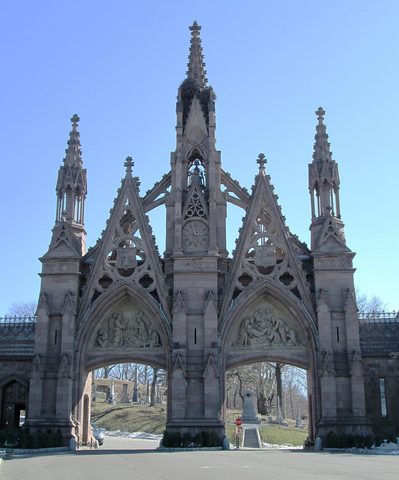
Greenwood, commonly written Greenwood Heights, takes its name from the cemetery beside it. Real estate developers coined the name starting in the late 1980s and it spread further amid 2000s gentrification; a November 2005 rezoning actually curbed new luxury development in the area rather than causing that gentrification. Green-Wood Cemetery itself was chartered in 1838, with acts of incorporation passed on April 18, 1838, and the first interment took place on September 5, 1840. It was founded as a rural cemetery inspired by Mount Auburn Cemetery in Cambridge, Massachusetts, at a time when city churchyards were overcrowded, and its popularity inspired a competition to design Central Park in Manhattan, as well as Prospect Park nearby. By the early 1860s it was drawing annual crowds second in size only to Niagara Falls.
-
walk
478 acres of rural-cemetery landscape, free and open every day of the year. Four gates, each with its own seasonal hours.
-
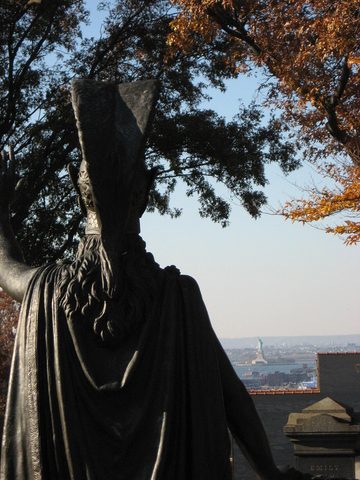
Brooklyn's highest natural ground, fought over in 1776, with Ruckstull's 1920 Minerva facing the Statue of Liberty across the harbour.
-
The 1860s main gate, landmarked in 1966, with Moffitt's carved resurrection panels and a 106-foot clock tower.
-
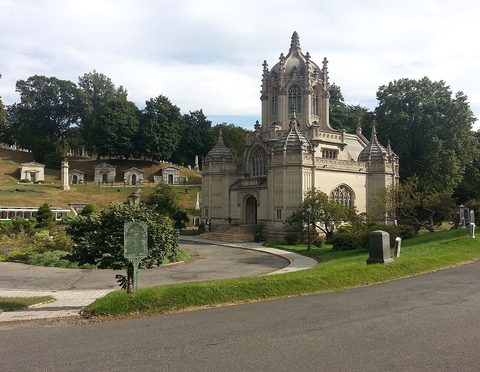
Warren and Wetmore's limestone chapel of 1911-1913, landmarked in 2016 alongside the Fort Hamilton Parkway entrance.
-
The 1895 Weir Greenhouse restored as the cemetery's visitor hub, open Thursday to Monday and free to enter.
-
A brownstone double gateway of 1876-77 on the cemetery's Fort Hamilton Parkway side.
A rural cemetery and its gates
Green-Wood was Henry Evelyn Pierrepont's idea, and it worked on the Mount Auburn model: landscape first, burial second. In 2017 it received 280,000 visitors. It was listed on the National Register of Historic Places on March 8, 1997 and designated a National Historic Landmark on September 20, 2006.
Its gates and its chapel carry individual New York City landmark designations. The 25th Street gate, built between 1861 and 1865, is Gothic Revival, with sculptured panels by John M. Moffitt depicting biblical resurrection scenes and a 106-foot clock tower set between the two gateways; it was designated on April 19, 1966. The Fort Hamilton Parkway entrance is a brownstone double gateway built in 1876 and completed the next year. The chapel, in a Late Gothic and Beaux-Arts manner, was built between 1911 and 1913 by Warren and Wetmore in limestone, with a central octagonal tower. The Fort Hamilton Parkway entrance and the chapel were designated together on April 12, 2016.
The cemetery's most recent addition is a restoration rather than a new building. The Weir Greenhouse of 1895, designated an individual landmark on April 13, 1982, was restored and reopened as The Green-House at Green-Wood, the cemetery's visitor entrance and hub, over the weekend of April 18, 2026.
Battle Hill
Battle Hill, inside the cemetery, is the highest natural point in Brooklyn at roughly 216 feet. Fighting took place there during the Battle of Long Island in 1776.
The hill now holds Frederick Ruckstull's bronze Altar to Liberty: Minerva, erected in 1920 and positioned so that Minerva faces the Statue of Liberty across the harbour.
The neighborhood around the cemetery is administered as part of New York City Community District 7, which the 2018 figures put at roughly 132,721 residents district-wide. Greenwood Heights is described as the section of that district north of about 36th Street, but that is a colloquial description rather than a formal boundary: sources disagree on whether this is a distinct neighborhood at all, and where Greenwood Heights, Sunset Park, South Slope and Windsor Terrace divide.
Getting there
25th Street, at 25th Street and Fourth Avenue, is situated in Greenwood Heights. The R serves it at all times, the D and N stop there late nights, and a limited number of peak-direction W trains call.
Prospect Avenue, at Prospect Avenue and Fourth Avenue, sits near the convergence of the Gowanus, Greenwood Heights, Park Slope and South Park Slope neighborhoods. The R serves it at all times, with the D and N late nights and a limited peak-direction W.
36th Street, at 36th Street and Fourth Avenue, is in Sunset Park rather than in Greenwood Heights. The D, N and R serve it at all times, with limited rush-hour W service.
Frequently asked questions
- How do I get to Greenwood?
- Take the R to 25th Street, at 25th Street and Fourth Avenue, which is situated in Greenwood Heights and is the closest station to Green-Wood Cemetery's main gate at Fifth Avenue and 25th Street. Prospect Avenue, also on the R, sits near the convergence of Gowanus, Greenwood Heights, Park Slope and South Park Slope. 36th Street is in Sunset Park.
- Where does the name Greenwood come from?
- From Green-Wood Cemetery. Real estate developers coined Greenwood Heights as a name for this stretch starting in the late 1980s, and it spread further amid 2000s gentrification. A November 2005 rezoning curbed new luxury development in the area rather than causing the gentrification.
- Does it cost anything to visit Green-Wood Cemetery?
- No. Admission is free and the cemetery is open 365 days a year. There are four entrances: the main gate at Fifth Avenue and 25th Street, plus Fourth Avenue at 35th Street, Fort Hamilton Parkway at Micieli Place, and Prospect Park West at 20th Street, each with its own seasonal hours. The gates are locked promptly on the hour, so plan to be out before closing time rather than at it.
- What is Battle Hill?
- The highest natural point in Brooklyn, at roughly 216 feet, inside Green-Wood Cemetery. Fighting took place there during the Battle of Long Island in 1776, and it now holds Frederick Ruckstull's 1920 bronze Altar to Liberty: Minerva, positioned facing the Statue of Liberty.
- What is The Green-House at Green-Wood?
- The cemetery's visitor entrance and hub, built around the restored 1895 Weir Greenhouse and opened over the weekend of April 18, 2026. It holds exhibitions and space for research, education and events, is open Thursday through Monday from 10am to 7pm, is free, and closes on federal holidays.
Connected pages
Nearby
-
Windsor Terrace, Brooklyn: Forty-Nine Pleasant Cottage Lots
· Windsor Terrace, New York
The Landmarks Preservation Commission's history describes Windsor Terrace as set between Prospect Park and Green-Wood Cemetery.
Shared history
-
Prospect Park
· park · Park Slope
Green-Wood's popularity as a destination inspired a competition to design Central Park in Manhattan, as well as Prospect Park nearby.
Same region
-
Downtown Brooklyn, Brooklyn: Borough Hall and the Fulton Mall
· Downtown Brooklyn, New York
The B63 runs along Fifth Avenue, the street Green-Wood's main gate fronts on, north to Downtown Brooklyn.
-
Cobble Hill, Brooklyn: A Name Revived in 1959
· Cobble Hill, New York
The B63 links the Fifth Avenue corridor past Green-Wood's main gate with Boerum Hill and Cobble Hill.
-
Sunset Park, Brooklyn: The Hill, the Terminal, Eighth Avenue
· Sunset Park, New York
Green-Wood Cemetery's own description places it among several adjoining neighborhoods, Sunset Park among them.
-
Gowanus, Brooklyn: A Canal, a Cleanup, a Power Station
· Gowanus, New York
The Prospect Avenue station sits at the convergence of the Gowanus, Greenwood Heights, Park Slope and South Park Slope neighborhoods.
-
Park Slope, Brooklyn: The Slope Up to Prospect Park
· Park Slope, New York
Prospect Avenue on the R sits at the convergence of Gowanus, Greenwood Heights, Park Slope and South Park Slope.
What travelers think
Log in to react.
No reviews yet.