
Orientation
Pelham Bay Park, the Bronx: 2,772 Acres and Thirteen Miles of Shore
Pelham Bay Park, New York
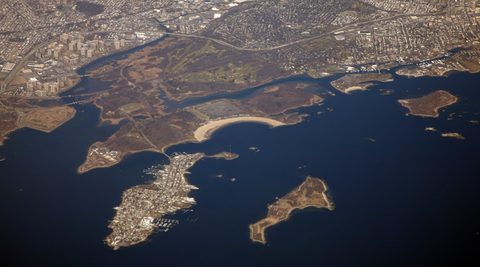

Pelham Bay Park covers 2,772 acres (1,122 ha) at the northeastern edge of the Bronx, the largest public park in New York City and slightly more than three times the size of the 843-acre Central Park, with 13 miles (21 km) of shoreline on Long Island Sound. Orchard Beach runs 1.1 miles along the park's eastern shore and is the only public beach in the borough, built on landfill under parks commissioner Robert Moses in the 1930s. The Bartow-Pell Mansion Museum stands at 895 Shore Road in a gray-stone house built between 1836 and 1842, and two golf courses share one address at 870 Shore Road. Two wildlife sanctuaries created in 1967 total 489 acres. The city bought the land in 1887, and it officially became a park in 1888.
What's here
Orchard Beach is the only public beach in the New York City borough of the Bronx: 115 acres of sand, 1.1 miles long, running along Pelham Bay on the park's eastern shore at the western end of Long Island Sound. It is not a natural feature. Parks Commissioner Robert Moses announced the expansion on February 28, 1934, inspired by Jones Beach, and the work filled approximately 110 acres of LeRoy's and Pelham Bays with sand brought from Sandy Hook, New Jersey and the Rockaway Peninsula, connecting Hunter Island and the Twin Islands to Rodman's Neck. The beach was dedicated, incomplete, in July 1936, officially opened on June 25, 1937 and was fully completed in 1938.
Aymar Embury II designed it, with Gilmore David Clarke and Michael Rapuano. The bathhouse, designed by Embury, is composed of a raised plaza flanked by two pavilions to the north and south; there are blue and white tiles inside the pavilions, and the lowest 6 feet of each pavilion's walls are clad with blue tiles. A 50-foot-wide promenade of hexagonal gray tiles runs the beach's full length. The bathhouse and promenade were designated a New York City Landmark on June 20, 2006. At opening the complex held a pavilion with two bathhouses, as well as a cafeteria, a small-boat lagoon, a 5,400-person locker and dressing facility, and two parking lots with a collective 8,000 spots; after the 1980s renovation the pavilions held some shops and fast food, with a nature center and museum planned for the buildings. Today there is a 13-section sandy shorefront, a hexagonal-block promenade, and a central pavilion with food stores and specialty shops, along with two playgrounds, two picnic areas, a large parking lot and 26 courts for basketball, volleyball and handball.
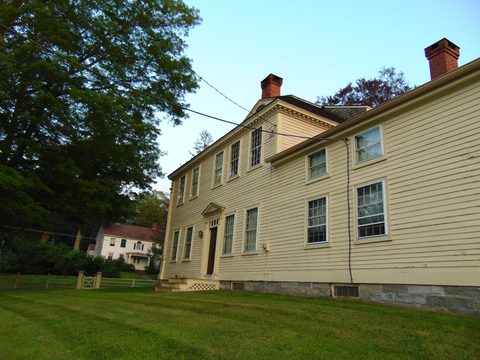
The Bartow-Pell Mansion Museum, at 895 Shore Road, is a gray-stone mansion with a Greek Revival facade and federal interiors, and the third residence on its site after Pell houses of circa 1675 and around 1790. Robert Bartow acquired 30 acres in 1836 and the house was constructed between 1836 and 1842. Wikipedia calls it the last surviving manor house in the Pelham Bay Park area, and calls its carriage house the last remaining masonry carriage house in New York City that retains its original design.
The Pelham Bay & Split Rock Golf Courses are one facility at 870 Shore Road, with two courses, Pelham Bay and Split Rock, under a single pro shop and booking system. They were reopened in June 1935, sixteen months after construction commenced, and were created through the efforts of New York City park commissioner Robert Moses — the same programme, and the same commissioner, as Orchard Beach. John van Kleek designed Split Rock.
Away from the built edges the park holds marsh, water and old forest. The Thomas Pell Wildlife Sanctuary comprises the westerly part of Pelham Bay Park, and the Hunter Island Marine Zoology and Geology Sanctuary, established in 1967, encompasses all of Twin Islands, Cat Briar Island, Two Trees Island, and the northeastern shoreline of Hunter Island; it contains the largest continuous oak forest in Pelham Bay Park, at least three centuries old and dating to colonial times. Both sanctuaries were created in 1967 in response to opposition to a planned landfill, and together they total 489 acres (1.98 km²). The Thomas Pell sanctuary takes in saltwater wetlands adjoining the Hutchinson River, Goose Island, Split Rock, and oak–hickory forests in tidal marshes bordering the Split Rock Golf Course; Goose Creek Marsh was once part of a 5,000-acre wetland covering what is now Co-op City and the southern part of Pelham Bay Park. There are 195 acres (79 ha) of salt marsh, and raccoon, egrets, hawks and coyotes live in the park. The Kazimiroff Nature Trail, named for the historian Theodore Kazimiroff, opened in June 1986.
Hunter Island covers 166 acres, down from 215 before the 1930s landfill. The Twin Islands were once true islands in Pelham Bay but are now connected to each other and to Orchard Beach and nearby Rodman's Neck by a landfill created in 1937; the Twin Islands Salt Marsh Restoration Project followed in 1995, at a cost of $850,000. Two Trees Island is connected to East Twin Island by a mudflat and consists of a rocky plateau upon which one can see Orchard Beach and the environmental center. The lagoon was called LeRoy's Bay until the mid-20th century and was mostly filled during the mid-1930s Orchard Beach reconstruction; what remained was widened and dredged into a four-lane 2,000-metre course for the 1964 Summer Olympics rowing trials, at a cost of $630,000. Other landmarks in the park include the Bronx Victory Column & Memorial Grove.
The Siwanoy, the Pell purchase and the Battle of Pell's Point
The Siwanoy were the first Native American tribe to inhabit the Long Island Sound's northern shoreline, east to Connecticut. By 1640 their territory, called Wykagyl, ran from Hell Gate to Norwalk, Connecticut and inland to White Plains; Poningo, near modern Rye, was their largest village that year, and they held stockade settlements at Ann Hook's Neck, Hunter Island and Davenport Neck. The general vicinity around Hunter Island was Laaphawachking, "place of stringing beads". The area was a ceremonial and burial site, evidenced by wampum belts found here.
In 1654 five sagamores — Shāwānórōckquot, Poquōrūm, Anhōōke, also known as Wampage I, Wawhāmkus and Mehúmōw — deeded land to Thomas Pell, signing near the site of the Bartow-Pell Mansion under the Treaty Oak. After Charles II's charter of 1666 the land became Pelham Manor. Pell died in 1669, willing his property to his nephew John, who sold off City Island in 1685; on John Pell's death in 1700 it passed to his son Joseph, then to Joseph's son John, and then to the Bartow family. The city acquired the land in 1887 and it officially became a park in 1888, paying $2,746,688 for land from multiple estates spread out over an excess of 1,700 acres, and ownership passed to New York City in 1895 with the annexation of the Bronx east of the Bronx River.
The Battle of Pell's Point was fought on Friday, October 18, 1776, in the Manor of Pelham, now the Bronx and Westchester County. General Sir Henry Clinton led the 4,000-man landing force as an advance guard; General Sir William Howe was the British commander-in-chief. Colonel John Glover's 750 American troops deployed behind stone walls and fell back through prepared positions, delaying the British and enabling Washington's withdrawal to White Plains. American casualties were 8 killed and 13 wounded. The official British report gave 3 killed and 20 wounded, excluding Hessian casualties, and estimates of Hessian losses are disputed, running from 200 to 1,000.
Glover's Rock, a large granite glacial erratic, carries a bronze plaque inscribed: "Near this site on October 18, 1776 Col. John Glover and 600 patriots held off British and Hessian forces under Gen. Howe long enough to save Washington's troops from destruction." Contrary to popular belief, the rock had nothing to do with the battle, and the claim that Glover stood on it is erroneous, as these distances were computed based on an inaccurate map using estimates recorded by Glover. Split Rock, a large dome-shaped granite boulder measuring approximately 25 feet (7.6 m) from north to south and 15 feet (4.6 m) from east to west, borders the Split Rock Golf Course and falls within the Thomas Pell Wildlife Sanctuary. The New York State Legislature approved a bronze tablet for it in 1904; the Colonial Dames of New York installed the tablet in 1911, and it was stolen in 1914. Its inscription read, in part, "In 1643 She and her Household were Massacred by Indians".
Hunter Island passed to Joshua Pell, a descendant of Thomas Pell, in 1743. The island was offered for lease on the death of its owner Henderson in 1804, and John Hunter, a successful businessman and politician, purchased the property shortly afterward. In 1811 the Hunter family built a mansion in the English Georgian style at the island's highest point, 90 feet above sea level: three stories with a large veranda and terraced gardens. Hunter, his wife Elizabeth and his son Elias moved to the island in 1813. The house held an art collection of over 400 works, among them Rembrandt, Rubens, van Dyck and da Vinci. John Hunter lived on the estate until his death in 1852 and his descendants until 1865; New York City acquired the land in 1889 for $324,000, and half a million seasonal visitors were coming by 1917. The mansion was demolished in 1937 during Moses's Orchard Beach construction, and LeRoy's Bay lagoon was filled to connect Hunter Island to the mainland.
Rodman's Neck, the peninsula that juts out into Long Island Sound, was originally Anne's Hoeck, or Ann Hook's Neck, and was renamed for Samuel Rodman, who owned a ferry that ran between Minneford Island — now known as City Island, which lies south of Pelham Bay Park — and Anne's Hoeck where the bridge is now, the crossing that is City Island's only connecting road to the mainland. The land was included in the purchase made by Thomas Pell in 1654, the same purchase that covered City Island; the Pelham Park & City Island Railway later connected the island to Pelham Bay Park from 1887 to 1919, running 3.2 miles of narrow gauge between the Bartow station of the Harlem River & Port Chester Railroad and Brown's Hotel on City Island. Its northern side was joined to former Hunter Island and Twin Island to form Orchard Beach and a parking lot. In 1959 the peninsula's operation was transferred to the NYPD, who built the current firing range at the peninsula's southern tip: the southern third is a 54-acre police training facility operated by the NYPD Firearms & Tactics Section, with seven rifle ranges and 230 total firing points, also used by the FBI, Fire Department fire marshals, the Correction Department, ICE, and the National Guard for riot training in the 1960s.
Getting there
Pelham Bay Park station is the northern terminal of the IRT Pelham Line. The 6 serves it at all times except weekday peak-direction hours, when the <6> serves it instead. The line was completed to the station on December 20, 1920. It is the only New York City Subway terminal that does not use numerical track labels, using compass-direction East and West labels instead, and its elevators were installed in December 1989. There is also a pedestrian bridge from the station entrance that crosses the Bruckner Expressway and leads to Pelham Bay Park: it leads into the park, and not onward to City Island.
Five bus routes serve the station: the Bx5, Bx12, Bx12 SBS, Bx24 and Bx29. The Bx29 runs 24 hours a day and year-round, with its western terminal at City Island Avenue and Rochelle Street and its eastern terminal at Bruckner Boulevard at Pelham Bay Park station. The Bx12 is the seasonal route to the beach itself, serving it on summer weekends: Bx12 local buses are extended to Orchard Beach during the summer, with all weekend service that season running the full route, while the Bx12 Select Bus Service — which began on June 29, 2008 as New York City's first bus rapid transit service — terminates at Bay Plaza and does not serve Orchard Beach. The Bx5 once ran a seasonal summer service to Orchard Beach, first introduced in February 1984, curtailed to weekends in September 1990, eliminated in September 1995 on budget grounds and discontinued again in Summer 2016. The Bx5 runs between Pelham Bay and Co-op City.
No NYC Ferry route or landing serves Pelham Bay Park or Orchard Beach; City Island residents advocated for a ferry stop in their neighborhood.
What's here
-
Pelham Bay Park
2,772 acres (1,122 ha) with 13 miles (21 km) of shoreline, the largest public park in New York City and slightly more than three times the size of Central Park.
-
Orchard Beach
The only public beach in the Bronx, 115 acres and 1.1 miles long. Its bathhouse and promenade were landmarked on June 20, 2006.
-
Bartow-Pell Mansion Museum
895 Shore Road. Built between 1836 and 1842 with a Greek Revival facade and federal interiors, and a National Historic Landmark since December 8, 1976.
-
Pelham Bay & Split Rock Golf Courses
870 Shore Road. Two courses under one pro shop and booking system, reopened in June 1935; John van Kleek designed Split Rock.
Questions
How do I get to Pelham Bay Park?
By subway, Pelham Bay Park station is the northern terminal of the IRT Pelham Line, served by the 6 at all times except weekday peak-direction hours, when the <6> serves it instead; a pedestrian bridge from the station entrance crosses the Bruckner Expressway and leads to Pelham Bay Park. The station is served by the Bx5, Bx12, Bx12 SBS, Bx24 and Bx29 buses. The Bx29 runs 24 hours a day between City Island Avenue and Rochelle Street and Bruckner Boulevard at the station. For Orchard Beach, Bx12 local buses are extended to the beach during the summer, with all weekend service that season running the full route; the Bx12 Select Bus Service terminates at Bay Plaza and does not serve Orchard Beach.
What is Orchard Beach?
The only public beach in the New York City borough of the Bronx, 115 acres and 1.1 miles long, running along Pelham Bay on the eastern shore of Pelham Bay Park. Parks Commissioner Robert Moses announced its expansion on February 28, 1934, inspired by Jones Beach; approximately 110 acres of LeRoy's and Pelham Bays were filled with sand brought from Sandy Hook, New Jersey and the Rockaway Peninsula, and the beach was dedicated in July 1936, officially opened on June 25, 1937 and completed in 1938. Aymar Embury II designed it with Gilmore David Clarke and Michael Rapuano, and the bathhouse and promenade were designated a New York City Landmark on June 20, 2006.
What is the Bartow-Pell Mansion Museum?
A gray-stone mansion at 895 Shore Road with a Greek Revival facade and federal interiors, built for Robert Bartow between 1836 and 1842 on a site that had held two earlier Pell houses, one circa 1675 and another around 1790. The Bartow and Pell families alternately owned it through 1888, when New York City acquired it for Pelham Bay Park, and the International Garden Club leased it from 1914. It reopened as a house museum in May 1946. It was designated a New York City Landmark on February 15, 1966, listed on the National Register of Historic Places on December 30, 1974, and made a National Historic Landmark on December 8, 1976.
Connected pages
Shared history
-
City Island, the Bronx: Boatyards, Seafood and One Bridge
· City Island, New York
Rodman's Neck was included in the same 1654 Pell purchase as City Island, and Samuel Rodman's ferry ran from it to Minneford Island.
Same region
-
Throgs Neck, the Bronx: Fort Schuyler at the Peninsula's Tip
· Throgs Neck, New York
Repulsed at Throgs Neck in October 1776, Howe's troops landed six days later at Rodman's Neck, to the north across Eastchester Bay.
-
Van Cortlandt Park, the Bronx: 1,146 Acres, Public Golf and a 1748 House
· Van Cortlandt Park, New York
Van Cortlandt Park's 1,146 acres rank third in New York City, behind the Staten Island Greenbelt and Pelham Bay Park's 2,772 acres.
See also
-
Coney Island, Brooklyn: The Cyclone, the Wheel and the Boardwalk
· Coney Island, New York
Parks commissioner Robert Moses announced Orchard Beach's expansion in 1934, reported on redeveloping Coney Island in 1937 and moved its boardwalk from 1949.
-
City Island, the Bronx: Boatyards, Seafood and One Bridge
· City Island, New York
City Island lies south of Pelham Bay Park, and the City Island Bridge lands on the mainland at Rodman's Neck, inside the park.