
Van Cortlandt Park, the Bronx: 1,146 Acres, Public Golf and a 1748 House
Van Cortlandt Park, New York
Pictures from Van Cortlandt Park
See all 1 photos →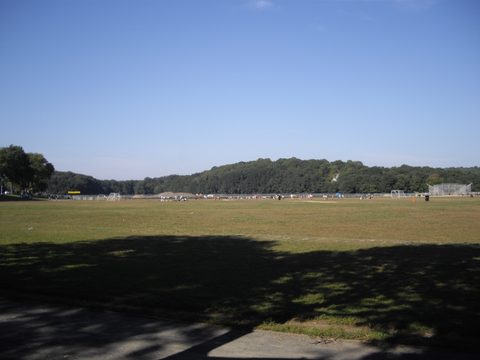
Van Cortlandt Park covers 1,146 acres (464 ha) in the Bronx, the third-largest park in New York City behind the Staten Island Greenbelt at 1,778 acres and Pelham Bay Park at 2,772 acres. Van Cortlandt Lake, the largest freshwater lake in the Bronx, covers 18 acres and runs 4 to 8 feet deep, fed by Tibbetts Brook, a stream originating in Yonkers which runs through a series of culverts before draining into the lake's south edge. Public golf courses, a stone house begun in 1748, a family burial ground, a parade ground, a stadium and named trails share the ground with 301 bird species recorded since 1875 and mammals including white-tailed deer, raccoons, Eastern coyotes and wild turkeys. The Van Cortlandt family sold the property to the City of New York in 1888. NYC Parks owns it and manages it with assistance from the Van Cortlandt Park Alliance.
-
The oldest known surviving house in the Bronx, begun in 1748 and open as a museum since May 28, 1897. Washington and Howe both used it as headquarters.
-
sight
The Van Cortlandt family burial ground, created in 1749. Augustus Van Cortlandt hid city records under it during the Revolutionary War.
-
The oldest public golf course in the United States, opened on July 6, 1895 with nine holes and expanded to eighteen in 1899.
-
sight
Built in 1914 as an eighteen-hole course and now nine. Its driving range and putting green also function as a water treatment plant.
-
sight
The largest freshwater lake in the Bronx, 18 acres and 4 to 8 feet deep, created in 1699 when Jacobus Van Cortlandt dammed Tibbetts Brook.
-
walk
1.5 miles, rated easy, on the former New York and Putnam Railroad railbed; reconstructed in 2019 and 2020.
-
1.1 miles, rated easy to moderate. The Old Croton Trail enters New York City on the eastern side of the park.
-
1.25 miles, rated easy, opened in 1987, passing 13 stone pillars tested for the facade of Grand Central Terminal.
-
walk
1.5 miles, rated moderate, established in 1997 — the park's only east–west trail, connecting the three northern forested areas.
-
1.4 miles, rated moderate to difficult, and the hardest trail in the park: a loop through the rocky forests of its northwestern portion.
-
walk
A sprawling lawn that began as grain fields, used by the National Guard for brigade practice and restored with Croton filtration-plant mitigation funds.
-
160 feet underground beneath the Mosholu driving range, 830 by 550 feet, activated in May 2015 at a final cost of $3.2 billion.
-
sight
Where the Stockbridge Militia was attacked by the Queen's Rangers in August 1778, in the northeast of the park.
-
At the park's southeast corner, built as a construction-mitigation project of the Croton Water Filtration Plant.
-
sight
Added in 1939 on the site of a former swamp; a pool followed in 1970.
What's in the park
The Van Cortlandt House stands in the southwestern corner of the park, near the Riverdale neighborhood: a 2½-story Georgian building with a rubblestone facade, L-shaped, with wings extending along the south and east sides. It is the oldest known surviving house in the Bronx. Keystones above its windows are carved as grotesque masks, several fireplaces are set with Dutch tiles, and a U-shaped stairway in the front hall carries turned balusters. It has been open to the public as a museum since May 28, 1897, and is operated by the National Society of Colonial Dames in the State of New York.
The Van Cortlandt Golf Course and the Mosholu Golf Course sit inside the park, both run by NYC Parks. The Van Cortlandt Golf Course opened on July 6, 1895 as a nine-hole course, expanded to eighteen holes in 1899, and its clubhouse dates to 1902; it is the oldest public golf course in the United States and is frequently called Vanny or Vannie. The park's own article credits Tom Bendelow, nicknamed the "Johnny Appleseed of Golf", with expanding it to 18 holes, and records a renovation in 2016. The clubhouse locker room was a filming location for the 1987 film Wall Street. Mosholu Golf Course was built in 1914, originally designed as an eighteen-hole course and now nine due to road construction; its driving range and putting green also function as a water treatment plant, and it is adjacent to the Woodlawn station on the IRT Jerome Avenue Line. Beneath that driving range, 160 feet underground, is the Croton Water Filtration Plant, which measures 830 by 550 feet — larger than Yankee Stadium — and processes up to 320 million gallons a day.
The Putnam Trail is 1.5 miles and rated easy, following the former New York and Putnam Railroad railbed and connecting to the South County Trailway; it was reconstructed in 2019 and 2020. The Old Croton Aqueduct Trail runs 1.1 miles and is rated easy to moderate; the Old Croton Trail enters New York City on the eastern side of Van Cortlandt Park. The John Kieran Nature Trail, 1.25 miles and rated easy, opened in 1987 and passes 13 stone pillars tested for the facade of Grand Central Terminal. The John Muir Trail, 1.5 miles and rated moderate, was established in 1997 and is the park's only east–west trail, connecting the three northern forested areas. The Cass Gallagher Nature Trail, 1.4 miles and rated moderate to difficult, is the hardest trail in the park: a loop through the rocky forests of the park's northwestern portion, given its current name in 1984 and repeatedly crossing a 3-mile cross-country trail.
Vault Hill, the Van Cortlandt family burial ground, was created in 1749 and holds the remains of Frederick Van Cortlandt. The Parade Ground began as grain fields and was converted into a sprawling lawn, used by the National Guard for brigade practice and later for recreational facilities and concerts; it was restored with construction-mitigation funds from the Croton Water Filtration Plant project, which also paid for the Sachkerah Woods Playground at the park's southeast corner. Van Cortlandt Stadium was added in 1939 on the site of a former swamp, and a pool followed in 1970. In the northeast of the park is Indian Field, where the Stockbridge Militia was attacked in August 1778.
The Van Cortlandts, the Revolution and the city park
Jacobus Van Cortlandt purchased the land from John Barrett around 1691. In 1699 he dammed Tibbetts Brook to power a sawmill and gristmill, creating the mill pond that became Van Cortlandt Lake. Frederick Van Cortlandt began developing the Van Cortlandt House on the property in 1748. He died before the house was finished; his will, signed on October 2, 1749, indicated that the house was almost complete, and he bequeathed the estate to his son Jacobus (James) Van Cortlandt. A family burial ground was created in 1749, later to be known as Vault Hill, and Frederick was buried there.
The property was used during the American Revolution between 1776 and 1783, by both Patriot and British forces. The house served as Washington's headquarters after his troops were defeated in the 1776 Battle of Long Island; the British general William Howe made it his headquarters on November 13, 1776; Washington stayed there again before the Battle of White Plains and returned in 1781 and 1783. In 1781 he came back to strategize with Rochambeau while their troops waited on what is now the Parade Ground and Vault Hill. Augustus Van Cortlandt hid city records under Vault Hill to protect them during the war, turning them over to the new American government afterward.
In August 1778, at Indian Field in the northeast of the park, approximately one mile north of Kingsbridge, the Stockbridge Militia was attacked in a cavalry charge by the Queen's Rangers, a Loyalist unit commanded by Lieutenant Colonel John Graves Simcoe. The militia was a Native American unit of Mohican, Wappinger, Munsee, Tunxis, Shawnee and Housatonic people serving the Continental Army under Jehoiaikim Mtohksin and Abraham Nimham. By most accounts roughly 40 Stockbridge Militia were killed, while the Queen's Rangers suffered 1 cavalryman killed and 3 wounded. Survivors were discharged by Washington's order in September 1778 and paid $1,000.
The family sold the property to the City of New York in 1888 and it was converted to public parkland; the golf course followed on July 6, 1895. Between the 1930s and 1955 Robert Moses directed construction of the Henry Hudson and Mosholu Parkways, fragmenting the park into six pieces. The 1975 New York City fiscal crisis caused much of the park to fall into disrepair. A "Van Cortlandt Park Master Plan 2034" was published in 2014.
Getting there
Woodlawn, at Bainbridge Avenue and Jerome Avenue in Norwood, outside Woodlawn Cemetery, is the northern terminus of the IRT Jerome Avenue Line and is served by the 4 at all times. It opened on April 15, 1918, built by the Interborough Rapid Transit Company as part of the Dual Contracts, and was listed on the National Register of Historic Places following 2005 renovations for its ornamental concrete design. It is not ADA-accessible, and the MTA announced in July 2025 that it would install elevators there. Its connecting buses are the Bx16, Bx34, BxM4 and Bee-Line Routes 4, 20 and 21.
Van Cortlandt Park–242nd Street, at West 242nd Street and Broadway on the border of Fieldston and Kingsbridge, is the northern terminal of its line and is served exclusively by the 1; the next stop to the south is 238th Street. It opened on August 1, 1908 as part of the Contract 1 system, designed by Heins & LaFarge in Victorian Gothic style, and is the only elevated terminal station left in that style from Contract 1. It was added to the National Register of Historic Places on March 30, 2005, reference #05000226. It is not ADA-accessible; an elevator contract was awarded in December 2023, with construction anticipated to complete in 2026. Its connecting buses are the Bx9, BxM3 and Bee-Line Routes 1, 2 and 3.
Bus routes serving the park are the Bx9, Bx10, Bx16 and Bx34; the BxM3 and BxM4 express routes; and Bee-Line Routes 1, 2, 3, 4, 20 and 21.
The New York and Putnam Railroad's main line once ran through the park. Its main-line passenger service ended on May 29, 1958, and the corridor is now the Putnam Trail; the skeletal remains of Van Cortlandt station and a milepost marker, Milepost 6, are still in the park.
Frequently asked questions
- How do I get to Van Cortlandt Park?
- Woodlawn, at Bainbridge Avenue and Jerome Avenue in Norwood, outside Woodlawn Cemetery, is the northern terminus of the IRT Jerome Avenue Line and is served by the 4 at all times; its connecting buses are the Bx16, Bx34, BxM4 and Bee-Line Routes 4, 20 and 21. Van Cortlandt Park–242nd Street, at West 242nd Street and Broadway, is the northern terminal of its line and is served exclusively by the 1; its connecting buses are the Bx9, BxM3 and Bee-Line Routes 1, 2 and 3. Bus routes serving the park are the Bx9, Bx10, Bx16 and Bx34, the BxM3 and BxM4 express routes, and Bee-Line Routes 1, 2, 3, 4, 20 and 21. Neither subway station is ADA-accessible.
- How big is Van Cortlandt Park?
- 1,146 acres (464 ha), which makes it the third-largest park in New York City, behind the Staten Island Greenbelt at 1,778 acres and Pelham Bay Park at 2,772 acres. Between the 1930s and 1955 Robert Moses directed construction of the Henry Hudson and Mosholu Parkways, which fragmented the park into six pieces.
- What is the Van Cortlandt House Museum?
- A 2½-story Georgian house with a rubblestone facade in the park's southwestern corner, the oldest known surviving house in the Bronx. Frederick Van Cortlandt began developing it in 1748 and died before it was finished; his will, signed on October 2, 1749, indicated the house was almost complete, and his son Jacobus (James) inherited it. It was Washington's headquarters after the 1776 Battle of Long Island and General Howe's from November 13, 1776. New York City acquired it in 1888, it served as police and military barracks, and it opened as a museum on May 28, 1897. Its exterior was designated a New York City Landmark on March 15, 1966 and its interior on July 22, 1975.
- Which trails run through the park?
- The Putnam Trail, 1.5 miles and rated easy, follows the former New York and Putnam Railroad railbed and connects to the South County Trailway. The Old Croton Aqueduct Trail runs 1.1 miles and is rated easy to moderate. The John Kieran Nature Trail is 1.25 miles and rated easy, and passes 13 stone pillars tested for the facade of Grand Central Terminal. The John Muir Trail, 1.5 miles and rated moderate, is the park's only east–west trail. The Cass Gallagher Nature Trail, 1.4 miles and rated moderate to difficult, is the hardest trail in the park.
- What happened at Indian Field?
- In August 1778 the Stockbridge Militia — a Native American unit of Mohican, Wappinger, Munsee, Tunxis, Shawnee and Housatonic people serving the Continental Army under Jehoiaikim Mtohksin and Abraham Nimham — was attacked at Indian Field, in the northeast of what is now Van Cortlandt Park, by the Queen's Rangers under Lieutenant Colonel John Graves Simcoe, in a cavalry charge. By most accounts roughly 40 Stockbridge Militia were killed; the Queen's Rangers suffered 1 cavalryman killed and 3 wounded. Survivors were discharged by Washington's order in September 1778 and paid $1,000.
Connected pages
Same region
-
Pelham Bay Park, the Bronx: 2,772 Acres and Thirteen Miles of Shore
· Pelham Bay Park, New York
Van Cortlandt Park's 1,146 acres rank third in New York City, behind the Staten Island Greenbelt and Pelham Bay Park's 2,772 acres.
-
Riverdale, the Bronx: High Ground and Disputed Borders
· Riverdale, New York
Van Cortlandt Park and Broadway form Riverdale's eastern border, and the Van Cortlandt House stands in the park's southwestern corner, near Riverdale.
What travelers think
Log in to react.
No reviews yet.