.jpg)
Sallustiano, Rome: rione XVII, Bernini's Saint Teresa and the Gardens of Sallust
Sallustiano, Rome
Pictures from Sallustiano
See all 1 photos →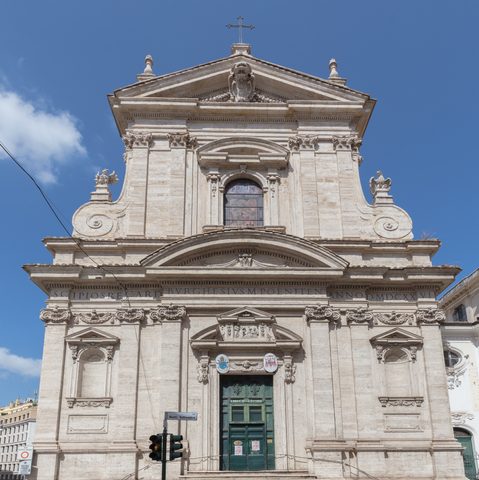
Sallustiano is rione XVII of Rome, Roma Capitale's toponymic code 117. Roma Capitale's Annuario statistico 2022 gives it 0,2 km² and 2.191 residents at 31 December 2021. It was created in 1921, one of seven rioni instituted by the Giunta Municipale and each given a coat of arms. Italian Wikipedia describes it as two zones — a reasonably residential strip between via Piave and via Piemonte/via Salandra, and the rest, down to via Bissolati, «praticamente disabitata e con un'alta concentrazione di uffici e ministeri», practically uninhabited and thick with offices and ministries. That is the honest shape of the place. What brings a traveller here is one chapel: Bernini's Ecstasy of Saint Teresa, in Santa Maria della Vittoria. Around it are the sunken Gardens of Sallust, two more churches, a state museum of fashion and decorative arts, and a street of turn-of-the-century villini, most of them now offices.
-
Carlo Maderno built it 1608–1620; the Cornaro Chapel holds Bernini's marble and gilt-bronze Ecstasy of Saint Teresa of Ávila, executed 1647–1652, watched by the Cornaro family from what read as theatre boxes.
-
A domed circular hall and a semicircular frescoed residential block survive 14 metres below piazza Sallustio, on ground Sallust bought in 44 BC and Tiberius took into imperial hands; the Aula itself is hired out for events rather than opened to callers.
-
Five rooms of the villino's own furniture, tapestries and ceramics alongside Italian fashion and costume — Capucci, Valentino, Mila Schön, Gattinoni — left to the State in 1972 by Princess Blanceflor de Bildt Boncompagni and opened in 1995.
-
Begun 1906 to Tullio Passarelli's design and consecrated in 1910, brick outside and travertine block within, with a 30-metre campanile and a Vegezzi-Bossi organ of 1910–11 donated by Margherita of Savoy.
-
Aristide Leonori built it 1914–1916 behind a wrought-iron railing on via Piave; the windows above the matroneum are Munich glass, and the body of the congregation's foundress, Rafaela Porras y Ayllón, lies in a chapel on the left.
-
sight
Raised in 1750 for Cardinal Silvio Valenti Gonzaga and bought by Napoleon's sister in 1816, it is now the French embassy to the Holy See and shut to callers; the orange trees along via XX Settembre are a memento of its orangery.
-
sight
Built 1908–1914 at the wish of Francesco Cocco-Ortu, with three Latin inscriptions in the frieze and an atrium of twenty-two red Baveno granite columns; it is a working ministry, so what you see is the exterior and the gates by Alberto Gerardi.
-
sight
Ernesto Basile built it 1904–1906 for the family of Antonio Starabba di Rudinì: a severe block set back from the street, with Liberty ornament in the frieze, window frames and Antonio Ronconi's wrought iron; it holds a diplomatic chancery and does not admit visitors.
What the rione is, and where its edges run
Italian Wikipedia gives the rione's arms as a gold mirror of Venus Erycina on blue — «Di azzurro allo specchio di Venere Ericina d'oro» — alluding to the goddess's temple in the Gardens of Sallust, citing Carlo Pietrangeli's 1953 article on the arms of the rioni of Rome.
The same article states the borders in one sentence: «Mura aureliane fino a piazza Fiume (esclusa) con il quartiere Salario; via Calabria-via Boncompagni-via Lucullo-via Friuli con il rione Ludovisi; via Leonida Bissolati-largo Santa Susanna con Trevi e via XX Settembre fino a Porta Pia (esclusa) con il rione Castro Pretorio.» In English: the Aurelian Walls as far as piazza Fiume, which is excluded, with the quartiere Salario; via Calabria–via Boncompagni–via Lucullo–via Friuli with the rione Ludovisi; via Leonida Bissolati–largo di Santa Susanna with Trevi; and via XX Settembre as far as Porta Pia, which is excluded, with the rione Castro Pretorio. The Ludovisi article describes the same staircase of streets in reverse, so the two rioni carved out of one estate do not in fact disagree about where the line runs. Two consequences are worth carrying in your head: Porta Pia is outside this rione, and so is piazza Fiume.
The history, as Italian Wikipedia tells it: this was part of the Augustan Regio VI Alta Semita; the Horti Sallustiani and a temple of Venus Erycina stood here; via Piave follows the line of the via Salaria Nova running out of the former Porta Collina toward the demolished Porta Salaria. Alaric's Visigoths cut the aqueducts and sacked Sallust's villa in 410, after which the ground between the Pincio and the Quirinal emptied out. There was a partial revival in the sixteenth century with the opening of via Pia and Sixtus V's Acqua Felice, but the zone stayed thinly populated and formed part of the rione Trevi, holding large villas — villa Barberini, villa Mandosi, villa Cicciaporci. It was built up after 1870 and constituted as its own rione in 1921. Via XX Settembre itself is the ancient Alta Semita line, opened in the sixteenth century as via Pia and renamed for the date of the 1870 breach; it is context here and not a place in this corpus, because it is filed under three different rioni by its own sources.
Italian Wikipedia states that a surviving green space of the rione is the ground against the walls between Porta Pia, via Augusto Valenziani and via Piave — the grounds of the former villa Cicciaporci Valenti Gonzaga, now known as villa Paolina. It is inside an embassy compound and you cannot walk in it.
Sallustiano falls in Municipio I. No source states the heritage protection status of any building in the rione, so nothing here says a building is protected.
Villini, ministries and embassies
The plots north of via Boncompagni were subdivided out of the Villa Ludovisi estate from 1883 and built up as detached villini around the turn of the twentieth century. Italian Wikipedia records villino Rattazzi at via Boncompagni 8–10, of about 1900, by Giulio Podesti for the family of Urbano Rattazzi, third prime minister of the Kingdom of Italy; villino Pignatelli at no. 12, of 1898, by Giuseppe Mariani for Duke Giuseppe di Terranova Pignatelli; villino Rasponi at no. 14, of 1901, by Carlo Pincherle, the father of Alberto Moravia, for Count Giulio Rasponi Murat; villino Levi at no. 28 on the corner of via Nerva, of about 1890, by Augusto Giustini for Baron Giorgio Levi delle Trezze and enlarged in 1905 by Pincherle; villino Casati at via Piemonte 51, of 1906, built by Pincherle to a design by Achille Majnoni d'Intignano for the Casati Stampa di Soncino and the Roman residence of the Marchesa Luisa Casati; and villino Maccari on via Sallustiana, of 1902, by Augusto Fallani for the painter Cesare Maccari. Most are now offices, and none is open to visitors. Italian Wikipedia cites no sources for the Pignatelli, Rasponi and Levi articles.
Two larger buildings belong to the same passage. Italian Wikipedia records Palazzo Fiat on via Calabria, of 1924–26, in the barocchetto manner, by Enrico Del Debbio; and the Palazzo della Società Beni Stabili on via Piemonte at the corner of via Giosuè Carducci, of 1957, modernist, by the engineer Cesare Pascoletti. Neither is a visitor place either.
Note that via Boncompagni, via Calabria, via Lucullo and via Friuli are the declared line between Sallustiano and Ludovisi. Buildings on them can sit on either side, and this guide claims buildings rather than streets.
The rest of the rione is government and diplomacy. Alongside the Ministry of Agriculture on via XX Settembre and the Ministero dell'ambiente e della sicurezza energetica at via Sallustiana 53, boundary tests put a cluster of diplomatic missions inside these few blocks: the Embassy of France to the Holy See at Villa Paolina on via Piave, the chancery and consular section of the Embassy of Japan to the Italian State in the villino Rudinì on via Quintino Sella, the Embassy of Eritrea on via Boncompagni, and the embassies of Cape Verde and of Timor-Leste to the Holy See on via Giosuè Carducci. None of them is a visitor place, and one point matters more than any of them individually: a diplomatic mission stands on the territory of the state that hosts it. Every one of these buildings is on Italian soil in the rione Sallustiano. None is foreign territory, none is Vatican territory, and none is one of the Lateran Treaty's extraterritorial properties — an embassy accredited to the Holy See is not in the Vatican, it is on via Piave.
Getting there
Sallustiano is 0,2 km² of Rome between the Aurelian Walls and via Leonida Bissolati. If you are trying to find it on the ground, use the four edges the rione's own description gives: the walls down to piazza Fiume, which is outside it; via Calabria, via Boncompagni, via Lucullo and via Friuli on the Ludovisi side; via Leonida Bissolati and largo di Santa Susanna on the Trevi side; and via XX Settembre as far as Porta Pia, which is outside it, on the Castro Pretorio side. Santa Maria della Vittoria stands on the north side of via XX Settembre, at the corner of largo di Santa Susanna, and is the easiest fixed point in the rione.
For public transport, the only measured distance published by any source is the one on the Horti Sallustiani venue's own website, which gives under Come raggiungerci «Fermata Metro A Barberini-Repubblica, 800 mt» — metro line A at Barberini–Repubblica, 800 metres. No bus route numbers are given here, because none was sourced. The same page also gives a walking time, which this guide does not repeat: walking times are not something a guide can check for you.
One thing this guide will not do is tell you how long anything takes or how close anything feels. Where a distance is stated it is a measured figure from the source named beside it.
Frequently asked questions
- Where is Bernini's Ecstasy of Saint Teresa, and when can I see it?
- In the Cornaro Chapel of Santa Maria della Vittoria, Via XX Settembre 17, 00187 Roma. The Discalced Carmelite province of central Italy, whose community serves the church, publishes these hours: the church open 6.45–12.00 and 16.00–19.00, and on Sundays 9.00–12.00 and 16.00–18.00. Visiting hours are given separately as 8.00–12.00 and 16.00–18.00 on weekdays and 9.00–12.00 and 16.00–18.00 on Sundays. The same page states that visits are not permitted during services and asks guided groups to use audio headsets. Hours as published by the province and checked on 2 September 2026.
- Can I go inside the Gardens of Sallust?
- Not on a walk-in basis. The Aula is run as a private venue for hire. Its own website advertises corporate events, conferences and meetings, receptions, gala dinners, fashion shows, art exhibitions, music events and photographic and film shoots, and offers an enquiry form rather than opening hours; no public opening hours and no admission price are published. Enquiries: 06 4201 1597, or eventi@hortisallustiani.it. The remains themselves lie 14 metres below street level and Italian Wikipedia says they can still be seen in piazza Sallustio.
- Is Villa Bonaparte open to visitors, and is it French territory?
- It is not open, and it is not French territory. Villa Paolina, also called Villa Bonaparte, is the seat of the Embassy of France to the Holy See, with its entrance on via Piave. It is a diplomatic mission standing on Italian soil in the rione Sallustiano: it is not Vatican territory, it is not French territory, and it is not one of the Lateran Treaty's extraterritorial properties. No source states any public opening, and the garden inside the compound is not a public park.
- What are the Museo Boncompagni Ludovisi's opening hours and admission?
- No sourced opening hours or admission price are given here. Italian Wikipedia states hours and prices for the museum but cites no source for them; they are not repeated. The address is Via Boncompagni 18.
- Is Porta Pia in Sallustiano?
- No. The rione's own border description runs along via XX Settembre «fino a Porta Pia (esclusa)» — as far as Porta Pia, excluded — and boundary tests put the gate outside this rione. Porta Pia belongs to the rione Castro Pretorio. Sallustiano does touch the Aurelian Walls, but this guide names no stretch of the walls as a place of its own: the wall line is a boundary here, and a boundary is not a place inside the thing it bounds.
- Santa Maria della Vittoria and Santa Susanna face each other. Are both in this rione?
- No. Santa Maria della Vittoria is in Sallustiano — boundary tests put both the church building and Roma Capitale's own published point for it inside the rione, and it stands on the north side of via XX Settembre. Santa Susanna is not in Sallustiano, and this guide does not state which rione it is in, because the sources that were checked do not agree. Largo di Santa Susanna itself is not claimed here either: Italian Wikipedia says the square lies partly in Sallustiano and partly in Trevi.
Connected pages
Nearby
-
Ludovisi, Rome: Via Veneto, the Capuchin Crypt and the Villa That Was Sold Off
· Ludovisi, Rome
Ludovisi and Sallustiano were carved from the same Villa Ludovisi estate. Via Calabria, via Boncompagni, via Lucullo and via Friuli are the line between them.
-
Castro Pretorio, Rome: The Baths of Diocletian, Porta Pia and the Quarter Built After 1870
· Castro Pretorio, Rome
Via XX Settembre is the border between the two rioni, and Sallustiano's own boundary text runs along it as far as Porta Pia, which is Castro Pretorio's.
Same region
-
Prati, Rome: the Palazzaccio, a Caryatid Fountain and the Only Rione Outside the Walls
· Prati, Rome
Prati is rione XXII in Roma Capitale's toponymic list of Rome's 22 rioni; Sallustiano is rione XVII.
-
Pinciano, Rome: Villa Borghese, the Galleria Borghese and the academies of Valle Giulia
· Pinciano, Rome
The rione inside the walls east of Porta Pinciana, along the same stretch of Corso d'Italia.
See also
-
3 Days in Rome: Colosseum Arena Floor, the Vatican, and the Back Streets of Monti
· Rome, Italy
A three-day Rome itinerary, for fitting one Bernini chapel and a sunken Roman garden into a wider first visit.
What travelers think
Log in to react.
No reviews yet.