
Prati, Rome: the Palazzaccio, a Caryatid Fountain and the Only Rione Outside the Walls
Prati, Rome
Pictures from Prati
See all 1 photos →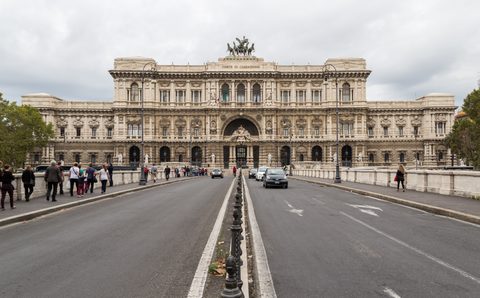
Prati is the twenty-second and last of Rome's rioni, and it lies outside the city walls - outside the Aurelian, the Gianicolensi and the Leonine circuits alike. Roma Capitale's Annuario statistico 2022 gives it the toponymic code 122; Italian Wikipedia's table of the rioni, citing comune.roma.it, records 14,631 residents on 1.2743 square kilometres. It is a made quarter rather than a grown one: flood-plain known as Prati di Castello into the 1880s, laid out on a grid after a building convention of 1873, and constituted a rione only in 1921. Almost every street, square and embankment road in it carries a dated council act in Roma Capitale's own toponymy register, and this guide quotes those acts rather than guidebooks. The stops are a colossal courthouse, a caryatid fountain, two neo-Gothic churches and a museum of the souls in Purgatory.
-
Guglielmo Calderini's travertine-faced block for the Corte suprema di cassazione: first stone laid 14 March 1889, inaugurated 11 January 1911, with Ettore Ximenes's bronze quadriga on the Tiber front.
-
sight
Nicodemo Severi laid out the central garden between 1895 and 1911; the Waldensian temple and the Teatro Adriano both stand on the square.
-
Stefano Galletti executed it between 1885 and 1895, with four colossal bronze groups at the foot of the pedestal, and it was unveiled on 24 September 1895 for the twenty-fifth anniversary of 20 September 1870.
-
Built from June 1911 to 1913 by Emanuele Rutelli with Paolo Bonci, decorated inside by Paolo Paschetto and inaugurated on 8 February 1914; Sunday worship is at 11.00.
-
The engineer Giuseppe Gualandi took northern Gothic as his model on the embankment; the foundation stone was blessed in 1894 and the church consecrated on 17 May 1921.
-
One room off the sacristy holding what Victor Jouët gathered across Italy, France, Belgium and Germany after a fire in the building on 15 September 1897, including burn-marked garments of 1731 and 1789.
-
Attilio Selva's marble and travertine work of 1928: four kneeling nude figures hold a quatrefoil catino crowned by a pine cone, and the argument over them delayed the unveiling set for 21 April 1928.
-
Built at the wish of Leo XIII for his priestly jubilee, with works carried out between 1891 and 1898 and a mosaic of the five continents of 1898 across the façade.
-
The rione's second neo-Gothic church, entrusted to the Dominicans, a parish since 1912 and completed 1912-16 to Giuseppe Ribaldi's design, with a mosaic rose window behind its iron street gate.
-
walk
The shopping street crosses the whole rione from piazza della Libertà to piazza del Risorgimento, carrying 272 conforming street numbers on the national address register, certified 16 December 2022.
-
sight
Luca Carimini built it in 1890 for a family of Alsatian origin; its lungotevere dei Mellini front carries an attic loggia of three serliane over a balustraded balcony on four composite columns, with the Gran Caffè Esperia beneath.
-
Marcello Piacentini's rough tufa and travertine building for Carlo Delcroix's association, first block 1925 to 1928 and a second added in 1936, inaugurated unfinished on 4 November 1928.
-
Free admission, Tuesday to Sunday 09.00 to 13.00, on a route through 26 rooms that begins with the Regie Patenti of 13 July 1814 and runs to the Resistance and the Liberation.
-
A bakery and pastry shop at via Tacito 76/78, listed by Roma Capitale's tourism service among the members of the Associazione dei Negozi Storici di Eccellenza.
How Prati was made
The ground was the Horti Domitii, later the Prata Neronis and then the Prata Sancti Petri, and into the 1880s it was an undeveloped flood-plain called Prati di Castello. Italian Wikipedia records that in 1873 the Comune signed a building convention under pressure from Cardinal Francesco Saverio de Mérode, a large landowner here, that the area sat outside the master plan of that year, and that it was folded into the plan of 1883. The Corte di cassazione's own history page gives the frame from the other side: Rome had about 200,000 inhabitants in 1871, and the new quarters built for the capital - it names Prati, Esquilino and Castro Pretorio - went up in a manner contemporaries called piemontese. Fill was trucked in to lift the ground above the Tiber's flood level, and the clay beneath forced repeated consolidation works under the Palazzo di Giustizia. Two aggregators, Italian Wikipedia and Roma Segreta, both give 20 August 1921 as the date of the municipal deliberation that made Prati a rione; no source gives the deliberation itself, so this guide reports the date as theirs. The register corroborates the lateness sideways: its 1914 entry for piazza Cola di Rienzo still reads Q. PRATI, quartiere, while every post-1954 note reads R. PRATI. The rione's arms are blazoned d'azzurro al mausoleo d'Adriano d'argento - Hadrian's mausoleum in silver on blue - which is a building in the neighbouring rione of Borgo, not in this one. Prati's western edge is formed by viale dei Bastioni di Michelangelo and via Leone IV. Both are Italian streets within the rione. Nothing on the far side of the wall belongs to Prati or to any rione.
The street names, and the register that dates them
Prati's street list is not an accumulation; it is a programme, written in one go and dated. Roma Capitale's toponymy register carries, for each named public space, every council act that named or re-limited it, with a note giving the rione - which is why this page can date via Cola di Rienzo, piazza Cavour, piazza dei Quiriti, piazza della Libertà and piazza dell'Unità all to one act, Prop. al CC n. 96 of 8 May 1885, and the three embankment roads to acts of 1887 and 1911. The names themselves were drawn from republican and imperial Rome, from the classical writers and from the Risorgimento, and the effect was deliberately anticlerical in a quarter built up against the Vatican wall: Attilio Regolo, Boezio, Caio Mario, Cassiodoro, Catone, Catullo, Cicerone, Crescenzio, Duilio, Ezio, Fabio Massimo, Germanico, Lucrezio Caro, Marcantonio Colonna, Orazio, Ottaviano, Ovidio, Paolo Emilio, Plinio, Pompeo Magno, Pomponio Leto, Properzio, Silla, Tacito, Terenzio, Tibullo, Triboniano, Ulpiano, Varrone, Vespasiano and Virgilio, beside the battle names Damiata, Famagosta, Fornovo, Gavinana, Lepanto, Otranto, Vigliena, Cosseria and Barletta. The register files via Cola di Rienzo under the group Personaggi e avvenimenti storici medioevali e moderni and via dei Gracchi under Antica Roma. The same register records that Prati sits in Municipio I, under Del. AC n. 11 of 11 March 2013, the amalgamation of the municipi, and Del. G. Cap. n. 392 of 8 November 2013. One caution about it: the register publishes a single representative point for each toponym, not a shape, so it settles which acts named a street and not exactly where a long street ends.
Getting there
Line A of the metro runs along viale Giulio Cesare with two stations inside the rione, Lepanto and Ottaviano. Italian Wikipedia records that both opened on 16 February 1980 with the first Anagnina-Ottaviano section, and that Ottaviano remained the north-western terminus until 29 May 1999, when the line was extended to Valle Aurelia. Ottaviano is often described as serving the rione across the southern boundary; the station itself is in Prati. From the east bank, three bridges land in Prati. Ponte Regina Margherita, of about 103 metres, comes in at piazza della Libertà. Ponte Giacomo Matteotti, 138.6 metres, crosses at the northern corner of the rione. Ponte Pietro Nenni carries line A across the water on its only surface stretch, the tracks rising at via Cesare Beccaria and dropping underground again between viale Giulio Cesare and via degli Scipioni. Roma Capitale records each of these crossings as lying in more than one unit of the city, so none of them is Prati's alone. Via Cola di Rienzo runs the width of the rione from piazza della Libertà at the river to piazza del Risorgimento at the other end.
Frequently asked questions
- Which rione is Prati, and when did it become one?
- Prati is R. XXII, the twenty-second and most recent of the rioni, with the toponymic code 122 in Roma Capitale's Annuario statistico 2022. Italian Wikipedia and Roma Segreta both give 20 August 1921 as the date of the municipal deliberation that constituted it; neither is the act itself. Roma Capitale's toponymy register supports the late date from the side: its 1914 entry for piazza Cola di Rienzo still calls the area a quartiere.
- Is Prati part of the Vatican?
- No. Prati is an Italian rione and Vatican City is a sovereign state that belongs to no rione. Prati's western edge is formed by viale dei Bastioni di Michelangelo and via Leone IV. Both are Italian streets within the rione. Nothing on the far side of the wall belongs to Prati or to any rione. The one embassy building in this guide, the Villino Vivante, houses the Embassy of the Czech Republic; diplomatic premises are inviolable but they are not foreign soil.
- What are the opening hours of the Carabinieri museum?
- The Arma dei Carabinieri states that the museum opens Tuesday to Sunday, 09.00 to 13.00, and closes on Mondays, 1 and 6 January, Easter Sunday and Easter Monday, 1 May, 15 August, 1 November, 8 December, 25 and 26 December. Admission is free. The Arma describes a chronological and thematic route through 26 exhibition rooms, beginning with the Regie Patenti of 13 July 1814.
- Can you visit the Museo delle anime del Purgatorio?
- The museum is one room off the sacristy of the Sacro Cuore del Suffragio, at lungotevere Prati 12. No opening hours and no admission arrangements could be sourced for it: neither the church nor the museum has a website that resolves, so this guide publishes no times. The same applies to the Museo degli orrori at via dei Gracchi 260.
- Why are all the streets named after Romans and battles?
- Because they were named in one programme, not over centuries. Roma Capitale's toponymy register attributes most of the rione's squares and main streets to a single act, Prop. al CC n. 96 of 8 May 1885, and the names were drawn from republican and imperial Rome, the classical writers and the Risorgimento - an anticlerical choice in a quarter laid out along the Vatican wall.
- Which metro stations serve Prati?
- Lepanto and Ottaviano, both on line A, both on viale Giulio Cesare, and both opened on 16 February 1980. Ottaviano was the line's north-western terminus until 29 May 1999. Line A reaches the rione over ponte Pietro Nenni, which carries that line above ground.
Connected pages
Nearby
-
Vatican City: St Peter's, the Vatican Museums and the Sistine Chapel
· Vatican City
The quarter behind the Museums entrance, reached from the same Metro line A stations, Ottaviano and Cipro.
-
Campo Marzio, Rome: the Spanish Steps, piazza del Popolo, the Augustan monuments and the Pincio
· Campo Marzio, Rome
Across the river. Ponte Cavour lies in both rioni, and Prati's guide covers the far bank.
-
Ponte, Rome: the bridge the rione is named for, Palazzo Altemps and via dei Coronari
· Ponte, Rome
Ponte Umberto I crosses into Prati, which holds three further Tiber bridges of its own.
Shared history
-
Castro Pretorio, Rome: The Baths of Diocletian, Porta Pia and the Quarter Built After 1870
· Castro Pretorio, Rome
The Corte di cassazione's history page names Prati, Esquilino and Castro Pretorio together as the quarters built for Rome after 1871.
Same region
-
Sallustiano, Rome: rione XVII, Bernini's Saint Teresa and the Gardens of Sallust
· Sallustiano, Rome
Sallustiano, like Prati, is in Municipio I; its plots north of via Boncompagni were subdivided out of the Villa Ludovisi estate from 1883.
-
Ludovisi, Rome: Via Veneto, the Capuchin Crypt and the Villa That Was Sold Off
· Ludovisi, Rome
Ludovisi was built out of the Villa Ludovisi estate, subdivided from 1883 - the same decade in which Prati's grid was laid out and named.
-
Castro Pretorio, Rome: The Baths of Diocletian, Porta Pia and the Quarter Built After 1870
· Castro Pretorio, Rome
Prati is rione XXII in Roma Capitale's list of Rome's 22 rioni; Castro Pretorio is rione XVIII.
-
Flaminio, Rome: MAXXI, the Teatro Olimpico and the left bank of the Tiber
· Flaminio, Rome
Across the Tiber by ponte Giacomo Matteotti and ponte Pietro Nenni.
See also
-
3 Days in Rome: Colosseum Arena Floor, the Vatican, and the Back Streets of Monti
· Rome, Italy
A three-day Rome itinerary. Its metro connections run on line A, whose Ottaviano and Lepanto stations are both in Prati.
What travelers think
Log in to react.
No reviews yet.