.jpg)
Ludovisi, Rome: Via Veneto, the Capuchin Crypt and the Villa That Was Sold Off
Ludovisi, Rome
Pictures from Ludovisi
See all 1 photos →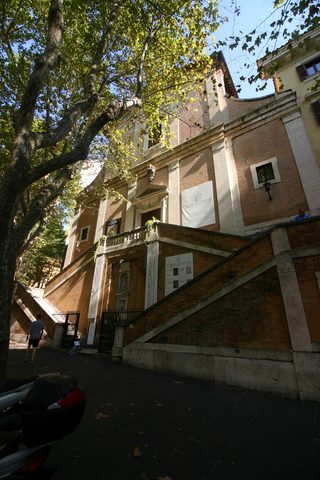
Ludovisi is one of Rome's rioni. Roma Capitale's Annuario statistico 2022 gives it the toponymic code 116, and Roma Capitale's roster of rioni places it in Municipio I. Almost all of it was built after 1886, when the Boncompagni Ludovisi heirs, the Comune and the Società Generale Immobiliare signed the convention that put the park of Villa Ludovisi to subdivision; Italian Wikipedia's article on Palazzo Margherita says the quarter that replaced the park was constituted as a rione in 1921. What stands there now is a grid of wide streets around via Vittorio Veneto, built up with hotels, ministries, embassies and villini, and a great deal of it cannot be entered: the United States Embassy occupies Palazzo Margherita, and Roma Capitale says plainly that it is closed to the public. What you can go into here is mostly churches, one ossuary crypt and one Swiss cultural institute.
-
Cardinal Antonio Barberini blessed the first stone on 4 October 1626; one nave and five chapels a side, with paintings by Guido Reni, Pietro da Cortona and Domenichino.
-
Five chapels decorated with the skulls and bones of about 4,000 friars, gathered between 1528 and 1870, on a ticket of their own; hours change, so check the museum's site.
-
sight
Gaetano Koch built it on the ground of the villa the Boncompagni Ludovisi were subdividing; it housed the Queen Mother Margherita until 1926 and is now the United States Embassy, closed to the public and seen only from outside.
-
sight
The building of Villa Ludovisi that survives intact, with Guercino's Aurora on the salone vault; it is private, and no source establishes whether it can be entered.
-
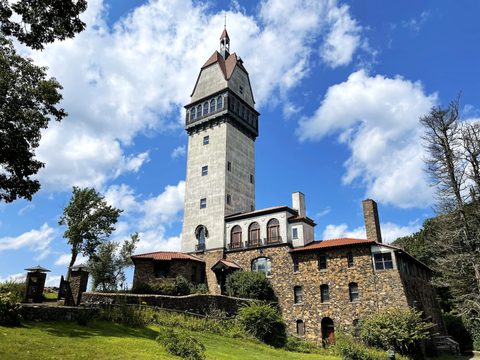
Raised 1903-1905 on an artificial hill of spoil from the digging of via Ludovisi, with a 26-metre Torre Belvedere; the Swiss Institute runs guided visits inside, by booking only.
-
tour
Inaugurated 1932 as the Palazzo delle Corporazioni, with Sironi's Carta del Lavoro window and Prini's bronze doors on via Veneto; visits are by appointment, arranged at least fifteen days ahead.
-
Irish Franciscans took it two years after the 1622 foundation and own it still; Bizzaccheri built the façade, portico and double stair in 1704-1705, and the De Sylva chapel was remodelled to Bernini's design.
-
Aristide Leonori's church of 1908, with Villani's 1929 apse mosaic; the Paulist Fathers arrived on 1 August 2017 and all Masses are in English.
-
Opened in 1922 to a design by Wilhelm II's court architect, with an apse mosaic of the Tree of Life, a font modelled on Reykjavík's and a Steinmeyer organ of 1930.
Villa Ludovisi, and what happened to it
Everything in this rione begins with a garden that no longer exists. Italian Wikipedia records that Cardinal Ludovico Ludovisi, nephew of Gregory XV, bought the Villa Orsini in 1622 and enlarged it with adjoining properties, over the ground of the Horti Sallustiani; Roma Capitale's via Veneto page instead dates his purchase of the Horti land to 1621. The buildings were designed by Domenichino, who is credited with at least part of the gardens too on the strength of Bellori (1672), Malvasia (1678), Sebastiani (1683) and Milizia (1768); later writers attribute the gardens instead to André Le Nôtre, on the strength of Milizia's own Memorie of 1781. Italian Wikipedia presents that as an unsettled scholarly dispute.
The villa's extent is reported variously: Italian Wikipedia's article on the villa gives 30 hectares, its article on the rione says the 1886 convention put about 25 hectares of park to subdivision, and the Boncompagni Ludovisi family's own archive at villaludovisi.org gives 89.6 acres. Subdivision was decided in 1883, and Italian Wikipedia's articles on the villa and on the rione both date the convention with the Comune and the Società Generale Immobiliare to 1886, signed sotto gli auspici del sindaco di Roma, duca Leopoldo Torlonia. Its article on Palazzo Margherita dates that convention to 1883 instead.
The gardens, the casini and the palazzo were mostly not spared. Italian Wikipedia says the cardinal's collection ran to more than 450 antique sculptures, that a hundred or so were bought by the Italian state in 1910 and first placed in the Piccolo Chiostro at Santa Maria degli Angeli, and that the collection is not in Ludovisi. The Trono Ludovisi was not part of that collection: Italian Wikipedia records that it was found in 1887, during the destruction of the villa. What survives on the ground is the Casino dell'Aurora, and the trees of two gardens.
Via Veneto
Via Vittorio Veneto, universally called via Veneto, climbs from Piazza Barberini to Porta Pinciana. Italian Wikipedia files the street under two rioni, Colonna and Ludovisi, and states that along its opening stretch the street separates the one from the other; its upper length runs through Ludovisi. Roma Capitale dates the street's creation to 1894, when it was laid out as a broad passeggiata Umbertina during the building-over of Villa Ludovisi; Italian Wikipedia's rione article instead says the street was completed in 1906. It was renamed for the battle of Vittorio Veneto by resolution of the Giunta Municipale, no. 37 of 25 October 1919. Roma Capitale records that the street's international fame rests on the Dolce Vita, and states that Fellini rebuilt via Veneto in the studios at Cinecittà rather than filming on it.
Roma Capitale records that the Hotel Excelsior on via Veneto was inaugurated in 1906 by Baron von Pfyffer, the owner of the Grand Hotel, among the first-class hotels built along the new street. Via Veneto ends at the Aurelian Walls, at the largo named for Federico Fellini. No referenced source gives a length for the street; the figure that circulates is an unreferenced Wikipedia infobox value. Roma Capitale publishes a via Veneto address for Porta Pinciana together with a coordinate that falls in the quartiere Pinciano, and Italian Wikipedia's boundary description makes the walls up to that gate the rione's edge rather than something inside it.
Getting there
Via Veneto climbs from Piazza Barberini to Porta Pinciana, so arriving at the bottom means walking up and leaving from the top means walking down.
Four of the five borders run down the middle of a street, which is worth knowing before you trust a map pin. Italian Wikipedia describes the perimeter as the Aurelian Walls up to Porta Pinciana with the quartiere Pinciano; via di Porta Pinciana and via Francesco Crispi with Campo Marzio; via degli Artisti, via di Sant'Isidoro and via Veneto with Colonna; via di San Basilio with Trevi; and via Friuli, via Lucullo, via Boncompagni and via Calabria as far as piazza Fiume, excluded, with Sallustiano. The Sallustiano article gives the same line from the other side. On via Boncompagni the odd numbers are Ludovisi and the even numbers Sallustiano: St Patrick's, at no. 31, is in this rione, and the Museo Boncompagni Ludovisi, at no. 18, is not.
Frequently asked questions
- Can you go inside Palazzo Margherita?
- No. Roma Capitale states that the palace is closed to the public and can be seen only from outside. It is the diplomatic mission of the United States in Italy: it stands on Italian soil and is subject to Italian law, and its premises are inviolable under the Vienna Convention on Diplomatic Relations, which is an obligation on Italy rather than a transfer of sovereignty. The palace is not United States territory.
- What are the opening hours of the Capuchin crypt?
- The museum's own site gives the hours as every day 09:30-13:30 and 14:30-18:30, with last admissions at 12:30 and 17:30, and the telephone as 06 88803695. The same page says the museum closes at 13:30 on Holy Saturday, 2 November, 24 December and 31 December, and does not open on Easter Sunday, 25 December or 1 January. Hours change; check the museum's site before going.
- Can you visit the Casino dell'Aurora?
- The building is private. Italian Wikipedia records that it was put up for auction after an inheritance dispute, that every auction held between January 2022 and January 2023 drew no bidder, that Princess Rita Boncompagni Ludovisi was evicted by court order on 20 April 2023, and that in July 2023 the heirs agreed to sell it privately instead. Whether and on what terms it can be visited is not established by any source. The family archive at villaludovisi.org still describes the Princess as living there and is out of date on that point.
- Is the Museo Boncompagni Ludovisi in Ludovisi?
- No, despite the name. It is at Via Boncompagni 18, in the Villino Boncompagni Ludovisi, and via Boncompagni is the boundary street: the even numbers are in Sallustiano. Italian Wikipedia files the museum under its Sallustiano category.
- Why does one small rione have so many foreign churches?
- Two of them are national churches, one is owned by an Irish order, and one is a foreign-language congregation. Italian Wikipedia records that Sant'Isidoro a Capo le Case passed to the Irish Franciscans two years after its foundation and that they own it still; that San Patrizio became the national parish of Americans resident in Rome on 1 August 2017, when the Paulist Fathers moved into it; and that San Marone is the national church of Lebanon, served by Maronites of Lebanon in the Antiochene rite in Arabic. The Lutheran Christuskirche on via Sicilia is the fourth, built to the design of Wilhelm II's court architect and run by a congregation whose own site is in German and Italian.
- Was La Dolce Vita filmed on via Veneto?
- Roma Capitale ties the street's international fame to the Dolce Vita, and states that Fellini rebuilt via Veneto in the studios at Cinecittà rather than filming on the street itself. Italian Wikipedia records the Cafe de Paris, one of the cafes the film made famous, as closed in 2008.
Connected pages
Nearby
-
Sallustiano, Rome: rione XVII, Bernini's Saint Teresa and the Gardens of Sallust
· Sallustiano, Rome
Via Boncompagni is the line between the two rioni, and the Museo Boncompagni Ludovisi, at no. 18, is on Sallustiano's side of it.
-
Campo Marzio, Rome: the Spanish Steps, piazza del Popolo, the Augustan monuments and the Pincio
· Campo Marzio, Rome
The neighbour east of via di Porta Pinciana and via Francesco Crispi.
-
Pinciano, Rome: Villa Borghese, the Galleria Borghese and the academies of Valle Giulia
· Pinciano, Rome
The rione inside the walls at Porta Pinciana, reached through the gate at the end of Corso d'Italia.
Shared history
-
Castro Pretorio, Rome: The Baths of Diocletian, Porta Pia and the Quarter Built After 1870
· Castro Pretorio, Rome
The Ludovisi antique sculptures were first placed in the Piccolo Chiostro at Santa Maria degli Angeli, which stands in Castro Pretorio.
Same region
-
Prati, Rome: the Palazzaccio, a Caryatid Fountain and the Only Rione Outside the Walls
· Prati, Rome
Another Rome rione guide; Prati lies on the right bank of the Tiber.
-
Castro Pretorio, Rome: The Baths of Diocletian, Porta Pia and the Quarter Built After 1870
· Castro Pretorio, Rome
Ludovisi is rione XVI in Roma Capitale's list of Rome's 22 rioni; Castro Pretorio is rione XVIII.
See also
-
3 Days in Rome: Colosseum Arena Floor, the Vatican, and the Back Streets of Monti
· Rome, Italy
A three-day Rome itinerary; via Veneto and the Capuchin crypt sit above the Barberini end of its centro storico walking loop.
What travelers think
Log in to react.
No reviews yet.