
Trevi, Rome: the Fountain, the Acqua Vergine and the Quirinal
Trevi, Rome
Pictures from Trevi
See all 1 photos →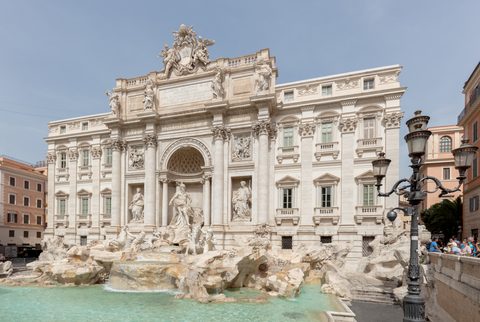
Trevi is R. II, the second of Rome's rioni. Roma Capitale records the Fontana di Trevi under Rione: Trevi, and records the fountain as the terminal mostra of the Acqua Vergine, the aqueduct inaugurated by Agrippa in 19 BC that feeds the monumental fountains of the Baroque city. Roma Capitale now charges for access to the fountain's inner perimeter and caps the number of people inside it; the arrangements are set out below. From the fountain the rione climbs to the Quirinal, where the palace that housed popes, then kings, and now the President of the Italian Republic stands on a square Trevi shares with Monti. In between are a palace remodelled by Borromini, a covered passage of the 1880s, and a church that keeps the precordia of twenty-two popes.
-
sight
Built 1732-1762 by Nicola Salvi and Giuseppe Pannini against the façade of Palazzo Poli; €2.00 to stand inside the perimeter from 09:00 to 22:00, and free to everyone after the 22:00 closure.
-
Inaugurated 19 BC by Agrippa and running over 20 kilometres from Salone, predominantly underground; three travertine arches survive at via del Nazareno, under the inscription recording Claudius's rebuilding in AD 46.
-
Excavation at the end of the 1990s uncovered a Neronian insula, a 4th-century domus and a cistern that collected the Acqua Vergine, under the side of the square facing the fountain.
-
The 18 columns on its façade earned it the name il canneto; inside, urns hold the precordia of 22 popes, from Sixtus V to Leo XIII, and they are not displayed.
-
sight
Papal residence from 1605 to 1870, royal residence from 1871 to 1946, and the President of the Republic's since; sources disagree on who built it and in which years.
-
walk
Known as Piazza di Monte Cavallo from the Middle Ages into the 19th century, and laid out from 1586 by Domenico Fontana for Sixtus V; Monti holds part of it and Trevi the rest.
-
A fountain fed by the Acqua Felice stood at the foot of the statues from 1589 until 1783; the present one dates from 1818 and reuses a grey granite basin that had been in the Roman Forum.
-
sight
Red Aswan granite, 14.63 m high and 28.94 m with its base and carrying no hieroglyphic inscriptions; Pius VI had it brought from the Mausoleum of Augustus in 1786.
-
sight
An 18th-century building by Alessandro Specchi and Ferdinando Fuga, restored between 1997 and 1999 and now used for art exhibitions that change; the venue publishes what is on at scuderiequirinale.it.
-
Palazzo Carpegna was enlarged and remodelled by Francesco Borromini for Count Ambrogio di Carpegna after 1630 and completed under Francesco Ferrari between 1732 and 1736; the academy and its gallery have been here since 1934.
-
walk
A covered passage built 1886-1888 to Giulio De Angelis's design for Prince Maffeo Sciarra; it is a private courtyard in office use, open to the public during office hours.
-
The Colonna family's palace on Via della Pilotta, with a picture gallery inside it that opens on a limited schedule published at galleriacolonna.it.
-
The palace and its garden on Via delle Quattro Fontane house the Gallerie Nazionali d'Arte Antica, which publish opening and ticketing at barberinicorsini.org; the Mitreo Barberini is here too.
Water: the aqueduct, the fountain and the city underneath
Trevi's subject is water, and the water arrives by a Roman aqueduct. Roma Capitale records the Acquedotto Vergine under Rione: II - Trevi: inaugurated in 19 BC by Agrippa, drawing from the Agro Lucullano near the eighth mile of the via Collatina, at the modern locality of Salone, and running over 20 kilometres, predominantly underground, to end in the Campo Marzio. It feeds the monumental fountains of the Baroque city, among them the Fontana di Trevi, which in the modern age is its terminal mostra. Part of it is visible above ground in the rione: at via del Nazareno three partly buried travertine arches in rusticated blocks survive at the sides of a larger fornix, identified with the arch Claudius had raised to mark his victory over the Germans, above which is set the inscription recording his rebuilding of the aqueduct in AD 46. Roma Capitale describes those arches as part of the Acquedotto Vergine and states its rione as II - Trevi; no source we fetched places them in another rione.
The fountain itself is eighteenth-century civic architecture built against the façade of Palazzo Poli. Roma Capitale gives the authors as Nicola Salvi and Giuseppe Pannini and the dates as 1732-1762, in travertine, marble, plaster, stucco and metals, and records that Pannini concluded the construction, partly modifying the scogliera and regularising the central basins. It also records an earlier attempt: in 1640, for Urban VIII and in step with the enlargement of the square, Gian Lorenzo Bernini designed a fountain on the present orientation, of which only an exedra base and a basin were built, set against buildings later absorbed into Palazzo Poli.
Under the buildings on the far side of the same square, excavation at the end of the 1990s, during restructuring and consolidation work, uncovered traces of an insula of Neronian date fronting the Vicus Caprarius, converted partly into a patrician domus in the middle of the fourth century and partly into a large cistern collecting the Acqua Vergine. Remains of twelfth- and thirteenth-century buildings were found above and partly overlying them, and traces of that urbanisation survive in the medieval portico on the side of the square facing the fountain. The area has been reorganised and is open to visitors as La Città dell'Acqua.
The Quirinal, and the treaty buildings on Italian soil
The Palazzo del Quirinale was a papal residence from 1605 to 1870, a royal residence from 1871 to 1946, and has been the residence of the President of the Italian Republic since; the Italian Wikipedia article ties the two changes to the presa di Roma of 20 September 1870 and to the referendum of 2 June 1946. Its construction is not settled. One Italian Wikipedia article gives 1573-1583 with Ottaviano Mascherino as first architect; another says it was built in the years 1573-1585 by Martino Longhi il Vecchio and then, from 1578, by Ottaviano Mascherino. Sources differ, and this guide does not choose between them.
The square in front of it belongs to two rioni. The Italian Wikipedia article, citing Sergio Delli, Le strade di Roma, 3rd ed., Newton Compton, 1988, p. 809, places Piazza del Quirinale between Via del Quirinale and Via XXIV Maggio, nei rioni I Monti e II Trevi. From the Middle Ages and still into the nineteenth century it was known as Piazza di Monte Cavallo. The fountain and the obelisk standing in it are in Trevi: Roma Capitale states Rione: Trevi for the Fontana di Monte Cavallo, and records that in 1786 Pius VI had the Egyptian granite obelisk taken from the Mausoleum of Augustus in the Campo Marzio set between the Dioscuri, to a design by the architect Giovanni Antinori.
Buildings in Trevi appear in the Lateran Treaty of 1929 in three different ways, and the differences matter. Article 15 names the palazzi della Dataria among the buildings which, although forming part of the territory of the Italian State, enjoy the immunities that international law recognises for the seats of the diplomatic agents of foreign States: that is a diplomatic-headquarters immunity granted on Italian soil, not a piece of Vatican City and not a border. Article 14's third alinea instead transfers to the Holy See the ex-conventual buildings in Rome annexed to the Basilica dei Santi XII Apostoli, and Article 15 reaches only the properties indicated in Article 13 and in the first and second alinea of Article 14, so those buildings fall outside Article 15 altogether. Article 16 then provides that the properties named in the three preceding articles, together with the buildings used as the seats of a named list of pontifical institutes including the Università Gregoriana and the Istituto Biblico, shall never be subjected to encumbrances or to expropriation for reasons of public utility save by prior agreement with the Holy See, and shall be exempt from taxation, ordinary and extraordinary, whether to the State or to any other body. That is a property and tax provision. It is not extraterritoriality and it is not diplomatic immunity. The Gregoriana and the Biblicum both stand in rione Trevi, on Italian soil; neither is in Vatican City and neither is extraterritorial.
Getting there
Trevi is bounded by streets rather than by anything you can see, and the Italian Wikipedia articles for the neighbouring rioni name them. Colonna's article gives its boundary with Trevi as piazza Barberini, via del Tritone, largo Chigi, piazza Colonna and via del Corso. Trevi's own article gives its boundary with Monti as via del Quirinale, piazza del Quirinale, via Ventiquattro Maggio and largo Magnanapoli. Via del Corso is crossed by four rioni and belongs to none of them; San Marcello al Corso and Palazzo Mancini are in Trevi while the Galleria Alberto Sordi, on the same street, is in Colonna.
Two of the rione's set pieces stand on ground shared with a neighbour. Piazza Barberini lies across Trevi, Colonna and Ludovisi, and Colonna's article names it as its boundary with Trevi. Piazza del Quirinale is shared with Monti. The buildings and fountains described here stand in Trevi even where their square does not.
At the fountain, Roma Capitale routes visitors in by the central staircase and out through the gate on the via dei Crociferi side, and caps the inner perimeter at about 400 people at a time; the charge, the free list and the hours are in the entry for the fountain below. For the aqueduct, entry is only to accompanied groups, by booking on 060608, and Roma Capitale states that the site is temporarily closed for works, so check before making the trip. We could not reach the Palazzo del Quirinale's own website from this network, and nothing here therefore describes whether or how the palace can be visited. The Accademia Nazionale di San Luca, the Gallerie Nazionali d'Arte Antica at Palazzo Barberini, the Galleria Colonna, the Scuderie del Quirinale, Palazzo Valentini and Vicus Caprarius each publish their own opening information on their own sites, and this guide sends you to those rather than repeating hours it could not verify.
Frequently asked questions
- Do you now have to pay to see the Trevi Fountain?
- To stand in the inner perimeter, yes, if you are a tourist or not resident in Rome or in the Città Metropolitana: Roma Capitale charges €2.00, from 09:00 to 22:00, and the charge remains in force on the first Sunday of the month. Entry is by the central staircase and exit through the gate on the via dei Crociferi side, with a maximum of about 400 people inside at a time. After the daily closure, fixed at 22:00, the fountain remains visible free of charge to everyone. Roma Capitale gives free access to residents of Rome and the Città Metropolitana on production of an identity card at the access control, to holders of the Roma MIC Card, to people with disabilities and one companion, to tour guides on production of a valid badge, and to children up to 5. Checked 2 September 2026.
- Can you go inside the Acqua Vergine aqueduct?
- Not at present. Roma Capitale states that the site is temporarily closed for works. Its published arrangements are entry only to accompanied groups, a maximum of 20 people per visit, with booking obligatory on 060608 between 09:00 and 19:00; individual visits are also possible, always by booking on 060608, on a calendar published by Roma Capitale. Tariffs are €4.00 full and €3.00 reduced, free for residents of Rome and the metropolitan area on production of a valid document attesting residence, and for MIC card holders. A guided tour is not included in the entrance price. Checked 2 September 2026.
- Is the Palazzo della Dataria part of Vatican City?
- No. Article 15 of the Lateran Treaty of 1929 names the Palazzo della Dataria among the buildings which, although forming part of the territory of the Italian State, enjoy the immunities that international law recognises for the seats of the diplomatic agents of foreign states. The palace stands in via della Dataria, in rione Trevi. It is on Italian soil: it is not in Vatican City, it is not Vatican territory, it is not a border, and visitors in it are subject to Italian law. What its status is today is not established by any source we could reach.
- Are Piazza del Quirinale and Piazza Barberini in Trevi?
- Both are shared. The Italian Wikipedia article on Piazza del Quirinale, citing Sergio Delli's Le strade di Roma, places the square nei rioni I Monti e II Trevi. Piazza Barberini lies across three rioni, Trevi, Colonna and Ludovisi, and the Italian Wikipedia article on rione Colonna names the piazza as Colonna's boundary with Trevi. The monuments standing in them are a separate question: Roma Capitale states Rione: Trevi for the Fontana di Monte Cavallo, and the Fontana del Tritone in Piazza Barberini stands on the Trevi side.
- Which church keeps the popes' precordia?
- Santi Vincenzo e Anastasio a Trevi, on Piazza di Trevi. The Italian Wikipedia article records that it preserves the precordia removed during the embalming of popes, the urns of 22 popes from Sixtus V to Leo XIII, and that they are not displayed to the faithful. The same article quotes Belli's phrase for the collection, un museo de corate e de ciorcelli. It is precordia, not hearts, and there is nothing to see.
- Is the Palazzo Colonna in the rione called Colonna?
- No. The palace on Via della Pilotta and the Galleria Colonna inside it stand in rione Trevi, and the research done for rione Colonna positively confirms that neither is in that rione. A second name trap works the same way: Palazzo Chigi-Odescalchi, on Piazza dei Santi Apostoli, is in Trevi and is not the Palazzo Chigi on Piazza Colonna.
Connected pages
Nearby
-
Colonna, Rome: Piazza Colonna, Montecitorio and the seat of government
· Colonna, Rome
Colonna's own article names piazza Barberini, via del Tritone, largo Chigi, piazza Colonna and via del Corso as its boundary with Trevi.
-
Pigna, Rome: the Pantheon, the Largo Argentina temples and the Jesuit quarter
· Pigna, Rome
Pigna, across via del Corso, holds the Pantheon, Santa Maria sopra Minerva and Palazzo Venezia.
Same region
-
Parione, Rome: Piazza Navona, Campo de' Fiori and the Cancelleria
· Parione, Rome
Parione, another of Rome's 22 rioni, holds Piazza Navona and the Palazzo della Cancelleria.
See also
-
3 Days in Rome: Colosseum Arena Floor, the Vatican, and the Back Streets of Monti
· Rome, Italy
A three-day itinerary across the historic centre, if you are fitting Trevi into a first visit to Rome.
What travelers think
Log in to react.
No reviews yet.