
Parione, Rome: Piazza Navona, Campo de' Fiori and the Cancelleria
Parione, Rome
Pictures from Parione
See all 1 photos →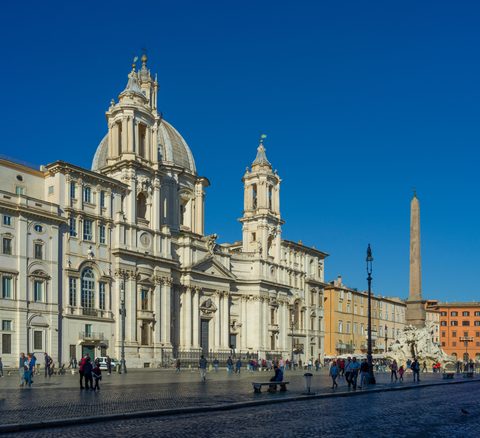
Parione is the sixth of Rome's rioni, a wedge of the centro storico with Piazza Navona at one end and Campo de' Fiori at the other. Between the two squares the rione is working streets — Via del Pellegrino, Via dei Cappellari, Via di Grotta Pinta, whose bend still follows the seating of Pompey's theatre. It also holds the Palazzo della Cancelleria, which the Lateran Treaty names among the Holy See's properties standing on Italian soil. Almost every edge of Parione is shared with a neighbouring rione, so several things visitors place here are not here: Santa Maria della Pace and Santa Maria dell'Anima are contested between rioni, and this guide does not carry them.
-
sight
The square keeps the outline of the ancient stadium beneath it, and lies wholly inside the rione, which is not true of most of Parione's edges.
-
The Sovrintendenza Capitolina gives it to Gian Lorenzo Bernini and dates it 1648-1651, in travertine, marble, granite and bronze, on the site of a trough from the 1570s.
-
sight
The church on Piazza Navona, on the traditional site of St Agnes's martyrdom; the parish publishes its own opening times and a restoration programme in the crypt.
-
The archaeological area is closed to the public, so plan to read the stadium from the piazza above rather than from inside; the walls re-emerged in 1936 and were built into the Palazzo dell'INA.
-
sight
The Sovrintendenza Capitolina reads the battered group as Patroclus and Menelaus, found at the corner of Piazza Navona and Via della Cuccagna, and refers it to the Stadium's decoration.
-
sight
Collections covering the social history and artistic activity of Rome from the Middle Ages to the early 20th century, with entrances at Piazza San Pantaleo 10 and Piazza Navona 2.
-
sight
Classical and Ancient Near Eastern sculpture, given to the Comune by Giovanni Barracco in 1904, at corso Vittorio Emanuele 166/A.
-
Article 15 of the Lateran Treaty of 1929 grants it the immunities international law recognises for the seats of foreign diplomatic agents, on Italian soil; it houses the Apostolic Penitentiary, the Apostolic Signatura and the Roman Rota.
-
sight
The Sovrintendenza Capitolina describes it as the seat of a city market; it runs between via dei Giubbonari and piazza della Cancelleria, on the Parione-Regola boundary.
-
Ettore Ferrari's bronze and Baveno granite figure, raised on 9 June 1889 on the site of the burning of 17 February 1600, with the philosopher drawn into himself and his hands crossed on his book.
-
walk
There is nothing to go inside; walk Via di Grotta Pinta and the bend of the houses is the line of the seating.
-
walk
An opening off Via del Pellegrino leading to an inner courtyard ringed by buildings of medieval origin.
-
sight
it.wikipedia gives it to Francesco Borromini, 1637-1667, for the Congregation of the Oratory; his Torre dell'Orologio stands on the same complex, and the Biblioteca Vallicelliana and the Archivio Storico Capitolino are inside it.
The edges
Parione's southern edge is Corso Vittorio Emanuele II, a cut driven through the older fabric, and it is shared with three other rioni — Ponte, Sant'Eustachio and Pigna. The Museo Barracco at corso Vittorio Emanuele 166/A, San Pantaleo and Palazzo Massimo alle Colonne stand in Parione. The Oratorio dei Filippini is inside Parione, and the Piazza dell'Orologio it addresses from is mostly in rione Ponte; the Oratory, the Biblioteca Vallicelliana and the Archivio Storico Capitolino share the one building. Campo de' Fiori sits on the line between Parione and Regola, and it.wikipedia declares that boundary itself; part of the Chiesa Nuova falls in Ponte. Santa Maria della Pace, its cloister and Santa Maria dell'Anima are contested between rioni. The Sovrintendenza Capitolina records that the Fontana della Terrina stood at the centre of Campo de' Fiori until it was dismantled for the Giordano Bruno monument, and was rebuilt in 1924 before the Chiesa Nuova; the Sovrintendenza Capitolina and it.wikipedia give different accounts of where it now stands. No source states a legal protection status for any building in Parione.
The Cancelleria, the Lateran Treaty and UNESCO
The Palazzo della Cancelleria has an unusual legal position, and it is easy to get wrong. Article 15 of the Lateran Treaty of 11 February 1929 names it among buildings which, in the treaty's own words, although forming part of the territory of the Italian State, enjoy the immunities that international law recognises for the seats of the diplomatic agents of foreign States. That is the immunity of a diplomatic headquarters, granted on Italian soil. The palazzo is not part of Vatican City, it is not Vatican territory, it is not a border, and a visitor standing outside it is in Italy and subject to Italian law. It remains the property of the Holy See and houses the Apostolic Penitentiary, the Apostolic Signatura and the Roman Rota. The basilica of San Lorenzo in Damaso is incorporated into the palace, its main door set in the right-hand part of the façade — and nothing this guide could reach says anything about the basilica's own legal position, so it says nothing. On the wider record: the Historic Centre of Rome, the Properties of the Holy See in that City Enjoying Extraterritorial Rights and San Paolo Fuori le Mura was inscribed on the UNESCO World Heritage List in 1980, as site 91, with a significant boundary modification in 1990 and minor modifications in 2015 and 2023, under criteria (i)(ii)(iii)(iv)(vi), over a property of 1,469.7 hectares. UNESCO's own description of the site names Piazza Navona by name among the Renaissance and Baroque urban developments of the historic centre. It does not name the Cancelleria, or any other individual Parione building.
Getting there
This guide publishes no walking times and no distance it has not taken from a source, so steer by street numbers rather than by an impression of how far apart things are. Its southern edge is Corso Vittorio Emanuele II, which carries the addresses of two of the rione's institutions. The addresses worth having, each taken from the institution's own website: the Museo di Roma in Palazzo Braschi gives two entrances, Piazza San Pantaleo 10 and Piazza Navona 2; the Museo Barracco gives corso Vittorio Emanuele 166/A; the Archivio Storico Capitolino gives Piazza dell'Orologio 4. All three are 00186 Roma. To orient yourself on the eastern side, the church of Nostra Signora del Sacro Cuore has its front on corso del Rinascimento and its rear façade on Piazza Navona, so the two run parallel with the church between them. No source names a metro station inside Parione, so none is given.
Frequently asked questions
- Is Piazza Navona in Parione?
- Yes, and wholly so — the square lies entirely inside the rione. UNESCO's description of the Historic Centre of Rome names Piazza Navona among the site's Renaissance and Baroque urban developments.
- Is Campo de' Fiori in Parione?
- Partly. it.wikipedia places the square between via dei Giubbonari and piazza della Cancelleria, on the boundary of the rioni Parione and Regola, and carries both rione categories on the same article. Most of it falls in Parione, but the market and the monument to Giordano Bruno in it are not wholly Parione's.
- Can I go into the Stadium of Domitian under Piazza Navona?
- Not at present. The whole of what the archaeological area's own website carries is a notice, in four languages, that the area is currently closed to the public, directing enquiries to the Sovrintendenza Capitolina ai Beni Culturali. It gives no hours, no address and no ticket, so none are given.
- Is the Palazzo della Cancelleria part of the Vatican?
- No. Article 15 of the Lateran Treaty says the opposite in its own words: the buildings it names form part of the territory of the Italian State, and what they are granted is the immunity international law gives to the seats of foreign diplomatic agents. The palazzo is not Vatican City, not Vatican territory and not a border, and anyone visiting it is in Italy and subject to Italian law.
- Is Santa Maria della Pace in Parione?
- No. Three independent methods put Santa Maria della Pace in rione Ponte, including it.wikipedia's own prose, which says it stands in the square of the same name in rione Ponte. Santa Maria dell'Anima is in Ponte too, though the evidence there is genuinely split. Neither is carried in this guide, and rione Ponte has not been written yet.
- What does the Museo di Roma cost, and where do you go in?
- The museum occupies Palazzo Braschi and has two entrances, at Piazza San Pantaleo 10 and Piazza Navona 2. Entry is free for MIC-card holders, with separate ticketing for the exhibition space; the museum gives 060608, 9.00-19.00, for information and booking. Its collections cover the social history and artistic activity of Rome from the Middle Ages to the early 20th century.
Connected pages
Nearby
-
Pigna, Rome: the Pantheon, the Largo Argentina temples and the Jesuit quarter
· Pigna, Rome
Parione's neighbour along corso Vittorio Emanuele II, a cut that four rioni divide between them and that this corpus gives to none of them.
-
Regola, Rome: Palazzo Farnese, via Giulia and the national churches
· Regola, Rome
Campo de' Fiori, the Giordano Bruno monument and the Arco degli Acetari are Parione's; Roma Capitale names Campo de' Fiori among Regola's limits.
-
Sant'Eustachio, Rome: Borromini's Sant'Ivo, the Caravaggios of San Luigi dei Francesi and the Senate's palaces
· Sant'Eustachio, Rome
The rione on the other side of Corso del Rinascimento, holding piazza Navona and the Palazzo della Cancelleria.
-
Ponte, Rome: the bridge the rione is named for, Palazzo Altemps and via dei Coronari
· Ponte, Rome
Ponte's landward neighbour. Roma Capitale's register puts piazza Navona wholly in Parione, and several streets behind it in both rioni.
Same region
-
Colonna, Rome: Piazza Colonna, Montecitorio and the seat of government
· Colonna, Rome
Another rione of Municipio I in this series. It holds the Palazzo di Propaganda Fide, another Lateran Treaty property standing on Italian soil.
-
Trevi, Rome: the Fountain, the Acqua Vergine and the Quirinal
· Trevi, Rome
Another rione of Municipio I in this series, covering the Trevi Fountain and the Quirinal.
-
Pigna, Rome: the Pantheon, the Largo Argentina temples and the Jesuit quarter
· Pigna, Rome
Another rione in this series, west across the historic centre: piazza Navona, the Palazzo della Cancelleria and Campo de' Fiori.
See also
-
3 Days in Rome: Colosseum Arena Floor, the Vatican, and the Back Streets of Monti
· Rome, Italy
The three-day itinerary whose final morning ends at Piazza Navona, the square this guide starts from.
What travelers think
Log in to react.
No reviews yet.