
Colonna, Rome: Piazza Colonna, Montecitorio and the seat of government
Colonna, Rome
Pictures from Colonna
See all 1 photos →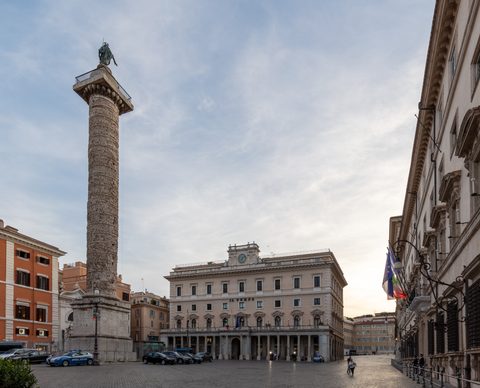
Colonna is the third of Rome's twenty-two rioni and the one the Italian state works out of. Palazzo Chigi has been the seat of the government since 1961; Palazzo Montecitorio has housed the Camera dei deputati since 1871. Palazzo Chigi stands on Piazza Colonna, which Roma Capitale calls the centre of the city's business and political life. The square takes its name from the Column of Marcus Aurelius standing at its centre, and the rione takes its name from the square. Around that core are a shopping arcade inaugurated in 1922, ten churches, the palace of the Holy See's missionary congregation, and a buried Augustan sundial for which Roma Capitale publishes two addresses in two different rioni. Almost every edge of Colonna is a named street or square, which is why a good deal that visitors file here turns out to sit next door.
-
walk
Palazzo Chigi, Palazzo Ferrajoli and Palazzo Wedekind stand around it, with the fountain and the column at the centre.
-
sight
Dated 180 to 193 and completed under Commodus, its marble reliefs narrate the Danube crossing and the campaigns against the Germani and the Sarmatians.
-
Made 1575 to 1577 to Giacomo della Porta's design and sculpted by Leonardo Sormani; Achille Stocchi put in the paired dolphins in 1830.
-
sight
Seat of the Italian government since 1961; guided visits run by prior booking, one Saturday a month from October to June, in groups of 35.
-
sight
Begun 1653 to Bernini's design and finished by Carlo Fontana; the Camera dei deputati has sat here since 1871 and visits go through the Chamber's own site.
-
sight
Raised at Heliopolis under Psammetichus II, found broken in five pieces in 1748 and re-erected here in 1792; the 1998 repaving restored its zodiac and meridian lines.
-
Bernini built the front towards the piazza between 1642 and 1644 and Borromini the one on Via di Propaganda; the building stands on Italian soil, not Vatican territory.
-
sight
Dario Carbone's Liberty arcade, inaugurated in October 1922 and reopened in 2024 after a restoration that removed the external glazing.
-
sight
Its portico carries sixteen columns, twelve of them brought from the excavations of Veio, as the Latin frieze inscription states.
-
Borromini designed the apse, the dome drum and the campanile nicknamed «ballerino», which sways when the great bell rings; contact the church for hours.
-
Eleven Roman columns stand embedded in the later building on Piazza di Pietra, which afterwards served as the city's stock exchange.
-
The civic collection formed in 1925, covering Roman art from the later nineteenth century to the years after the Second World War; free with the MIC card.
-
sight
Inaugurated in 1949 as a cinema-theatre to Marcello Piacentini's design, and tied to the musicals of Garinei e Giovannini; contact the venue for what is on.
The shape of the rione
The Italian Wikipedia article on the rione lists Colonna's five neighbours street by street: Ludovisi along via degli Artisti, via di Sant'Isidoro and via Veneto; Trevi along piazza Barberini, via del Tritone, largo Chigi, piazza Colonna and via del Corso; Pigna along via del Caravita, piazza Sant'Ignazio, piazza San Macuto and via del Seminario; Sant'Eustachio along piazza della Rotonda, via del Pantheon and piazza e via della Maddalena; and Campo Marzio along via di Campo Marzio. Colonna borders neither Parione nor Campitelli. Read that list again and you can see the problem it creates: every one of Colonna's borders is a named public space, so the rione's boundary does not run near piazza Colonna and via del Corso, it runs down them.
That has one consequence worth carrying with you. Where a boundary is defined as a street, mapping data draws the line along one kerb, so the street or square that is the border lands wholly inside whichever side the mapper chose. Buildings are assigned by their own outline; the street they are addressed from is a separate question, and a street address is never a claim about which rione a building is in. This guide follows that rule strictly. Palazzo Fiano is addressed to piazza di San Lorenzo in Lucina, which lies in Campo Marzio, and is nevertheless a Colonna building. Santa Maria Odigitria is addressed on via del Tritone, which the rione article names as part of the Trevi border, and is nevertheless a Colonna church.
It also means several squares get no rione statement here at all. Piazza della Rotonda is a three-rione junction where Colonna, Pigna and Sant'Eustachio meet, and the sources disagree about how many rioni are even involved, so this guide makes no claim on it. Piazza di Spagna, which the Palazzo di Propaganda Fide faces, is in the rione Campo Marzio and is not claimed here either.
Finally, the name trap. The Galleria Colonna and the Palazzo Colonna that appear in guidebooks are the Colonna family's palace and picture gallery, and they are in the rione Trevi, not in the rione Colonna. What Colonna has is the shopping arcade on piazza Colonna, which carried the name Galleria Colonna and which Roma Capitale now publishes as the Galleria Alberto Sordi (già Galleria Colonna). Three names, two buildings, two rioni.
Getting there
What follows is the practical information for this rione that could actually be sourced. Almost everything else about getting around Colonna is guesswork, and it is left out.
Two of the buildings can be visited by arrangement. Roma Capitale states that guided visits to Palazzo Chigi, Piazza Colonna 370, are held by prior booking, one Saturday a month from October to June, 9.30 to 13.00, in groups of 35 with entry every thirty minutes, and that booking and the calendar are published by the Presidency of the Council at governo.it/visitare-i-palazzi-istituzionali/visitare-palazzo-chigi/palazzo-chigi-prenotazioni-e-calendario. For Palazzo Montecitorio, Piazza di Monte Citorio 1, Roma Capitale links the Chamber's own visitor site at visita.camera.it and its events site at eventi.camera.it/eventionline. Palazzo Ferrajoli, Piazza Colonna 355, telephone 06 69200497, can be visited only on the occasion of receptions, conferences and exhibitions, per Roma Capitale.
The Galleria d'Arte Moderna di Roma Capitale is at Via Francesco Crispi 24, 00187 Roma, and is part of Roma Capitale's Sistema Musei Civici; entry is free for MIC card holders, and information and booking are on 060608, 9.00 to 19.00. The Museo Missionario di Propaganda Fide, inside the palazzo of the same name, is closed for now: as at 2 September 2026 Roma Capitale states that entry is temporarily closed for urgent conservation work, and its contact is museopropagandafide.va, telephone 06 69880266.
Other addresses, as the institutions give them: Palazzo di Propaganda Fide at Via di Propaganda 1 — not the piazza di Spagna address that circulates, which sends geocoders into the wrong rione; Palazzo Capranica at Piazza Capranica 101 and Via del Collegio Capranica 36-43; Palazzo Wedekind at Piazza Colonna 366; Palazzo Fiano at Piazza di San Lorenzo in Lucina 4; Sant'Andrea delle Fratte at Via di Sant'Andrea delle Fratte 1; the Teatro Sistina at Via Sistina 129; the Teatro Sala Umberto at Via della Mercede 50; Palazzo Marignoli at Via del Corso 180 and Palazzo Bocconi at Via del Corso 189; Santa Maria Odigitria at Via del Tritone 82; and the Orologio di Augusto at Via In Lucina 16/a, which is the Colonna one of the two addresses Roma Capitale gives it.
A warning about hours. No source states opening times for nearly anything in this rione, so nearly none are given here. Roma Capitale's pages for Sant'Andrea delle Fratte, the Teatro Sistina and the Teatro Sala Umberto all say only to contact the church or the venue, so no opening times appear on those records here. Check before you travel.
Frequently asked questions
- What is actually in Colonna?
- The political core — Palazzo Chigi, Palazzo Montecitorio, piazza Colonna with the Column of Marcus Aurelius and its fountain, and piazza di Monte Citorio with the Egyptian obelisk. Around it, the Galleria Alberto Sordi arcade, the Palazzo di Propaganda Fide, about ten churches, of which Sant'Andrea delle Fratte, San Macuto and the Santi Bartolomeo e Alessandro dei Bergamaschi rest on Roma Capitale's own pages, a handful of eclectic nineteenth-century palaces along the Corso, two theatres, a civic art museum, and eleven Roman columns embedded in a later building on piazza di Pietra.
- Can you go inside Palazzo Chigi or Palazzo Montecitorio?
- Both by arrangement, neither on a walk-up. Roma Capitale states that guided visits to Palazzo Chigi run by prior booking, one Saturday a month from October to June, 9.30 to 13.00, in groups of 35 with entry every thirty minutes, booked through the Presidency of the Council. For Montecitorio, Roma Capitale points to the Chamber's own visitor site at visita.camera.it. No walk-in access is stated for either.
- Is the Galleria Colonna in the rione Colonna?
- It depends which Galleria Colonna you mean, and it is an easy one to get wrong. The Colonna family's picture gallery and the Palazzo Colonna that contains it are in the rione Trevi. The building in the rione Colonna is the shopping arcade on piazza Colonna, inaugurated in October 1922, which carried the name Galleria Colonna and which Roma Capitale now publishes as the Galleria Alberto Sordi. Three names, two buildings, two rioni.
- Is piazza di Spagna in Colonna?
- No. Piazza di Spagna is in the rione Campo Marzio, even though the Palazzo di Propaganda Fide faces it and is a Colonna building. That is why this guide gives the palazzo the address Roma Capitale gives it, Via di Propaganda 1, rather than an address on the piazza.
- Is the Palazzo di Propaganda Fide part of the Vatican?
- No. It stands in the rione Colonna, on Italian soil, in the Comune di Roma. Article 15 of the Lateran Treaty of 11 February 1929 provides that the building, although forming part of the territory of the Italian State, enjoys the immunities that international law recognises for the seats of the diplomatic agents of foreign States. It is not part of Vatican City, it is not Vatican territory, there is no border at its door, and a visitor there is subject to Italian law.
- Why does this guide leave some squares without a rione?
- Because the evidence does not settle them. Several of Colonna's borders are themselves squares and streets, and mapping data draws a boundary along one kerb, so a square that is the border tests as lying wholly inside one side. Where a text source and the geometry disagree, this guide states nothing rather than guessing: piazza della Rotonda is left unresolved. Buildings are assigned by their own outline, so nothing is lost.
Connected pages
Nearby
-
Trevi, Rome: the Fountain, the Acqua Vergine and the Quirinal
· Trevi, Rome
The rione along piazza Colonna and via del Corso. Palazzo Colonna and the Colonna picture gallery are there, not here.
-
Pigna, Rome: the Pantheon, the Largo Argentina temples and the Jesuit quarter
· Pigna, Rome
The rione across via del Seminario and piazza San Macuto, named in Colonna's own boundary list.
-
Sant'Eustachio, Rome: Borromini's Sant'Ivo, the Caravaggios of San Luigi dei Francesi and the Senate's palaces
· Sant'Eustachio, Rome
The neighbour along via della Maddalena, via del Pantheon and piazza della Rotonda, named in this rione's own boundary list.
-
Campo Marzio, Rome: the Spanish Steps, piazza del Popolo, the Augustan monuments and the Pincio
· Campo Marzio, Rome
The neighbour along via Frattina and via di Campo Marzio, holding San Lorenzo in Lucina, Palazzo Montecitorio and Palazzo di Propaganda Fide.
Same region
-
Parione, Rome: Piazza Navona, Campo de' Fiori and the Cancelleria
· Parione, Rome
Another rione of Municipio I covered in this series. It does not border Colonna.
See also
-
3 Days in Rome: Colosseum Arena Floor, the Vatican, and the Back Streets of Monti
· Rome, Italy
The three-day Rome itinerary this rione series sits alongside.
What travelers think
Log in to react.
No reviews yet.