
Pigna, Rome: the Pantheon, the Largo Argentina temples and the Jesuit quarter
Pigna, Rome
Pictures from Pigna
See all 1 photos →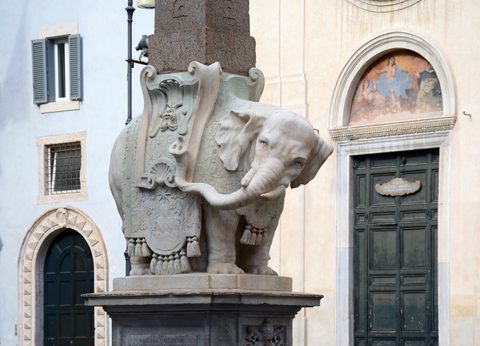
Pigna is the ninth of Rome's twenty-two rioni, and it is small and very densely built. The Pantheon stands in it. So do two Jesuit churches, the Gesu and Sant'Ignazio di Loyola; the Dominican basilica of Santa Maria sopra Minerva; four Republican temples in the sunken archaeological enclosure at Largo di Torre Argentina; a fifteenth-century palace that is now a national museum and a national research library; a family palace with its own picture gallery on via del Corso; and the sixteenth-century Jesuit college that today houses the Ministero della Cultura. Almost every edge of the rione is a street or a square shared with one of five neighbours. Via della Pigna and piazza della Pigna carry the rione's name.
-
sight
Agrippa's temple of 27 BC, rebuilt by Hadrian between 118 and 125 AD, now the basilica of Santa Maria ad Martyres and the burial place Raphael chose.
-
Four Republican temples in a sunken enclosure, reopened to the public on 20 June 2023 with a walkway; entry is timed every twenty minutes and closed on Mondays.
-
sight
The ruined hall at the west of the enclosure, where it.wikipedia records the tradition that Julius Caesar was killed in 44 BC.
-
sight
The fourteenth-century tower on piazza dei Calcarari holds the archaeological site's ticket office and bookshop, and its portico serves as a display area.
-
It holds the remains of Catherine of Siena and of Fra Angelico, and a fresco by Melozzo da Forli; mass is at 18.00 Monday to Saturday.
-
sight
An Egyptian obelisk from the Iseo Campense, riding a marble elephant that Ercole Ferrata carved to a 1667 design by Gian Lorenzo Bernini.
-
sight
Begun 1568 to Vignola's plan and finished by Giacomo della Porta, who designed the facade, in 1575; dedicated 1584, with Baciccia's painted decoration added later.
-
sight
The rooms in the Casa professa where Ignatius of Loyola lived and died, keeping their decoration by Andrea Pozzo and Borgognone.
-
Andrea Pozzo painted the false dome, the vault and the presbytery in 1685; the church was consecrated in 1722 and opens daily from 09.00 to 23.30.
-
sight
The pictures still hang to the late eighteenth-century arrangement recorded in a 1767 manuscript; closed every Wednesday, and the Appartamenti Segreti are ticketed separately.
-
sight
A fifteenth-century residence of popes, cardinals and ambassadors, begun by Cardinal Pietro Barbo, who became Paul II in 1464; VIVE gives its Sale Storiche as closed for restoration into 2026.
-
Founded in 336 by Pope Mark and recorded as Titulus Marci in the synod acts of 499, with a benediction loggia added under Paul II in 1465 to 1470.
-
sight
A wall fountain of a porter with a barrel, made for Jacopino del Conte's house between 1580 and 1598 and moved to via Lata in 1872 to 1873 for reasons of traffic.
-
Sacred vestments and episcopal insignia, one of the ecclesiastical outfitters clustered around via dei Cestari and via di Santa Caterina da Siena.
Pigna's edges
Pigna's edges are streets and squares it shares with five neighbouring rioni. it.wikipedia's article on the rione gives them as via del Seminario, piazza Sant'Ignazio and via del Caravita with Colonna; via del Corso, piazza San Marcello and piazza Venezia with Trevi; via San Marco with Campitelli; via delle Botteghe Oscure and via Florida with Sant'Angelo; and via della Torre Argentina, piazza Santa Chiara, via della Rotonda and piazza della Rotonda with Sant'Eustachio. A street named as a boundary is evidence of a line, not of what stands on either side of it.
Start with piazza della Rotonda, the square the Pantheon faces. OpenStreetMap's rione boundary data puts most of that square in Colonna, while it.wikipedia, citing Roma Capitale's own street register, describes it as a junction of three rioni and names a third party, Sant'Eustachio, that the geometry does not return at all. The two readings do not reconcile, and no source settles the rione of the square, of the fountain standing in it, or of the obelisk on that fountain. The Pantheon itself is in Pigna. The sources are divided over piazza Venezia in the same way. Palazzo Venezia, the basilica of San Marco and the museum and library inside the palazzo complex are a different matter: each stands in Pigna.
Two more boundaries are worth knowing before you walk. The church of Sant'Ignazio di Loyola is in Pigna; the square in front of it is a separate object. And at Largo di Torre Argentina the fenced archaeological area and the open square around it are two different objects with two different answers: the Area Sacra itself is wholly Pigna, while the square is shared with Sant'Eustachio, which also holds the Teatro Argentina.
Getting there
No source establishes a metro station or a bus route for Pigna, and no walking times or distances are given. Steer by addresses instead.
The Sovrintendenza Capitolina gives the entrance to the Area Sacra di Largo Argentina as via di San Nicola de' Cesarini, opposite no. 10, with the ticket office and bookshop in the Torre del Papito on piazza dei Calcarari. The Doria Pamphilj administration gives the gallery entrance as Via del Corso 305, 00186 Roma. VIVE, the state institute that runs Palazzo Venezia, is addressed at Piazza Venezia 1 for the Museo Nazionale del Palazzo di Venezia and Piazza Venezia 3 for the Biblioteca di Archeologia e Storia dell'Arte. Roma Capitale gives Piazza della Minerva 42 for Santa Maria sopra Minerva. The Pontificia Accademia Ecclesiastica is at Piazza della Minerva 74, in Palazzo Severoli.
One trap is worth naming, because it defeats map software as well as visitors. Several Pigna buildings, Palazzo Doria Pamphilj and Palazzo De Carolis among them, carry via del Corso addresses, but the carriageway of the Corso is itself a rione boundary. A street address is not a claim about which rione a building stands in. The streets that lie wholly inside Pigna, and that this guide uses for orientation rather than as records, are via del Plebiscito, via dei Cestari, via del Gesu, via del Pie di Marmo, via della Gatta and via di Torre Argentina.
Tickets and opening hours
The Pantheon's own site gives daily opening of 09.00 to 19.00, last entry 18.30, closed on 1 January and 25 December, and states that entry has been paid since 3 July 2023 and is free on the first Sunday of the month. No admission price is stated.
For the Area Sacra di Largo Argentina the Sovrintendenza Capitolina gives Tuesday to Sunday, 10.00 to 16.00 in winter and 10.00 to 19.00 in summer, with 9.30 to 14.00 on 24 and 31 December, closed Mondays, 25 December and 1 May, with entry timed every twenty minutes. Its published tariff is 7.00 euro full and 4.00 euro reduced for non-residents, plus 1.00 euro advance booking; entry is free for residents of Rome and the metropolitan area on production of proof of residence, and free on the first Sunday of the month subject to capacity. Read those two figures as the non-resident price, because that is what they are.
The Galleria Doria Pamphilj gives Monday to Thursday 09.00 to 19.00, last entry 18.00, and Friday to Sunday 10.00 to 20.00, last entry 19.00, closed every Wednesday and on 1 January, Easter and 25 December, with booking advised and no cloakroom. Its site is explicit that the Appartamenti Segreti with the Bagno di Diana are run separately and are not included in the gallery ticket. Roma Capitale gives Sant'Ignazio di Loyola as open Monday to Sunday 09.00 to 23.30, with masses Monday to Saturday at 18.30 and Sunday at 11.30 and 18.30, and gives Santa Maria sopra Minerva mass times of 18.00 Monday to Saturday and 11.00 and 18.00 on Sundays and feast days. For the Chiesa del Gesu, Roma Capitale carries separate winter and summer schedules, so check its page against the season you are travelling in.
Two things inside the rione are not simply walk-in. VIVE's site carries a standing notice that the Sale Storiche of Palazzo Venezia are closed to the public for restoration, with 2026 given as the notice's horizon. And the Sala della Crociera in the Collegio Romano is normally open only to scholars; VIVE opened it to the public through the programme Incontriamoci al Collegio Romano, four lecture cycles and special openings running from March to December 2026.
Frequently asked questions
- Is the Pantheon in Pigna?
- Yes. The Pantheon is in Pigna. The square it faces is a different question: OpenStreetMap puts most of piazza della Rotonda in Colonna, while it.wikipedia, citing Roma Capitale's street register, calls the square a junction of three rioni. Because those readings do not agree, this guide states no rione for the square, for the fountain in it, or for the obelisk on that fountain, and writes only the building.
- What is the Area Sacra di Largo Argentina, and can you go in?
- It is a sunken archaeological enclosure holding four Republican temples, known as A, B, C and D, together with the remains of the church of San Nicola de Calcarario and the medieval Torre del Papito. The Sovrintendenza Capitolina records that demolition of the old quarter began in 1926 and that the site was inaugurated on 21 April 1929 by Benito Mussolini; it reopened to the public on 20 June 2023 with a walkway funded by Bulgari. Entry is from via di San Nicola de' Cesarini, opposite no. 10, and the ticket office and bookshop are in the Torre del Papito on piazza dei Calcarari.
- Was Julius Caesar killed here?
- The ruined hall at the west of the Area Sacra is identified as the Curia of Pompey. it.wikipedia records the tradition that Julius Caesar was killed there in 44 BC. Roma Capitale's own account of the Area Sacra does not mention it, which is why this guide reports the tradition and its source rather than stating it as fact.
- Is Palazzo Maffei Marescotti part of the Vatican?
- No. The palazzo stands in Pigna, on the corner of via dei Cestari and via della Pigna, on Italian soil. The Holy See's own published list of its extraterritorial properties in Rome includes it. Extraterritoriality is the immunity international law grants to the headquarters of a foreign state's diplomatic agents; it is not part of Vatican City, it is not Vatican territory, it is not a border, and a visitor there is under Italian law. Two other Holy See bodies in the rione, the Pontificia Accademia Ecclesiastica on piazza della Minerva and the Pontificio Seminario Francese, are not on that list at all.
- Which of Pigna's churches can be visited most easily?
- Three carry published hours or mass times. Roma Capitale gives Sant'Ignazio di Loyola as open Monday to Sunday from 09.00 to 23.30, with masses Monday to Saturday at 18.30 and Sunday at 11.30 and 18.30. It gives Santa Maria sopra Minerva mass times of 18.00 Monday to Saturday and 11.00 and 18.00 on Sundays and feast days. For the Chiesa del Gesu it carries winter and summer schedules that differ, so check its page for the season. The Camere di Sant'Ignazio, the rooms where Ignatius of Loyola lived and died, are in the Casa professa on the same square as the Gesu.
- Is anything in Pigna free to enter?
- The Pantheon's own site states that entry, paid since 3 July 2023, is free on the first Sunday of the month. The Sovrintendenza Capitolina states that the Area Sacra di Largo Argentina is free for residents of Rome and the metropolitan area on production of proof of residence, and free on the first Sunday of the month subject to capacity. Beyond ticketed sites, the fountains and street sculpture of the rione cost nothing: the Fontana della Pigna and the talking statue Madama Lucrezia on piazza San Marco, the Fontana del Facchino on via Lata, the marble foot on via del Pie di Marmo and the elephant and obelisk on piazza della Minerva.
Connected pages
Nearby
-
Colonna, Rome: Piazza Colonna, Montecitorio and the seat of government
· Colonna, Rome
Pigna's northern neighbour across via del Seminario and via del Caravita.
-
Trevi, Rome: the Fountain, the Acqua Vergine and the Quirinal
· Trevi, Rome
The neighbour along via del Corso and piazza San Marcello, holding the Trevi Fountain and the Quirinal palace.
-
Sant'Angelo, Rome: the Portico d'Ottavia, the Teatro di Marcello and the old Jewish quarter
· Sant'Angelo, Rome
The neighbour across via delle Botteghe Oscure and via Florida. The Area Sacra di Largo Argentina and its four temples are there, not here.
-
Parione, Rome: Piazza Navona, Campo de' Fiori and the Cancelleria
· Parione, Rome
Parione's neighbour along corso Vittorio Emanuele II, a cut that four rioni divide between them and that this corpus gives to none of them.
-
Sant'Eustachio, Rome: Borromini's Sant'Ivo, the Caravaggios of San Luigi dei Francesi and the Senate's palaces
· Sant'Eustachio, Rome
The neighbour across via di Torre Argentina, holding the Area Sacra temples, the Curia di Pompeo and the Torre del Papito.
Same region
-
Parione, Rome: Piazza Navona, Campo de' Fiori and the Cancelleria
· Parione, Rome
Another rione in this series, west across the historic centre: piazza Navona, the Palazzo della Cancelleria and Campo de' Fiori.
-
Regola, Rome: Palazzo Farnese, via Giulia and the national churches
· Regola, Rome
Another rione in this series, east across the historic centre: the Pantheon, the Largo Argentina temples and the Jesuit quarter.
See also
-
3 Days in Rome: Colosseum Arena Floor, the Vatican, and the Back Streets of Monti
· Rome, Italy
The three-day Rome itinerary in this series. The Pantheon and the Largo Argentina temples both stand inside this rione.
What travelers think
Log in to react.
No reviews yet.