Orientation
Weston, Connecticut: Where a Meteorite Founded a Science
Weston, Connecticut

Weston began as Norfield Parish: in 1757, "outlivers" in Fairfield's remote northern lots petitioned to form their own parish, and in 1787 the Connecticut General Assembly combined Norfield with North Fairfield Parish to create Weston. In 1845 the eastern half split off to become Easton, giving Weston its present boundaries. Weston's defining event came December 14, 1807, when roughly 350 pounds of meteorite fell on the town; Yale professor Benjamin Silliman performed what is believed to be the first chemical analysis of a meteorite in the United States, founding the field of meteoritics. In the early 1800s Weston was an industrial town of mills and tanneries along the Saugatuck and Aspetuck Rivers, not the quiet town it became once the Merritt Parkway arrived in the 1930s.
Getting there
Weston has no train station of its own — Wikipedia calls it the closest Connecticut town to New York City without one. Exit the Merritt Parkway in Westport onto Route 57 (Weston Road) and follow it north into the town center, where it briefly overlaps Route 53, the only two through-routes in town. Rail travelers can use Metro-North's New Haven Line at Westport (Saugatuck) station, 1 Railroad Place, and drive the remaining few miles north, or the Danbury Branch's Cannondale station in neighboring Wilton. There is no Amtrak, Shore Line East or CTrail Hartford Line service in or near Weston.
A Nature Conservancy flagship and a working town farm
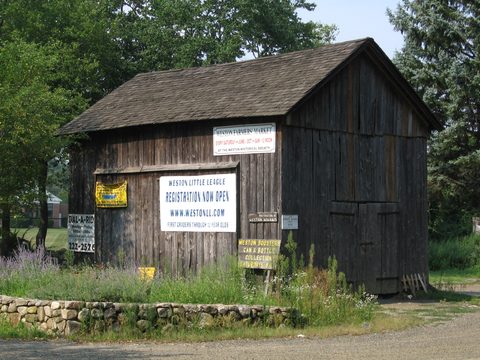
The Lucius Pond Ordway-Devil's Den Preserve, The Nature Conservancy's largest continuous preserve in Connecticut at roughly 1,800 acres, draws more than 40,000 visits a year on its 20-mile trail system; Katharine Ordway created it starting with a 1,100-acre purchase in 1966. A second Aspetuck Land Trust property, Trout Brook Valley Preserve, straddles Weston's border with Easton and adds nearly 14 miles of trails through meadows, woods and a working orchard — see Easton's guide for trailhead details. Lachat Town Farm, a 42-acre farm the late Leon Lachat deeded to the town and the Conservancy in 1997, keeps a circa-1770 farmhouse and runs a community garden, farmers markets and concerts. Weston farmers once grew a variety of onion called the Southport Globe, stored in local onion barns before shipment to warehouses in Southport and Norwalk and on to New York City; the surviving Onion Barn, at the Weston Road/Norfield Road junction, still serves as the town's community bulletin board. The Weston History & Culture Center, run by the Weston Historical Society, occupies the David Dimon Coley House and a visitor center with rotating exhibits.
What's here
-
Lucius Pond Ordway–Devil's Den Preserve
The Nature Conservancy's largest continuous preserve in Connecticut.
-
Weston History & Culture Center
Run by the Weston Historical Society.
-
Lachat Town Farm
A 42-acre working farm deeded to the town in 1997.
-
Lily's Weston Market
The town's grocery and prepared-food counter.
Questions
How do I get to Weston?
By car — exit the Merritt Parkway in Westport onto Route 57 (Weston Road) into the town center. The nearest train service is Metro-North's Westport (Saugatuck) station, a few miles south.
Is there a restaurant in Weston?
Weston's commercial core is a single shopping center at 190 Weston Road, anchored by Lily's Weston Market. There is essentially no restaurant scene in town — plan to eat just over the line.
What fell on Weston in 1807?
A meteorite — about 350 pounds of stone, the first meteorite fall recorded and scientifically studied in the United States, effectively founding the field of meteoritics.
Foliage
Turning this week · estimated peak Oct 28–Nov 3
On the Scenic Fairfield foliage driving route.
Derived from the Connecticut DEEP fall foliage map. DEEP's map is a climatological estimate last published in 2023; it describes a normal year, not this one. Stage names are ours. See the statewide forecast.
Connected pages
Nearby
-
Trout Brook Valley Preserve
· park · Easton
Trout Brook Valley Preserve straddles Weston and Easton; Easton's guide has the trailhead details.
-
Redding, Connecticut: Connecticut's Valley Forge and Mark Twain's Library
· Redding, Connecticut
Route 53's designated scenic stretch begins at the Weston town line in Redding.
-
Westport, Connecticut: From Onion Fields to an Arts Colony
· Westport, Connecticut
Route 57 begins at Route 33 in Westport and runs north into Weston.
-
Wilton, Connecticut: An Impressionist's Farm on Two Rail Stops
· Wilton, Connecticut
Route 57 continues north from Weston's town center to US Route 7 in Wilton's Georgetown section.
-
Fairfield, Connecticut: Burned in 1779, Rebuilt on the Green
· Fairfield, Connecticut
The two towns share a border
-
Easton, Connecticut: Reservoirs, Farms and Two Famous Retirees
· Easton, Connecticut
The two towns share a border
Shared history
-
Easton, Connecticut: Reservoirs, Farms and Two Famous Retirees
· Easton, Connecticut
Easton split off from Weston's eastern half in 1845.
Same region
-
Ridgefield, Connecticut: Connecticut's Only Inland Battle
· Ridgefield, Connecticut
Both on the Scenic Fairfield foliage route
-
Danbury, Connecticut: Hat City History, Rail Heritage, and Where to Eat
· Danbury, Connecticut
Both on the Scenic Fairfield foliage route
-
Norwalk, Connecticut: Oyster Town and a Second Empire Mansion
· Norwalk, Connecticut
Both on the Scenic Fairfield foliage route
-
Wilton, Connecticut: An Impressionist's Farm on Two Rail Stops
· Wilton, Connecticut
Both on the Scenic Fairfield foliage route