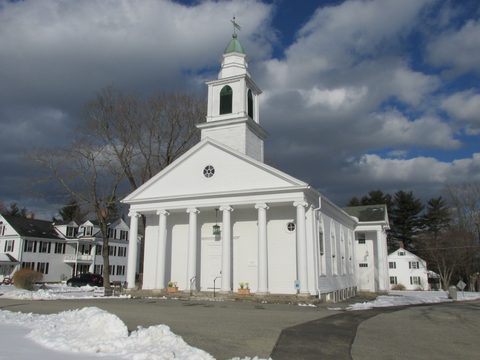

Bromley, London: Crystal Palace Park and its dinosaurs, Down House, Chislehurst Caves and Keston Windmill
Bromley, England
Pictures from Bromley
See all 1 photos →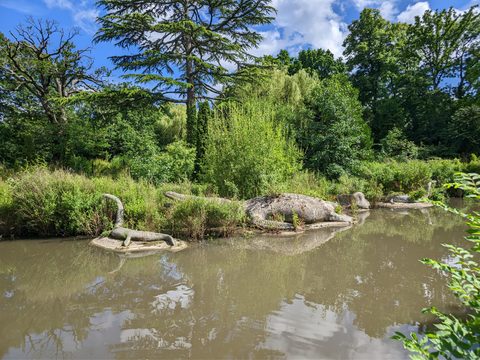
Bromley is a London borough on the Kent boundary, covering about 150 square kilometres. The town centre keeps the seventeenth-century almshouse quadrangles of Bromley and Sheppard's Colleges and the grounds of the Bishops of Rochester's old palace. Crystal Palace Park, at Penge, holds the terraces and the dinosaur sculptures of 1854 left behind by Paxton's relocated exhibition building, which burned in 1936; the palace's subway runs under Crystal Palace Parade on the borough boundary. East along the Southeastern main line lie the chalk mines under Chislehurst, a moated Tudor manor site and a Roman villa under a cover building. The rural south, on the dip slope of the North Downs, holds Darwin's house at Downe, a post mill of 1716 at Keston, a country park on the Lubbock estate and a fighter station with its memorial chapel. The National Heritage List for England records 415 listed-building entries inside the borough boundary, 8 of them Grade I and 23 Grade II*.
-
Almshouse quadrangles of 1670 to 1672 on London Road, listed Grade I as NHLE 1359324, with the gateway carrying its own Grade I entry, NHLE 1064374.
-
The borough's local collections at Bromley Central Library on the High Street, holding Provisional Accreditation assessed on 24 February 2022.
-
walk
The old palace grounds on Rochester Avenue, with Pulhamite rockwork, an ice house and a folly, each listed Grade II: NHLE 1392583, 1392584, 1393912 and 1186785.
-
Free museum in the grounds of the Bethlem Royal Hospital at Beckenham, open Wednesday to Saturday 09:30 to 17:00 with last entry at 16:30.
-
walk
A Grade II* registered park and garden, NHLE 1000373, holding the terraces of Paxton's exhibition building, which burned in 1936.
-
Sculptures unveiled in 1854 on and beside the lower-lake islands, listed Grade II in 1973 and upgraded to Grade I in 2007, NHLE 1067798.
-
Listed Grade II*, NHLE 1385457, and reached from Crystal Palace Parade; it opens on days run by the Friends of Crystal Palace Subway, so check before setting out.
-
Listed Grade II*, NHLE 1031539, standing inside the Grade II* registered park, NHLE 1000373, with a 50-metre pool.
-
tour
Guided lamp-lit tours on the hour from 10am to 4pm, Wednesday to Sunday, lasting 45 to 50 minutes; £10.00 for ages 16 to 63, £8.00 for 64 and over.
-
walk
Over 300 acres of Local Nature Reserve on the London Loop, around the moated Scadbury Manor site, a scheduled monument, NHLE 1409786.
-
sight
Ten rooms of a villa built about AD 140, under a modern cover building 91 m from Orpington station; a scheduled monument, NHLE 1001992.
-
Listed Grade II*, NHLE 1064330, in a Grade II registered park and garden, NHLE 1001444, on Church Hill beside All Saints.
-
Darwin's house for four decades, listed Grade I as NHLE 1038325, open daily 10am to 5pm with last entry at 4pm; the Sandwalk is in the grounds.
-
A chapel of 1951 listed Grade II, NHLE 1391588, with a museum of uniforms, medals and letters; £8.50 for an adult without Gift Aid.
-
sight
A post mill of 1716 on Heathfield Road at Keston Mark, listed Grade I as NHLE 1064369, with buses 146 and 246 stopping 160 m away.
-
About 250 acres of the Lubbock estate on the North Downs, with an Eton Fives court listed Grade II, NHLE 1186836, and a scheduled ice house, NHLE 1018959.
Bromley town centre and Beckenham
The civic and shopping core sits on the High Street, with Bromley and Sheppard's Colleges on London Road and the grounds of the old palace of the Bishops of Rochester immediately east of them; the borough runs west from there into Beckenham. Bromley and Sheppard's Colleges, London Road, BR1 1PE, are almshouse quadrangles founded under the 1666 will of John Warner, Bishop of Rochester, to house twenty poor widows of orthodox and loyal clergymen, and built between 1670 and 1672. Bromley College is listed at Grade I, NHLE 1359324; its gateway carries its own Grade I entry, NHLE 1064374; and Sheppard's College, added in 1840 by Mrs Sheppard for daughters who had lived with their mothers in the main college, is listed Grade II, NHLE 1186837. The main college holds 40 self-contained dwellings and Sheppard's a further seven, and the foundation still houses retired Church of England clergy and their dependants, with preference to the Diocese of Rochester. A K2 telephone kiosk at the junction with College Slip is listed Grade II, NHLE 1186822. The quadrangles are homes, and no source states visiting hours, so none are given here.
Bromley Palace Park, Rochester Avenue, BR1 3DB, is what survives of the palace grounds. The Old Palace building is listed Grade II, NHLE 1281268, and four structures in the grounds carry their own Grade II entries: the Pulhamite waterfall, NHLE 1392583, the Pulhamite fernery, NHLE 1392584, the ice house and ha-ha wall, NHLE 1393912, and a Victorian folly of medieval ruins, NHLE 1186785. Pulhamite is the artificial rockwork made by James Pulham and Son, and the waterfall and the fernery are two separate list entries within the same park. All four structures appear on Historic England's Heritage at Risk Register 2024, as does the Royal Bell Hotel at 173-177 High Street, listed Grade II, NHLE 1054095.
Bromley Museum at Bromley Historic Collections works from Bromley Central Library on the High Street, BR1 1EX. Historic England's Accredited Museums dataset records it as a local-authority museum holding Provisional Accreditation for 12 months, most recently assessed on 24 February 2022, and the collections are the successor to the former Bromley Museum, which occupied the Priory at Orpington. The same building houses the Churchill Theatre. Three museums in the borough hold Arts Council England Accreditation: the Historic Collections, Bethlem Museum of the Mind and the Crystal Palace Museum on Anerley Hill.
At the Beckenham end, Bethlem Museum of the Mind sits inside the grounds of the Bethlem Royal Hospital on Monks Orchard Road, BR3 3BX, which the museum describes as just 150 yards into the site. It opens Wednesday to Saturday, 09:30 to 17:00, with last entry at 16:30, and takes pre-booked groups only on Monday and Tuesday; admission is free and donations are welcomed. The museum is governed by the Bethlem Art and History Collections Trust and holds Full Accreditation under the Arts Council England scheme, most recently assessed on 20 September 2018. It states that it has disabled access and a disabled parking space, and its own directions give Eden Park, about 1,042 m away, as the nearest station, a fifteen-minute walk or the 356 bus.
Crystal Palace and Penge
Crystal Palace Park is the ruin-field of a vanished building, and it is reached by Overground and Southern trains rather than by road. The park is entered from Thicket Road, Penge, SE20 8DN, and is a Grade II* registered park and garden, NHLE 1000373. It holds the ground onto which Joseph Paxton's Great Exhibition building was moved from Hyde Park and re-erected; the building burned in 1936 and the terraces are what remain. The Upper and Lower Terraces of the Crystal Palace Gardens are separately listed Grade II, NHLE 1064352, and the base of the southern water tower, including its attached low walls, brick-lined trenches and pipework, is listed Grade II, NHLE 1469984. A surviving cast-iron column from the Crystal Palace is listed Grade II, NHLE 1470528, the bust of Sir Joseph Paxton Grade II, NHLE 1389535, and the Royal Naval Volunteer Reserve Trophy war memorial Grade II, NHLE 1400245. The park, the terraces, the water tower base and the dinosaurs all appear on Historic England's Heritage at Risk Register 2024, the park itself under the park-and-garden risk method. The Crystal Palace Park Trust manages the park and is contactable on 020 8050 7120 during office hours of 9am to 5pm; the Crystal Palace Museum on Anerley Hill, SE19 2BA, tells the story of both the Hyde Park and the Sydenham palaces and holds Full Accreditation under the Arts Council England scheme, assessed on 21 February 2019. The postcode SE20 8DT, long published as the park's address, was terminated in February 2025; SE20 8DN on Thicket Road is live and lies about 120 metres from the dinosaur islands.
The Crystal Palace Dinosaurs stand on and beside the islands at the lower lake. They are listed at Grade I, NHLE 1067798, under an entry naming prehistoric animal sculptures, geological formations and a lead mine on islands and on land facing the lower lake, so the geology and the mine fall inside the same designation as the animals. They were unveiled in 1854. Benjamin Waterhouse Hawkins designed and built them under the scientific direction of Sir Richard Owen, and they represent fifteen genera of extinct animals, of which three are true dinosaurs. Each was modelled full size in clay, moulded and cast in cement sections, and the larger figures are hollow over a brickwork core. Hawkins held a dinner inside the mould of one of the Iguanodon models on New Year's Eve 1853. Victor H. C. Martin carried out a full restoration in 1952. The sculptures were listed Grade II in 1973 and upgraded to Grade I in 2007.
The Crystal Palace Subway runs under Crystal Palace Parade, SE19 1LG, and is reached from the Parade. It is listed at Grade II*, NHLE 1385457, under an entry naming the subway, vestibule, terrace and stairs to the Crystal Palace, and it carried passengers from the Crystal Palace High Level Station under the Parade into the palace itself. Historic England's Heritage at Risk Register 2024 carries the same structure as the Pedestrian Subway under Crystal Palace Parade. The surviving entrance is on the park side. Access is by open days run by the Friends of Crystal Palace Subway rather than by daily opening, and no source states a schedule for them, so none is given here.
Crystal Palace National Sports Centre stands on Ledrington Road, SE19 2BB, inside the park. It is listed at Grade II, NHLE 1031539, one of the borough's 23 Grade II entries, and because it stands within the Grade II* registered park and garden, NHLE 1000373, the building and its setting are separately designated. It has a 50-metre pool. The concrete roof structure and the floodlight masts are visible across the park from the terraces. No source states its opening hours, so none are given here.
Chislehurst, Petts Wood and Orpington
These are the eastern commuter villages along the Southeastern main line, and they hold the chalk mines under Chislehurst, a moated Tudor manor site, a Roman villa under a modern cover building and the interwar garden suburb of Petts Wood. Chislehurst Caves are entered from Old Hill, Chislehurst, BR7 5NL, about 198 m from Chislehurst station. Admission is by guided lamp-lit tour only; tours leave on the hour from 10am to 4pm and last 45 to 50 minutes. The caves and the cafe open Wednesday to Sunday and every day during local school holidays, except at Christmas and the New Year. Adult admission for ages 16 to 63 is £10.00, senior admission for 64 and over £8.00 and child admission for ages 3 to 15 £8.00, with under-3s free. The operator describes the caves as carved out over hundreds of years for chalk extraction and flint mining; during the Blitz they served as a deep air-raid shelter protecting over 15,000 people every night, and they were used for mushroom cultivation in the 1920s and 1930s and as a music venue from the 1950s to the 1970s. They carry no entry on the National Heritage List for England. The operator gives BR7 5NL as the postal address and BR7 5QX for sat-nav; both are live postcodes and the two lie about 100 metres apart.
Scadbury Park is entered from Old Perry Street, Chislehurst, BR7 6PL. The moated site and fishponds of Scadbury Manor are a scheduled monument, NHLE 1409786, and appear on Historic England's Heritage at Risk Register 2024 under the archaeology risk method; the Lodge to Scadbury Park is listed Grade II, NHLE 1204436. The manor is first recorded in the thirteenth century under the de Scathebury family and passed in 1424 to Thomas Walsingham, a wine and cloth merchant and MP, whose descendants held it until about 1655. The London Borough of Bromley bought the estate in 1983 and opened it to the public in 1985. The park covers over 300 acres, about 120 hectares, is a Local Nature Reserve and a Site of Metropolitan Importance for Nature Conservation, and the London Loop walking route crosses it. Petts Wood is the interwar garden suburb between Chislehurst and Orpington; The Daylight Inn, beside Petts Wood station, is listed Grade II, NHLE 1427230, and is named for the daylight-saving campaign of William Willett, a Chislehurst builder.
Crofton Roman Villa is on Crofton Road, Orpington, BR6 8QE, about 91 m from Orpington station. It is a scheduled monument, NHLE 1001992, entered on the National Heritage List for England as Orpington Roman villa. The villa was built about AD 140 and abandoned about AD 400, and at its largest it probably had at least 20 rooms; ten are visible today inside a modern cover building. It was found in 1926 when workmen preparing a driveway for new council offices turned up Roman material, and the Kent Archaeological Rescue Unit excavated it in 1988 and published the findings in 1996. The remains include both channelled and pillared hypocausts, opus signinum floors in two rooms and tessellated floors in three. The Romano-British masonry building and Saxon cemetery at Fordcroft is a separate scheduled monument, NHLE 1001973, elsewhere in Orpington and also on the 2024 risk register. Crofton opens seasonally and no source states its hours, so none are given here.
The Priory stands on Church Hill, Orpington, BR6 0HE, and is listed at Grade II, NHLE 1064330, with the gardens around it a Grade II registered park and garden, NHLE 1001444. Outbuildings in the grounds carry their own Grade II entry, NHLE 1084403, and two garden walls 30 yards north of the Priory are separately listed Grade II, NHLE 1359342. The Priory housed the former Bromley Museum, whose collections are now held as Bromley Historic Collections at Bromley Central Library. The parish church of All Saints beside it is listed Grade II, NHLE 1083559. No source states the Priory's opening hours, so none are given here.
Downe, Keston, Farnborough and Biggin Hill
The rural south sits on the dip slope of the North Downs and is served by bus rather than by rail. Down House, Luxted Road, Downe, Orpington, BR6 7JT, is run by English Heritage and opens daily, 10am to 5pm, with last entry at 4pm. The house is listed at Grade I, NHLE 1038325, and its grounds are separately a Grade II registered park and garden, NHLE 1000358. Charles Darwin lived here for four decades and wrote On the Origin of Species in the house. The grounds were his outdoor laboratory, and the Sandwalk is the looped path he used as his daily thinking walk; a restored greenhouse displays his botanical experiments. The cafe occupies the kitchen where Darwin's meals were prepared, and English Heritage says its dishes use produce grown in the site's Kitchen Garden. The parish church of St Mary the Virgin in Downe village is listed Grade II*, NHLE 1359316. The R8 bus stops about 44 m from the house.
Keston Windmill stands on Heathfield Road at Keston Mark, BR2 6BE, on the edge of Keston Common. It is a post mill built in 1716 and is listed at Grade I, NHLE 1064369, one of the borough's eight Grade I entries. Keston Common holds a scheduled Iron Age camp, NHLE 1002022. The Keston war memorial is listed Grade II, NHLE 1426522, and Keston parish church Grade II*, NHLE 1064343. Buses 146 and 246 stop at Keston Village Hall, about 160 m from the mill. No source states the windmill's opening hours, so none are given here.
High Elms Country Park is entered from Shire Lane and from High Elms Road at Farnborough, BR6 7JH, and covers about 250 acres, or 100 hectares. The banker John William Lubbock, 2nd Baronet, bought the 260-acre estate in 1809, and his son Sir John Lubbock, 3rd Baronet, built an Italianate mansion here in 1840. It was the 3rd Baronet's son, Sir John Lubbock, 4th Baronet from 1865 and Baron Avebury from 1900, who was Darwin's friend and neighbour; Down House is about two miles away. The estate passed to the London Borough of Bromley in 1965 and the mansion burned down in 1967. The ice house 130 m south of Flint Lodge is a scheduled monument, NHLE 1018959, and the same structure carries a separate Grade II entry as the Ice Well, NHLE 1299027. Five structures in the park are listed Grade II: the Eton Fives Court, NHLE 1186836; the grotto, NHLE 1393489; the stone garden shelter, NHLE 1393488; the Clock House, NHLE 1054745; and the ice well, NHLE 1299027. The park surrounds High Elms Golf Course, and Bromley Council runs the Bromley Environmental Education Centre at High Elms, known as BEECHE, within it.
Biggin Hill Memorial Museum and St George's RAF Chapel of Remembrance stand on Main Road, Biggin Hill, TN16 3EJ. The chapel opened in 1951 and is listed Grade II, NHLE 1391588. From 1 November to 31 March the museum opens Tuesday to Saturday, 10am to 4pm, with last admission at 3pm; from 1 April to 31 October it opens Tuesday to Sunday, 10am to 5pm, with last admission at 4pm. Admission without Gift Aid is £8.50 for an adult, £4.50 for a child, £8.00 for a concession aged 60 and over and £21 for a family of four, with under-5s free; with Gift Aid the adult rate is £9.35 and the child rate £4.60. The collection covers uniforms, medals, letters, documents and objects relating to remembrance and to the founding of the two chapels at the airfield between 1943 and 1951. Six further former RAF Biggin Hill buildings are listed Grade II: the Former Officers Mess, NHLE 1186840; Building 33, Station HQ, NHLE 1391587; Buildings 1-5, the Airmen's barrack blocks, NHLE 1391589; Building 12, the former Sergeants' Mess, NHLE 1391606; Building 15, the Hawkinge Block, NHLE 1391604; and Building 10, the former Airmen's Institute, NHLE 1416723. A group of three fighter dispersal pens at Biggin Hill Airport is listed Grade II, NHLE 1444385, and the site lies within the Biggin Hill RAF conservation area, which appears on Historic England's Heritage at Risk Register 2024.
Getting there
Bromley has no London Underground station, no DLR station and no Elizabeth line station. The borough is reached by National Rail — Southeastern, Thameslink and Southern — by the London Overground Windrush line at its Crystal Palace corner, and by London Trams at Elmers End. Bromley South, on Southeastern and Thameslink, Bromley North, on Southeastern, and Orpington, on Southeastern and Thameslink, are the three principal railheads.
For the town centre, Bromley South is about 446 m from Bromley Central Library at BR1 1EX, Bromley North about 550 m and Shortlands, also National Rail on Southeastern and Thameslink, about 926 m. Elmers End, National Rail on Southeastern and also a London Trams stop, is the interchange for the Beckenham end, and buses 54 and 289 call there. For Bethlem Museum of the Mind, the museum names Eden Park as its nearest station, a fifteen-minute walk or the 356 bus; Eden Park is about 1,042 m from the museum building and West Wickham about 1,044 m, both National Rail on Southeastern. The museum gives East Croydon and Bromley South as the step-free routes, reached by the SL5, 119 or 198 bus.
For Crystal Palace and Penge, Crystal Palace station takes Southern trains and the Windrush line and stands about 29 m from the nearest point of Crystal Palace Park; the walk to the middle of the park is about 405 m. Penge West is about 767 m from the centre of the park and Anerley about 1,067 m, both on Southern and the Windrush line, and Penge East, on Southeastern, about 1,121 m. Sydenham, also on Southern and the Windrush line, is over the boundary in Lewisham. Buses 157, 249, 358, 410, 432 and N3 call at Crystal Palace Station, the 227 at Crystal Palace Park Road / Westwood Hill, and the 122, 176, 197 and 202 at Sydenham.
For Chislehurst, Petts Wood and Orpington, Chislehurst station, National Rail on Southeastern, is about 198 m from Chislehurst Caves and Orpington station about 91 m from Crofton Roman Villa. St Mary Cray, National Rail on Southeastern and Thameslink, is about 1,595 m from Priory Gardens. Petts Wood and Bickley are served by Southeastern and Thameslink and Elmstead Woods by Southeastern, all National Rail; Elmstead Woods stands about 60 m from the boundary of Sundridge Park, a Grade II registered park and garden, NHLE 1000841, and about 768 m from its centroid.
Downe, Keston, Farnborough and Biggin Hill are bus country: there is no rail, Underground, DLR, Overground or tram stop within 3 km of Down House or of the Biggin Hill museum. The R8 stops about 44 m from Down House and about 157 m from High Elms Country Park at the High Elms Nature Centre stop. Routes 246, 320, 664 and R2 stop about 112 m from the Biggin Hill museum, with the 464 joining them at Main Road / Saltbox Hill, about 188 m away. Buses 146 and 246 stop at Keston Village Hall, about 160 m from Keston Windmill. The nearest railway stations to this corner are National Rail: Chelsfield, on Southeastern, about 2,419 m from High Elms, Orpington, on Southeastern and Thameslink, about 2,583 m, and Hayes (Kent), on Southeastern, about 2,535 m from Keston Windmill. New Addington, a London Trams stop, is about 3,328 m from the Biggin Hill chapel and lies in Croydon. Every distance above is a straight-line approximation, not a walking measurement.
Frequently asked questions
- Does Bromley have an Underground station?
- No. Bromley has no London Underground station, no DLR station and no Elizabeth line station. The borough is served by National Rail, with Bromley South and Bromley North in the town centre and Orpington further out, all on Southeastern and, at Bromley South and Orpington, Thameslink. The London Overground Windrush line reaches Crystal Palace, Penge West and Anerley, which also take Southern trains, and London Trams call at Elmers End for the Beckenham end. Crystal Palace station stands about 29 m from the nearest point of Crystal Palace Park.
- Is Crystal Palace Park in Bromley?
- Yes. Crystal Palace Park is a Grade II* registered park and garden, NHLE 1000373, and the entry gives the district as Bromley. The dinosaur sculptures of 1854 are listed Grade I, NHLE 1067798; the Upper and Lower Terraces are Grade II, NHLE 1064352; and the National Sports Centre is Grade II*, NHLE 1031539. The Crystal Palace Subway, Grade II*, NHLE 1385457, runs under Crystal Palace Parade and is reached from the Parade. Selhurst Park, the ground of the club named for the palace, stands in Croydon.
- How many listed buildings does Bromley hold?
- The National Heritage List for England records 415 listed-building entries inside the borough boundary: 8 at Grade I, 23 at Grade II* and 384 at Grade II. The borough also holds 9 scheduled monuments and 5 registered parks and gardens — Crystal Palace Park at Grade II*, NHLE 1000373, and, at Grade II, the grounds of Down House, NHLE 1000358, Priory Gardens at Orpington, NHLE 1001444, Sundridge Park, NHLE 1000841, and Holwood Park. The Grade I entries include Bromley College, NHLE 1359324, its gateway, NHLE 1064374, Down House, NHLE 1038325, Keston Windmill, NHLE 1064369, and the Crystal Palace Dinosaurs, NHLE 1067798.
- What does it cost to visit Chislehurst Caves, Down House and the Biggin Hill museum?
- Chislehurst Caves admit by guided lamp-lit tour only, on the hour from 10am to 4pm, Wednesday to Sunday and every day during local school holidays except at Christmas and the New Year; a tour lasts 45 to 50 minutes and costs £10.00 for ages 16 to 63, £8.00 for 64 and over and £8.00 for ages 3 to 15, with under-3s free. Down House, listed Grade I, NHLE 1038325, opens daily, 10am to 5pm, with last entry at 4pm. Biggin Hill Memorial Museum charges £8.50 for an adult and £4.50 for a child without Gift Aid, £9.35 and £4.60 with it, and £21 for a family of four. Bethlem Museum of the Mind is free.
- What survives of the Crystal Palace itself?
- The building burned in 1936 and its ground is now a Grade II* registered park and garden, NHLE 1000373. The Upper and Lower Terraces are listed Grade II, NHLE 1064352; the base of the southern water tower Grade II, NHLE 1469984; a single cast-iron column from the palace Grade II, NHLE 1470528; the bust of Sir Joseph Paxton Grade II, NHLE 1389535; and the subway that carried passengers from the High Level Station Grade II*, NHLE 1385457. The park, the terraces, the water tower base, the subway and the Grade I dinosaurs, NHLE 1067798, appear on Historic England's Heritage at Risk Register 2024. The Crystal Palace Museum on Anerley Hill, SE19 2BA, tells the story of both the Hyde Park and the Sydenham palaces.
- How do I reach Downe, Keston and Biggin Hill without a car?
- By bus. There is no rail, Underground, DLR, Overground or tram stop within 3 km of Down House or of the Biggin Hill museum. The R8 stops about 44 m from Down House and about 157 m from High Elms Country Park at the High Elms Nature Centre stop. Routes 246, 320, 664 and R2 stop about 112 m from the Biggin Hill museum, and the 464 joins them at Main Road / Saltbox Hill. Buses 146 and 246 stop at Keston Village Hall, about 160 m from Keston Windmill. The nearest railway stations are Chelsfield, about 2,419 m from High Elms, and Hayes (Kent), about 2,535 m from Keston Windmill.
Connected pages
Nearby
-
Croydon, London: Croydon Minster, the Old Palace, Shirley Windmill and Airport House
· Croydon, England
The Crystal Palace ridge is shared: the park and its dinosaurs are Bromley's, while Selhurst Park, ground of the club named for the palace, is Croydon's.
-
Bexley, London: Red House, Danson House, Hall Place, Crossness Pumping Station and Lesnes Abbey
· Bexley, England
The Cray valley links Chislehurst and Orpington to Bexley's Foots Cray and Sidcup as one wooded chalk-edge landscape.
Shared history
-
Haringey, London: Alexandra Palace, Bruce Castle, the Highgate Grade I group and Tottenham High Road
· Haringey, England
Alexandra Palace and the Crystal Palace were the two Victorian exhibition palaces; Bromley holds the park and terraces of the one that burned in 1936.
See also
-
Lewisham, London: St Paul's Deptford, the Horniman Museum and Beckenham Place Park
· Lewisham, England
Beckenham Place Park is Lewisham's, and the registered landscape of Grove Park Cemetery, NHLE 1001681, has its centroid in Lewisham.
What travelers think
Log in to react.
No reviews yet.