
Haringey, London: Alexandra Palace, Bruce Castle, the Highgate Grade I group and Tottenham High Road
Haringey, England
Pictures from Haringey
See all 1 photos →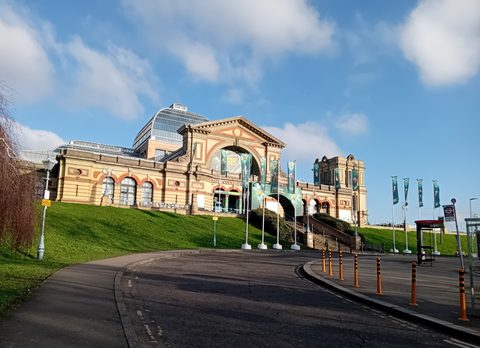
Haringey is an outer London borough on the northern hills, and it reads as four places rather than one. Alexandra Park and Wood Green are organised around a palace of 1873 covering about seven and a half acres, standing in a registered park of 78.52 hectares above a high street with three Piccadilly line stations. Muswell Hill and Highgate carry shopping parades of 1897 with a listed grocer's interior still trading, a cinema of 1935, seventy acres of woodland run by the City of London Corporation, and Lubetkin's two Grade I blocks on North Hill. Crouch End, Hornsey and Harringay hold a town hall of 1935 facing its own green and two Grade II* pubs by one builder. Tottenham runs a mile and a half up the old Roman road past a Grade I Tudor manor house, a c.1600 cross and a stadium of 62,850 seats. The National Heritage List for England records 285 listed-building entries inside the borough boundary.
-
sight
Grade II listed as NHLE 1268256 and covering about seven and a half acres; the East Court opens 9am to 5pm daily, entry to building and park is free and attractions are ticketed.
-
An auditorium of 1875 with a complete set of Victorian stage machinery by Messrs Grieve and Son below the stage, reopened on 1 December 2018 in a state of arrested decay.
-
walk
78.52 hectares of Grade II registered park and garden, NHLE 1001253, open day and night all year, with a boating lake, a pitch and putt course and the long view south.
-
Charles Holden's Piccadilly line station of 1932, Grade II listed as NHLE 1263624, with a double-height booking hall between two ventilation towers and an attached bus station.
-
sight
George Coles's Odeon of 1935–6 on Fortis Green Road, Grade II* listed as NHLE 1079178, with a laylight resembling a roll of film running down to the proscenium.
-
food
A grocer trading on Muswell Hill Broadway since 1897, open Monday to Saturday 9.30am to 5.30pm and Sunday 12pm to 4pm, roasting coffee daily behind a Grade II shopfront, NHLE 1393627.
-
walk
Seventy acres of ancient woodland run free of charge by the City of London Corporation, with a café, a playground and a Grade II drinking fountain, NHLE 1096149.
-
Lubetkin and Arup's two Grade I blocks on North Hill, NHLE 1358885 and NHLE 1079183, completed in 1935 and 1938 and seen from the street: they are private flats.
-
sight
A house of 1637–38 on Highgate Hill, Grade I listed as NHLE 1079233 with its forecourt walls separately Grade I, NHLE 1188817; an annex of Ghana's high commission, seen from outside.
-
sight
R. H. Uren's town hall of 1935 facing its green on The Broadway, Grade II* listed as NHLE 1263688 and now an aparthotel of 68 serviced apartments.
-
food
John Cathles Hill's pub of 1899–1901 on Broadway Parade, Grade II* listed as NHLE 1079170, with a QH mosaic lobby and a bar in four glazed-partition areas.
-
food
Hill's pub-hotel of 1898–9 on Green Lanes, Grade II* listed as NHLE 1358865, with a billiard room under a top-lit roof painted with a creeping vine.
-
45.18 hectares laid out by Alexander McKenzie in 1869, Grade II registered as NHLE 1000804, with gates open 8am to 4pm and a gallery in the McKenzie Pavilion.
-
A house of circa 1600 with a Tudor tower of 1514, both Grade I listed as NHLE 1358861 and NHLE 1294388; free, open Wednesday to Sunday 1 to 5pm.
-
A fourteenth-century tower and nave with a Butterfield chancel of 1875–7, Grade II* listed as NHLE 1188633, 196 m from Bruce Castle across the churchyard.
-
sight
A circa 1600 brick structure stuccoed in 1809 and given Gothic decoration, Grade II listed as NHLE 1188856, standing in the High Road on the line of Ermine Street.
-
A ground of 62,850 seats opened in April 2019, with a self-guided tour from £23 and the 90-minute Dare Skywalk above the roof from £29 on non-event days.
-
A 100 horsepower Wood Brothers beam engine of 1888 in its Grade II listed engine house, NHLE 1358862, steaming at 12.30 and 2.30 on the second and fourth Sunday of the month.
Alexandra Park and Wood Green
The hill the borough is organised around carries one very large building. Alexandra Palace, on Alexandra Palace Way, N22 7AY, is Grade II listed, NHLE 1268256, listed 1 October 1996 and amended 30 January 2012, under the name 'Alexandra Palace including former Alexandra Palace Station to North'; the list description states that 'the Palace covers about seven and a half acres' and describes cast-iron and steel columns with walls of white Huntingdon and yellow stock brick in the Italianate style, with Portland cement ornament. It opened on 24 May 1873 and was destroyed by fire sixteen days later, and was rebuilt to the designs of John Johnson and Alfred Meeson, whom the list entry names, reopening on 1 May 1875. The East Court opens Monday to Sunday 9am to 5pm and Visitor Services 9am to 5pm; the Phoenix Bar & Pizzeria opens Sunday to Thursday 11am to 9.30pm and Friday to Saturday 11am to 10pm. Entry to the building and the park is free and individual attractions are ticketed. The ice rink publishes weekly session times — Monday 11:00 to 16:30, Tuesday 13:15 to 17:00, Wednesday and Thursday 11:00 to 17:00, Friday 13:15 to 17:00, Saturday and Sunday 11:00 to 16:30 — with a standard off-peak skate at £11.75. The building is run by the Alexandra Park and Palace Charitable Trust, registered charity no. 281991.
Two of the palace's rooms are the reason the list entry runs long. The tower at the south-east corner was adapted in 1935 to house offices and studios for the BBC, with a tall steel latticed girder mast added on top, and the BBC began regular public high-definition television broadcasts from Studios A and B in November 1936. The Victorian theatre in the north-east corner is covered by the same Grade II entry, NHLE 1268256, rather than by a listing of its own, and it is a separate place to visit: it opened with the rebuilt palace in 1875, served as a dormitory, chapel and cinema when the whole palace was requisitioned as a Belgian refugee transit camp and then an internment camp during the First World War, and reopened in 2018 after a refurbishment that consolidated the room in a state of arrested decay rather than redecorating it. The first public performance was a BBC Prom on 1 September 2018 and the official reopening followed on 1 December 2018. Below the stage is a complete set of Victorian stage machinery by Messrs Grieve and Son — wooden bridges, traps, pulleys and levers for scene transformations and for projecting props and actors onto the stage. The theatre programmes ticketed performances rather than daytime admission, so no opening hours are given here.
Alexandra Park is a separate designation: a Grade II registered park and garden, NHLE 1001253, registered 9 May 1995, measuring 78.52 hectares, and the register names the entry ALEXANDRA PALACE. The operator states that the park is 'open throughout the day and night, all year round', with the playground and skatepark closing at dusk; the East Court car park opens seven days a week 5.30am to 12.30am on non-event days and the Grove car park 6am to 7pm. The park holds a boating lake, a pitch and putt course, a skatepark and the Grove bar area, and gives the long southward view over central London that the palace was sited for. Alexandra Palace and Park is also a Haringey conservation area, designated 22 September 1978.
Wood Green below it keeps three Piccadilly line stations of Charles Holden's 1932 extension, all three of them designated. Turnpike Lane Underground Station, on Green Lanes, N15 3LA, is Grade II listed, NHLE 1263624, listed 17 May 1994 as 'Turnpike Lane London Regional Transport Underground Station': red brick with grey diaper infill to reinforced concrete, the concrete roof slab expressed as a broad cornice band under deep eaves, and a double-height booking hall set between two ventilation towers, the one to Green Lanes carrying 'Underground' logos. Wood Green Underground Station is Grade II listed, NHLE 1401120, listed 20 July 2011, and Bounds Green is Grade II, NHLE 1393641, listed 19 January 2010.
Muswell Hill and Highgate
Muswell Hill is a suburb of 1896 to 1914 with no station of its own, and its shopping parades are the point. Queens Parade opened in August 1897, built by the developer James Edmundson, and W Martyn has traded on the site since it opened and is still owned and run by the Martyn family; the firm appears at No. 12 Queens Parade in the 1899 Kelly's Directory of Middlesex. The shop at 135 Muswell Hill Broadway, N10 3RS, opens Monday to Saturday 9.30am to 5.30pm and Sunday 12pm to 4pm, and coffee is roasted on the premises daily. What is Grade II listed, NHLE 1393627, listed 17 December 2009 and amended 15 July 2011, is the shop rather than the building: the entry is titled 'W Martyn, Grocers Shop on the Ground Floor'. It covers two plate-glass windows in narrow white metal frames above low black Vitrolite stallrisers, a white mosaic lobby floor carrying the shop's name, a black Vitrolite fascia with W. MARTYN in crimson raised block capitals, and inside, mahogany shelving with moulded tops, candy-twist columns and fluted pilasters running round three walls, with semi-circular metal storage bins with hinged wooden lids behind the counter.
Round the corner on Fortis Green Road, N10 3HP, the Everyman is the former Odeon, Grade II* listed, NHLE 1079178, listed 6 March 1984 under the entry name 'Odeon Cinema'. George Coles built it in 1935–6 for the Muswell Hill and Harlesden Property Company, of which Oscar Deutsch of Odeon Cinemas was a director: red brick with the cinema facade clad in black and cream faience tiles and the name ODEON in neon affixed to the parapet. The building was pushed onto Fortis Green Road because members of the church opposite opposed the prominent corner site originally intended, and the facade was deliberately kept low-key as a result. Historic England's assessment sets its interior beside the New Victoria in Westminster as a demonstration of the influence of German expressionism in British cinema design; the auditorium has a central laylight of separate small lights designed to resemble a roll of film running down to the proscenium, and the area under the balcony was subdivided into smaller screens in May 1974. It runs as a cinema and publishes film showtimes rather than opening hours, so none are given here.
Highgate Wood lies between Muswell Hill and Highgate on Muswell Hill Road, N10 3JN. The City of London Corporation describes it as 'a beautiful 70-acre ancient woodland in North London' and runs it as a charity, registered number 232986; entry is free, there are no published opening times, and the Corporation warns that the wood may close at short notice when winds of 37mph or above are forecast. It carries Green Flag and Green Heritage awards and has a café and terrace, a large playground and a sports field. Cycling is not permitted anywhere in the wood under its byelaws, in order to protect the ancient woodland, and there is no car park; two blue-badge bays sit near the café, reached from Onslow Gate. The wood itself carries no NHLE designation, but the drinking fountain in it is Grade II listed, NHLE 1096149, listed 3 March 2003.
Highgate village is divided by the borough boundary, and Haringey's half is where most of its Grade I entries are. Highpoint I and Highpoint II stand next to each other on North Hill, N6 4BA: Highpoint I is Grade I listed, NHLE 1358885, and Highpoint II Grade I listed, NHLE 1079183, both listed 10 May 1974. Berthold Lubetkin designed Highpoint I with structural design by Ove Arup and construction by J. L. Kier & Co Ltd, completed in 1935 for the entrepreneur Sigmund Gestetner and intended to house Gestetner company staff; it contains 64 flats. Le Corbusier visited in 1935 and said 'This beautiful building .... at Highgate is an achievement of the first rank.' Highpoint II, on the adjoining site, was completed in 1938, and Lubetkin lived in Highpoint I's penthouse until it was finished and then moved into Highpoint II's. Both are private flats, seen from North Hill, and both stand in Haringey's Highgate conservation area, designated 21 December 1967.
Cromwell House, at 104 Highgate Hill, N6 5HE, is Grade I listed, NHLE 1079233, listed 19 March 1951, with its forecourt walls a separate Grade I entry, NHLE 1188817, listed 10 May 1974. It was built in 1637–38 for Sir Richard Sprignell, whom Charles I created a baronet in 1641, to an unknown architect, and is recognised with Kew Palace as a surviving London example of seventeenth-century 'artisan mannerist' domestic architecture, its seven-window frontage showing the influence of Inigo Jones. The listing particulars call it a 'splendid example of Renaissance brickwork', with a slate mansard roof of seven dormers, a balustraded flat roof and a lead cupola on a tall octagonal column. It is owned by the Republic of Ghana and used as an annex of its high commission, so it is seen from Highgate Hill rather than entered. Three of the six Grade I entries the National Heritage List for England records in the borough stand within half a mile of each other here; Highgate Cemetery and Kenwood House, across the boundary, are in the London Borough of Camden.
Crouch End, Hornsey and Harringay
Crouch End is arranged around a small green and the building that faces it. Hornsey Town Hall, on The Broadway, N8 9JH, is Grade II* listed, NHLE 1263688, listed 16 January 1981 with a minor amendment on 29 November 2021. R. H. Uren designed it in 1935 and won the RIBA Architecture Medal and the Gold Medal of the Worshipful Company of Tylers and Bricklayers for it; the list description records the design as modelled on Willem Dudok's town hall at Hilversum — Historic England's text spells the Dutch architect's name Dudock — and as an influence on other British town halls built subsequently. It is the centrepiece of a composition around the green, flanked by the former Gas Board and Electricity Board showrooms, and the Electricity Board office and showroom is itself Grade II listed, NHLE 1358881. Interior decoration and furnishing were designed as part of the original conception and much survives: floor surfaces, wall cladding, columns, doors, light fittings, the imperial main stair with its openwork metal balustrade, the Council Chamber's original half-round seats and desks, and a galleried theatre with inlaid wood panelling to the walls. The building was the headquarters of the Municipal Borough of Hornsey until 1965, when the London Borough of Haringey was formed; restoration works began in October 2019 under a developer selected by Haringey Council, to a design by Donald Insall Associates, and it reopened in November 2025 as Dao by Dorsett North London, an aparthotel of 68 serviced apartments. The exterior is visible at all times from The Broadway and no visitor admission to the interior is published, so no opening hours are given here. It stands in Haringey's Crouch End conservation area, designated 25 October 1974.
John Cathles Hill (1858–1915), the builder and developer who laid out much of this part of north London, left two Grade II pubs, one in Crouch End and one in Harringay, and they are the pair worth seeing together. The Queen's, at 26 Tottenham Lane on Broadway Parade, N8 9DE, is Grade II listed, NHLE 1079170, listed 23 November 1973, and was built between 1899 and 1901: three storeys and an attic in red brick with extensive pale yellow limestone dressings, black granite to the ground-floor pilasters and base, and a lead-sheathed roof to the angle turret. Its circular entrance lobby has a mosaic floor with a QH monogram beneath a wrought-iron screen inscribed THE QUEENS, and Historic England records the interior as surviving 'largely intact', with a central bar divided into four areas by ornate glazed wooden partitions with etched decoration and Art Nouveau stained glass under a coffered ceiling with relief arabesques and mermaids. It stands in the Crouch End conservation area, designated 25 October 1974.
The Salisbury, at 1 Grand Parade, Green Lanes, Harringay, N4 1JX, is Grade II* listed, NHLE 1358865, listed 10 May 1974. Hill built it in 1898–9 as one of a pair of pub-hotels in Hornsey, in a French Renaissance style with shaped gables, ogee domed cupolas and large pedimented dormers, three storeys and an attic and nine windows on a corner site curving into St Ann's Road. Two enormous polished granite columns support half-octagonal turrets, and the ground floor is Portland stone on a high grey granite plinth with polished black granite Corinthian pilasters. The first-floor former restaurant and concert room has an elaborate compartmented ceiling with ornate fibrous plasterwork by the Mural Decoration Company and engraved glass by Cakebread & Robey; the ground floor retains a large billiard room with a top-lit roof, the glass painted with a creeping vine motif. Historic England calls the interior 'A magnificently elaborate and complete interior' and notes that Hill had his own workshops, where many of the fixtures and fittings for his pubs were made. Both pubs trade; no source states their opening hours, so none are given here.
Finsbury Park closes this part of the borough at its southern tip. It is a Grade II registered park and garden, NHLE 1000804, registered 1 October 1987, measuring 45.18 hectares, and it opened in 1869 to a layout by Alexander McKenzie. The park is not wholly Haringey's: Haringey Council's own page for it states that '3 London boroughs meet in Finsbury Park – Haringey, Islington and Hackney', and the eastern edge along Green Lanes falls in the London Borough of Hackney. Haringey manages it and publishes it as 'Open 24 hours a day', with gate opening times Monday to Sunday 8am to 4pm and gates 'locked promptly at 4pm', and lists the facilities as an athletics track, boating lake, bowls club, café, Changing Places toilet, disability play, netball courts, outdoor gym, picnic area, playground, skatepark, splash play, table tennis tables, tennis courts, toilets and zip wire. Furtherfield runs two venues in the park: Furtherfield Gallery in the McKenzie Pavilion, beside the boating pond and across the playground from the café, N4 2NQ, open during exhibitions, and Furtherfield Commons at Finsbury Gate, N4 2DE. None of the stations named for the park are in Haringey — Finsbury Park and Crouch Hill are in the London Borough of Islington and Manor House, at the park's eastern gate, is in the London Borough of Hackney.
Tottenham
Tottenham is a mile and a half of the old Roman road, and the things worth stopping for stand along it. Tottenham High Cross, on the High Road at Monument Way, N15 4ET, is Grade II listed, NHLE 1188856, listed 22 July 1949: an octagonal tower of three stages with a short spire, the ridges crocketed and the upper stages carrying cusped Gothic panelling. The amended list description reads 'Circa 1600 brick structure replacing an earlier wooden cross. Covered with stucco in 1809 and subsequently given Gothic decoration of the same material.' The entry states explicitly that its origins are obscure and that it 'does not have any apparent connection with crosses set up by Edward I in memory of Queen Eleanor' — the confusion with the Eleanor cross at Waltham Cross is common and wrong. It marks the historic centre of Tottenham village on the line of Ermine Street, which the High Road still follows, and it stands in Haringey's Tottenham Green conservation area, designated 26 March 1976.
Bruce Castle, on Lordship Lane, N17 8NU, is the borough museum and archive and is Grade I listed, NHLE 1358861, listed 22 July 1949, with the detached Tudor tower to its south west a separate Grade I entry, NHLE 1294388, listed the same day. The list description dates the house to circa 1600 — red brick, shallow H-shape — with additions of 1684 and of the early and late eighteenth century, the 1684 frontispiece carrying a stuccoed clock-tower stage crowned with a glazed octagon, open drum and cupola. The museum states that the Tudor Tower was built in 1514 using locally made bricks by Sir William Compton, Groom of the Stool to Henry VIII and lord of the manor, and that it is the oldest visible part of the site; its purpose has never been established, and Henry Hare, 2nd Lord Coleraine, writing in 1701, could not tell 'whether it was built for a Monument house or for a Mews or for a Pigeon house or as a Prison', with recent thinking favouring a hawks' mews. Rowland Hill, later the originator of the penny post, was headmaster of the radical Bruce Castle School here from 1827; the school closed in 1891 and the house opened as a museum in 1906. The museum opens Wednesday to Sunday 1 to 5pm and the Archive Search Room Wednesday to Friday 10am to 12.30pm and 1.30 to 4pm, and every second Saturday of the month at the same times, with booking essential for the Search Room; admission is free. The grounds became a public park in June 1892, given by the museum as 20 acres, and its gates are not locked. The boundary walls are separately Grade II listed, NHLE 1079218 to Bruce Castle Park on the south and NHLE 1294666 on the west, both listed 10 May 1974.
The Parish Church of All Hallows stands 196 m away across the churchyard on Church Lane, N17 7AA, Grade II listed, NHLE 1188633, listed 22 July 1949. The west tower and the western six bays of the nave arcades are fourteenth-century, the south aisle fifteenth-century and the south porch early sixteenth-century, with diaper brickwork, an embattled parapet and angels and Tudor roses on the string course below; the inner south door keeps its original early sixteenth-century carved spandrels. The top of the tower was built or rebuilt in brick in 1741 and the north aisle rebuilt in brick in 1816, and the eastern bay of the nave, the chancel, transepts and north vestry were added in 1875–7 to designs by William Butterfield, with his banded stone and brick diapering. It is a working parish church, open for services; no source states its opening hours, so none are given here. The vicarage, The Priory, is Grade II listed, NHLE 1079263, and its front wall and gates Grade II*, NHLE 1358844. Church and castle both sit in Haringey's Bruce Castle and All Hallows conservation area, designated 26 March 1976; the adjoining Tottenham Cemetery is a separate conservation area of the same date and holds Butterfield's own Grade II listed tomb, NHLE 1084329, listed 28 February 1995.
Further north on the High Road the scale changes. Tottenham Hotspur Stadium, at 782 High Road, N17 0BX, opened in April 2019 with a capacity of 62,850; the operator states that its South Stand is a single tier of 17,500 seats and consists of 7,217 tonnes of steel, that the ground has a dividing retractable grass surface with an artificial pitch beneath it, purpose built for American football and the NFL as well as for football, and that the concourse is made using aggregate from the demolished White Hart Lane. Published attractions include a self-guided Stadium Tour from £23, The Dare Skywalk, a 90-minute tour along a glass walkway above the roof, from £29, The Edge from £10, Technical Tours from £120 running 3 hours 45 minutes with access underneath the retracting pitch, and Legends and Matchday Tours; matchdays and events change access to the site entirely. Three Georgian and Regency houses stand on the High Road beside the ground: Percy House at No. 796, Grade II, NHLE 1079242, and Dial House at No. 790, Grade II, NHLE 1079241, both listed 22 July 1949 just north of the stadium's 782 frontage, and Warmington House at No. 744, of 1828, Grade II, NHLE 1358833, listed 10 May 1974, about 300 metres to its south, which the list entry records as 'most recently the supporters' club and offices to Tottenham Hotspur FC'.
Markfield Beam Engine and Museum, in Markfield Park on Markfield Road, N15 4RB, keeps a working 1886–88 engine in the building it was built for, Grade II listed, NHLE 1358862, listed 10 May 1974 under the title 'Pumping Station Building and Engine' — the entry covers the engine as well as the building. Wood Brothers of Sowerby Bridge built it between 1886 and 1888 and it was commissioned on 12 July 1888, replacing an earlier 45 horsepower beam engine; it is rated at 100 horsepower, 75 kW, and has a 27-foot, 8.2 m, flywheel driving a 21-foot, 6.4 m, beam that works two single-acting plunger pumps, each 26 inches in diameter with a 51-inch stroke, which at a working speed of 16 rpm could each move 2,000,000 imperial gallons a day. The sewage works opened in 1864 under the Tottenham and Wood Green Drainage Board and pumped Tottenham's sewage towards Beckton, closing in February 1964 when Deephams at Edmonton replaced them. Restoration of engine, building and grounds cost over £3 million, funded by the Heritage Lottery Fund, the Football Foundation, DCLG and the Big Lottery Fund, and the park and museum reopened in April 2010; in 2025 the museum merged with the Walthamstow Pumphouse Museum to form the Heritage and Communities Trust. Open days run 10am to 3.30pm and steaming days 10am to 4pm, usually the second and fourth Sunday of the month, with the engine running at 12.30 and 2.30; entry is free and donations are welcome. The River Moselle joins the River Lea at this point.
Getting there
Six Underground stations lie inside Haringey, on three lines: Turnpike Lane, Wood Green and Bounds Green on the Piccadilly line, Seven Sisters and Tottenham Hale on the Victoria line, and Highgate on the Northern line. The Overground adds the Weaver line at Bruce Grove, White Hart Lane and Seven Sisters and the Suffragette line at Harringay Green Lanes and South Tottenham. National Rail runs Great Northern and Thameslink to Alexandra Palace and Harringay, Great Northern to Hornsey and Bowes Park, and Greater Anglia to Tottenham Hale, Seven Sisters, Northumberland Park, Bruce Grove and White Hart Lane. There is no Elizabeth line station, no DLR station and no tram stop in the borough. Four stations that serve Haringey are outside it: Finsbury Park and Crouch Hill are in the London Borough of Islington, Manor House is in the London Borough of Hackney, and East Finchley, on the Northern line, is in the London Borough of Barnet.
For Alexandra Park and Wood Green, take the Piccadilly line to Wood Green, 81 m from Wood Green High Road, or Great Northern or Thameslink to Alexandra Palace, 835 m from the palace and a signposted walk uphill through the park rather than a station at the door. Turnpike Lane is 931 m south of Wood Green station and has a bus station attached; Bowes Park, on Great Northern, is 1,295 m north of it. Bus route W3 runs to the palace itself and is the only bus stopping within 400 m of the building.
For Muswell Hill and Highgate, take the Northern line to Highgate: it is 445 m from Highpoint I, 462 m from Highpoint II and 757 m from the drinking fountain in Highgate Wood, and the City of London names it along with bus routes 43, 134 and 234 in its own guidance for the wood. Muswell Hill has no station of any kind: from Muswell Hill Broadway, Highgate is 1,446 m, East Finchley 1,479 m and Alexandra Palace rail 1,798 m. Muswell Hill Broadway is reached by buses 43, 102, 134, 144, 234, 299 and W7 and by school routes 603, 634 and 653.
For Crouch End, Hornsey and Harringay, the nearest station to Crouch End is Crouch Hill on the Overground Suffragette line, 911 m from Hornsey Town Hall and in Islington rather than Haringey; Hornsey, on Great Northern, is 1,130 m from the town hall and Harringay, on Great Northern and Thameslink, 1,219 m. For The Salisbury, Harringay Green Lanes on the Suffragette line is 568 m and Harringay 676 m. For Finsbury Park, the station of that name carries the Piccadilly and Victoria lines, Great Northern and Thameslink and bus routes 4, 19, 29, 106, 153, 236, 253, 254, 259 and 310 with night routes N19, N29, N253 and N279, and stands immediately south of the park across Seven Sisters Road in Islington; Manor House, on the Piccadilly line, is at the park's eastern gate on Green Lanes and is in Hackney.
For Tottenham, take the Overground Weaver line or Greater Anglia to Bruce Grove, 691 m from Bruce Castle, which the museum gives as a seven-minute walk up Bruce Grove, or to White Hart Lane, about 310 m from Tottenham Hotspur Stadium and 725 m from Bruce Castle; Northumberland Park, on Greater Anglia, is about 900 m from the stadium. Seven Sisters is 709 m from Tottenham High Cross, with bus routes 76, 149, 243, 279, 318, 349, 476 and N73 at the hub, and Tottenham Hale is 697 m from the High Cross and 721 m from Markfield Beam Engine, with South Tottenham 753 m from Markfield. Buses 123, 243 and 318 stop by Bruce Castle in Lordship Lane, Bruce Grove or The Roundway, with the indicator announcing 'Bruce Castle Park and Museum', and the W3 also serves it. Every distance above is a straight-line figure, not a walking measurement.
Frequently asked questions
- What are Alexandra Palace's opening hours, and what does it cost?
- The East Court at Alexandra Palace, Alexandra Palace Way, N22 7AY, opens Monday to Sunday 9am to 5pm, as does Visitor Services; the Phoenix Bar & Pizzeria opens Sunday to Thursday 11am to 9.30pm and Friday and Saturday 11am to 10pm. Entry to the building and to Alexandra Park is free and individual attractions are ticketed: the ice rink runs Monday 11:00 to 16:30, Tuesday 13:15 to 17:00, Wednesday and Thursday 11:00 to 17:00, Friday 13:15 to 17:00 and Saturday and Sunday 11:00 to 16:30, with a standard off-peak skate at £11.75. The palace is Grade II listed, NHLE 1268256, and the park a Grade II registered park and garden, NHLE 1001253, of 78.52 hectares.
- Which buildings in Haringey are Grade I?
- Six list entries in the borough are Grade I, and they make two groups. Bruce Castle, NHLE 1358861, and the detached Tudor tower to its south west, NHLE 1294388, were both listed on 22 July 1949 in Tottenham. Cromwell House, NHLE 1079233, listed 19 March 1951, its forecourt walls, NHLE 1188817, and Highpoint I, NHLE 1358885, and Highpoint II, NHLE 1079183, all listed 10 May 1974, stand within half a mile of each other in Highgate. The National Heritage List for England records 285 listed-building entries inside the borough boundary — 6 at Grade I, 21 at Grade II* and 258 at Grade II — two Grade II registered parks and gardens, Finsbury Park, NHLE 1000804, and Alexandra Palace, NHLE 1001253. Historic England's scheduled monuments layer returns nothing anywhere inside the borough boundary, so Haringey appears to hold none.
- Is Finsbury Park in Haringey, and which station should I use?
- Mostly, and Haringey manages it, but not entirely: Haringey Council's own page for the park states that '3 London boroughs meet in Finsbury Park – Haringey, Islington and Hackney', and the eastern edge along Green Lanes is in Hackney. The park is a Grade II registered park and garden, NHLE 1000804, registered 1 October 1987, covering 45.18 hectares. None of its stations are in Haringey. Finsbury Park station, immediately south across Seven Sisters Road, carries the Piccadilly and Victoria lines, Great Northern and Thameslink and is in the London Borough of Islington; Crouch Hill, on the Overground Suffragette line, is also in Islington; and Manor House, on the Piccadilly line at the park's eastern gate, is in the London Borough of Hackney.
- Which Underground and rail lines serve Haringey?
- Six Underground stations lie inside the borough on three lines: Turnpike Lane, Wood Green and Bounds Green on the Piccadilly line, Seven Sisters and Tottenham Hale on the Victoria line, and Highgate on the Northern line. The Overground adds the Weaver line at Bruce Grove, White Hart Lane and Seven Sisters and the Suffragette line at Harringay Green Lanes and South Tottenham. National Rail runs Great Northern and Thameslink at Alexandra Palace and Harringay, Great Northern at Hornsey and Bowes Park, and Greater Anglia at Tottenham Hale, Seven Sisters, Northumberland Park, Bruce Grove and White Hart Lane. There is no Elizabeth line station, no DLR station and no tram stop in Haringey, and Finsbury Park, Crouch Hill, Manor House and East Finchley all lie in neighbouring boroughs.
- Can I go inside Highpoint, Cromwell House or Hornsey Town Hall?
- No. Highpoint I, Grade I listed as NHLE 1358885, and Highpoint II, NHLE 1079183, are private flats on North Hill and are seen from the street; both stand in Haringey's Highgate conservation area, designated 21 December 1967. Cromwell House, Grade I, NHLE 1079233, at 104 Highgate Hill, is owned by the Republic of Ghana and used as an annex of its high commission, and is seen from Highgate Hill. Hornsey Town Hall, Grade II*, NHLE 1263688, reopened in November 2025 as Dao by Dorsett North London, an aparthotel of 68 serviced apartments; its exterior faces The Broadway and no visitor admission to the interior is published, so no opening hours are given here.
- Which places in Haringey publish opening hours?
- Bruce Castle Museum opens Wednesday to Sunday 1 to 5pm, with the Archive Search Room Wednesday to Friday 10am to 12.30pm and 1.30 to 4pm and every second Saturday of the month at the same times, booking essential; admission is free. W Martyn opens Monday to Saturday 9.30am to 5.30pm and Sunday 12pm to 4pm. Markfield Beam Engine and Museum runs open days 10am to 3.30pm and steaming days 10am to 4pm, usually the second and fourth Sunday of the month, with the engine running at 12.30 and 2.30, free with donations welcome. Alexandra Palace's East Court opens 9am to 5pm daily and Finsbury Park's gates 8am to 4pm. The Everyman, the Alexandra Palace Theatre, The Queen's, The Salisbury and the Parish Church of All Hallows publish programmes or services rather than a weekly schedule, so none are given here.
Connected pages
Nearby
-
Barnet, London: the RAF Museum, Hampstead Garden Suburb, Chipping Barnet and the field of 1471
· Barnet, England
East Finchley and Muswell Hill face each other across one ridge, and the Northern line runs from Barnet's Finchley stations into Haringey at Highgate.
-
Camden, London: the British Museum, the British Library, Camden Lock and Kenwood House
· Camden, England
Highgate is divided between the two: Cromwell House and Highpoint, both Grade I, are in Haringey, while Highgate Cemetery and Kenwood House are in Camden.
-
Enfield, London: Forty Hall, Elsyng Palace, Trent Park and the Holden stations of the Piccadilly line
· London Borough of Enfield, England
The New River runs south out of Enfield through Wood Green and Harringay; Southgate, Arnos Grove and Turnpike Lane are Holden stations on one Piccadilly branch.
-
Waltham Forest, London: Walthamstow Wetlands, God's Own Junkyard, Queen Elizabeth's Hunting Lodge and Epping Forest
· Waltham Forest, England
Walthamstow Wetlands straddles the Lea on an N17 Tottenham postcode, and the Walthamstow Pumphouse Museum merged with Haringey's Markfield in 2025.
Shared history
-
Enfield, London: Forty Hall, Elsyng Palace, Trent Park and the Holden stations of the Piccadilly line
· London Borough of Enfield, England
The New River runs out of Enfield through Wood Green and Harringay; Turnpike Lane, Southgate and Arnos Grove are Holden stations on one Piccadilly branch.
-
Islington, London: the Charterhouse, St John's Gate, Sadler's Wells and Highbury Fields
· Islington, England
Finsbury Park carries Islington's old parish name and is managed by Haringey, while Finsbury Park and Crouch Hill stations are both in Islington.
-
Bromley, London: Crystal Palace Park and its dinosaurs, Down House, Chislehurst Caves and Keston Windmill
· Bromley, England
Alexandra Palace and the Crystal Palace were the two Victorian exhibition palaces; Bromley holds the park and terraces of the one that burned in 1936.
What travelers think
Log in to react.
No reviews yet.