.jpg)
Celio, Rome: the Colosseum, the Caelian hill and the road to the Porta Latina
Celio, Rome
Pictures from Celio
See all 1 photos →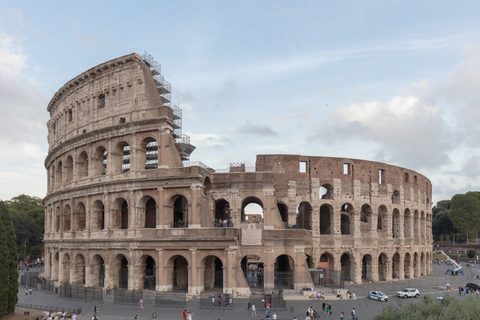
Celio is the nineteenth of Rome's rioni by toponymic code, and it is two pieces of ground rather than one. The northern piece is the Caelian hill, which Roma Capitale records was anciently called Mons Querquetulanus because it was covered in oaks. The Colosseum stands on its western edge, and so do a free archaeological park with two museums in it, a group of early basilicas, and the walled Mattei garden that is now the public park of Villa Celimontana. The southern piece is a long tongue of ground running inside the Aurelian Walls down via di Porta San Sebastiano, carrying the tomb of the Scipios, a painted columbarium, two churches at the Porta Latina and the city nursery that grows the azaleas for the Spanish Steps. Nearly every edge of the rione is a street shared with a neighbour.
-
The Flavian amphitheatre, begun in 70 AD under Vespasian and finished in 80 AD under Titus: 189 by 156 metres, over 48 metres high, with an arena of 76 by 46 metres.
-
The Parco archeologico del Colosseo gives the square's transport as Metro line B, station Colosseo, buses 51, 75, 81, 85, 87 and 118, and tram 3.
-
A free park on the shoulder of the hill facing the Colosseum, open 7.00 to 17.30 in winter and 7.00 to 20.00 in summer, with finds from the excavations of the late nineteenth century set out in the garden.
-
sight
The surviving fragments of the Severan marble plan of Rome, incised between 203 and 211 AD, laid out on the museum floors over Nolli's Pianta Grande of 1748.
-
sight
Twenty frescoed underground rooms beneath the basilica of Santi Giovanni e Paolo, found in 1887 and running from a second-century domus to a fourth-century titulus.
-
Raised from 398 on the site of a house church, with a campanile set on the remains of the Temple of Claudius; Roma Capitale gives the hours as 08.30 to 12.45 and 14.00 to 17.00.
-
walk
The Mattei garden of the late sixteenth century, now a public park of 110,000 square metres, open from dawn to sunset.
-
A ninth-century rebuilding by Paschal I, who put himself at the Virgin's feet in the apse mosaic, behind a portico designed by Andrea Sansovino.
-
A fortified medieval complex rebuilt after the fire of 1084, its entrance dominated by the Torre Maggiore and its Cosmatesque pavement still in place.
-
Three hundred square metres of thirteenth-century painting uncovered in 1995, shown on sixteen published days in 2026 with timed entries booked by email.
-
sight
The tomb of the Cornelii Scipiones on the urban stretch of the via Appia, built in the first decades of the third century BC and entered only by booking on 060608.
-
A basilica behind a cedar-shaded forecourt, open every day from 06.30 to 18.00 by its own account, with a twelfth-century fresco cycle of 46 scenes found in 1940.
-
Roman home cooking on Via Ostilia; the dishes it names include zucchine ripiene, tagliolini con ragu d'anatra, polpette ebraiche and tordo matto.
-
stay
A three-star hotel on Via Capo d'Africa, which its own site places in the Celio.
The rione's boundaries and its neighbours
it.wikipedia's article on the rione reproduces Celio's delimitation. The line with Monti runs along piazza del Colosseo, via di San Giovanni in Laterano, via Santo Stefano Rotondo and via della Navicella to piazza di Porta Metronia. The south-east side is the Aurelian Walls themselves, from Porta Metronia to Porta San Sebastiano, with the quartiere of Appio-Latino beyond them. The line with San Saba runs along via di Porta San Sebastiano, piazzale Numa Pompilio, a short stretch of viale delle Terme di Caracalla, via di Valle delle Camene and piazza di Porta Capena. To the west are Ripa, at piazza di Porta Capena, and Campitelli, along via di San Gregorio and piazza del Colosseo. A street named as a boundary tells you where a line runs; it does not tell you what stands on either side of it.
The Colosseum is in Celio. Two churches whose names point at the Caelian stand outside it: the basilica of Santo Stefano Rotondo al Celio carries the hill in its title, but via di Santo Stefano Rotondo is the line with Monti, and both Santo Stefano Rotondo and San Clemente stand in Monti, along with San Giovanni in Laterano and the park of Colle Oppio.
Roma Capitale addresses the Arch of Constantine to via di San Gregorio, which the delimitation names as the line with Campitelli. it.wikipedia's article on the rione states that the start of the Appia Antica at Porta San Sebastiano is shared to the east between rione Celio and rione San Saba; the Museo delle Mura is inside the gate, and the museum's own site carries a notice that the museum is not accessible. The Porta Latina stands on the same wall line, and the basilica and the oratory that take their names from it stand in Celio. The Terme di Caracalla, whose viale clips the rione's southern boundary, stand in San Saba.
Getting there
For the northern lobe, the Parco archeologico del Colosseo gives access to piazza del Colosseo as Metro line B, station Colosseo; buses 51, 75, 81, 85, 87 and 118; and tram 3. Everything on the Caelian shoulder is reached from that square on foot, and the rest of this section is addresses rather than distances.
The Parco archeologico del Celio has three entrances, which the Sovrintendenza Capitolina gives as Viale del Parco del Celio 20, Viale del Parco del Celio 22 and Clivo di Scauro 4; the Museo della Forma Urbis and the Casina del Salvi are both at Viale del Parco del Celio 20. The basilica of Santi Giovanni e Paolo is at Piazza dei Santi Giovanni e Paolo 13, and the Case Romane del Celio are entered from the Clivo di Scauro, which Roma Capitale describes as an ancient Roman road and the principal axis of the Caelian, keeping part of its original course. San Gregorio al Celio is at Piazza di San Gregorio 1, with the park behind it entered from Salita di San Gregorio 3. Villa Celimontana has entrances on via della Navicella and on piazza dei Santi Giovanni e Paolo, and Santa Maria in Domnica faces the fountain of the Navicella at Via della Navicella 10. The complex of the Santi Quattro Coronati is at Via dei Santi Quattro 20.
The southern lobe is a walk of its own and no source states a bus route or a station for it, so none is given here. Steer by via di Porta San Sebastiano and via di Porta Latina. The Sepolcro degli Scipioni is at Via di Porta San Sebastiano 9. The Parco degli Scipioni has two entrances, Via di Porta Latina 10 and one on via di Porta San Sebastiano that the Sovrintendenza Capitolina records as currently closed; the Colombario di Pomponio Hylas is inside it, addressed by Roma Capitale to Via di Porta Latina 10. San Giovanni a Porta Latina is at Via di Porta Latina 17 and the oratory of San Giovanni in Oleo at no. 77. Piazzale Numa Pompilio carries San Sisto Vecchio at no. 8 and the Parco Egerio, and the Semenzaio di San Sisto is on Via Druso at no. 2.
Tickets, hours and closures
No current opening hours for the Colosseum are given here. Times and last admission change with the season; the Parco archeologico del Colosseo publishes them at colosseo.it, and tickets are sold at ticketing.colosseo.it. The Museo del Colosseo is on the second level of the amphitheatre and is reached on the same visit.
Around it, a good deal is free. The Sovrintendenza Capitolina gives the Parco archeologico del Celio as free to enter, open 7.00 to 17.30 in winter and 7.00 to 20.00 in summer, closed on 25 December and 1 May, and states that the archaeological area and the museum are accessible to all. In the same park, the Museo della Forma Urbis opens Tuesday to Sunday, 10.00 to 16.00 in winter with last entry at 15.00 and 10.00 to 19.00 in summer with last entry at 18.00, closed Mondays, 25 December and 1 May; the Casina del Salvi serves as a caffetteria and study room daily, 9.00 to 16.30 in winter and 9.00 to 19.00 in summer.
For the churches, Roma Capitale publishes the hours of Santi Giovanni e Paolo as 08.30 to 12.45 and 14.00 to 17.00, with the note that some times may vary during the wedding season, and gives San Sisto Vecchio as open daily 9.00 to 12.00 and 16.00 to 18.00, adding that times may vary and advising a telephone call first. The basilica of San Giovanni a Porta Latina states on its own site that it is open every day from 06.30 to 18.00. For the Case Romane del Celio, Roma Capitale publishes the hours as 10.00 to 16.00 Monday to Sunday and on public holidays, with the ticket office closing an hour earlier; closed 1 January and 25 December; 10.00 to 14.00 on 24 and 31 December, with booking through Coopculture on 06 39967755.
Two things need planning and three are shut. The Aula Gotica of the Santi Quattro Coronati opens on sixteen published days in 2026 with timed entries and is booked by email in advance, and its site states that the thirteenth-century cloister and the Oratorio di San Silvestro can be visited on those days too, 9.30 to 14.00 and 15.00 to 17.45. The Sepolcro degli Scipioni is entered only by booking on 060608, in groups of no more than twelve with their own guide, or on a published calendar of individual visits. Closed: the Colombario di Pomponio Hylas, which the Sovrintendenza Capitolina states has been temporarily closed to the public since 1 August 2024 for works under the PNRR; the Ninfeo dell'Uccelliera in Villa Celimontana, which Roma Capitale gives as closed to the public; and the Semenzaio di San Sisto, which Roma Capitale states is not open to the public and may be visited only on guided visits of the Dipartimento Ambiente.
Frequently asked questions
- Is the Colosseum in Celio?
- Yes. The amphitheatre stands in Celio. Its address is Piazza del Colosseo, 00184 Roma. Roma Capitale addresses the Arch of Constantine to via di San Gregorio, which the rione's delimitation names as the line with Campitelli.
- What are the Colosseum's opening hours, and where do I buy a ticket?
- No current opening hours are given here. Times and last admission change with the season; the Parco archeologico del Colosseo publishes them at colosseo.it, and tickets are sold at ticketing.colosseo.it.
- What is the Museo della Forma Urbis?
- A museum in the Parco archeologico del Celio holding the surviving fragments of the Severan marble plan of Rome, incised on 150 slabs of marble between 203 and 211 AD and displayed on the wall of a hall in the Temple of Peace. The Sovrintendenza Capitolina records that the complete plan covered about 18 by 13 metres and represented at least 13,550,000 square metres of city at an average scale of about 1:240. The plan is known from the fragments that survive; they amount to about a tenth of the original. In the museum they lie on the floors, superimposed on Giovanni Battista Nolli's Pianta Grande of 1748.
- Can you get into the Aula Gotica at the Santi Quattro Coronati?
- Only on published days, and only by booking. The site's own calendar for 2026 gives Friday 23 and Saturday 24 January; Friday 6 and Saturday 7 February; Friday 24 and Saturday 25 April; Tuesday 12 and Wednesday 13 May; Friday 12 and Saturday 13 June; Friday 18 and Saturday 19 September; Friday 23 and Saturday 24 October; and Friday 13 and Saturday 14 November, with entry at 09.00, 10.00, 11.00, 12.00, 13.00, 15.00, 16.00, 17.00 and 18.00. Booking is by email to archeocontesti@gmail.com, leaving a telephone contact. The same page states that on those days the thirteenth-century cloister and the Oratorio di San Silvestro may also be visited, 9.30 to 14.00 and 15.00 to 17.45, and that in 2026 the cloister may also be visited on Wednesday and Friday mornings, 9.30 to 11.45, except on holidays. An offering is appreciated for entry.
- Is anything in Celio free to walk into?
- Yes. The Sovrintendenza Capitolina gives free entry to the Parco archeologico del Celio, with its garden of epigraphic and architectural finds arranged in thematic groups. Villa Celimontana is a public park of 110,000 square metres, open from dawn to sunset, approximately 7.00 to 18.00 from 1 May to 31 October and 7.00 to 17.00 from 1 November to 30 April, and the obelisk of Ramesses II and the Fontana del Fiume stand inside it. The Parco degli Scipioni opens 7.00 to sunset. The fountain of the Navicella on piazza della Navicella, the Fontana di via di San Gregorio and the Arco di Dolabella e Silano all stand in the open street.
- Is Santo Stefano Rotondo al Celio in the rione of Celio?
- No. A dedication is not an address. Via di Santo Stefano Rotondo is named in the rione's own delimitation as part of the line with Monti, and the basilica stands in Monti, as do San Clemente al Laterano, San Giovanni in Laterano and the park of Colle Oppio. The same caution applies at the other end of the rione: viale delle Terme di Caracalla clips Celio's southern boundary, but the Baths of Caracalla stand in San Saba.
Connected pages
Nearby
-
Monti, Rome: The North Half of the Imperial Fora, Four Towers and the Lateran
· Monti, Rome
The neighbour across piazza del Colosseo and via di San Giovanni in Laterano, holding San Clemente, Santo Stefano Rotondo and San Giovanni in Laterano.
-
Campitelli, Rome: the Capitoline, the Roman Forum and the Palatine
· Campitelli, Rome
The neighbour west along via di San Gregorio, holding the Campidoglio and the Roman Forum.
-
Ardeatino, Rome: the Appian catacombs, the Fosse Ardeatine and the Tre Fontane abbey
· Ardeatino, Rome
The other rione on the northern boundary, inside the walls between Porta San Sebastiano and the Colosseum.
-
Ripa, Rome: the Forum Boarium, the Circus Maximus, the Aventine and the Tiber island
· Ripa, Rome
The neighbour beyond piazza di Porta Capena, and the rione the Colosseum stands in.
-
San Saba, Rome: the Baths of Caracalla, Porta San Paolo and the Piccolo Aventino
· San Saba, Rome
The neighbour across Via di Porta San Sebastiano and Piazza di Porta Capena, holding the Colosseum and the Parco degli Scipioni.
Same region
-
San Saba, Rome: the Baths of Caracalla, Porta San Paolo and the Piccolo Aventino
· San Saba, Rome
The neighbour south-west across via di Valle delle Camene and piazzale Numa Pompilio, holding the Baths of Caracalla.
-
Esquilino, Rome: Termini, piazza Vittorio and Santa Croce in Gerusalemme
· Esquilino, Rome
Another rione in this series, beyond the Lateran: the Colosseum, the Celian hill churches and the Villa Celimontana.
See also
-
3 Days in Rome: Colosseum Arena Floor, the Vatican, and the Back Streets of Monti
· Rome, Italy
The three-day Rome itinerary in this series. The Colosseum stands inside this rione.
What travelers think
Log in to react.
No reviews yet.