
Ripa, Rome: the Forum Boarium, the Circus Maximus, the Aventine and the Tiber island
Ripa, Rome
Pictures from Ripa
See all 1 photos →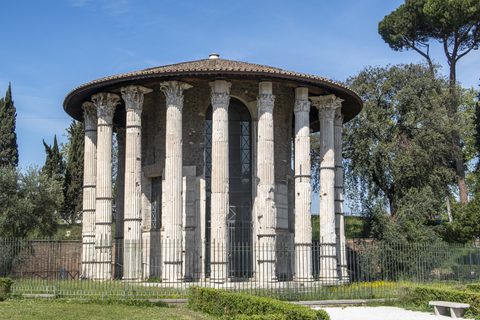
Ripa is R. XII, Roma Capitale toponymic code 112, in Municipio I. It is the left bank of the Tiber below the Capitoline, and it takes in the whole of the Aventine hill. It has four distinct parts. In the Forum Boarium, two Republican temples, two late-antique arches and a twelfth-century basilica stand on and around one square, and the marble disc called the Bocca della Verita is in that basilica's pronaos. The Circus Maximus fills the valley between the Palatine and the Aventine. On the Aventine itself are Santa Sabina, the walled orange garden inside the Savelli fortress ground, and the keyhole on piazza dei Cavalieri di Malta. And the Isola Tiberina belongs to Ripa, as it.wikipedia's article on the rione states. San Saba and Testaccio were carved out of Ripa in 1921. The rione's arms are a white ship's rudder wheel on red, in memory of the river landing that named it.
-
A diaconia first recorded in the sixth century, enlarged in 782 over the Ara Maxima of Hercules, with a 34.20 m campanile carrying a bell of 1289.
-
sight
The pierced marble face, about 1.80 m across and probably a Roman drain cover, set in the basilica's pronaos since 1632; the name dates from 1485.
-
sight
A trabeated gateway of AD 204 paid for by the money-changers and cattle merchants, with Geta and Plautilla chiselled off the dedicatory inscription.
-
sight
The chariot circus in the Valle Murcia, 600 m by 140 m, rebuilt almost entirely under Trajan; the archaeological area opens Tuesday to Sunday.
-
An augmented- and virtual-reality route of about 40 minutes with nine stops, in eight languages, tickets 12.00 euro full and 10.00 euro reduced.
-
Founded in 425 by Peter of Illyria, given to St Dominic in 1219, with carved cypress doors and twenty-four fluted Corinthian columns. Entry is free.
-
About 7,800 m2 of walled garden inside the Savelli fortress ground, laid out in 1932 by Raffaele De Vico, with a belvedere over the river.
-
The hole in the portal at Piazza dei Cavalieri di Malta 3 frames, at the end of an avenue of trees, the dome of St Peter's.
-
sight
About 300 m by 90 m, shaped in antiquity as a ship with stern, prow and an obelisk for a mast, and still carrying the island's medical vocation.
-
Built at the end of the tenth century for Otto III over a temple of Aesculapius; the Memoriale dei Nuovi Martiri opens on Saturday mornings and afternoons.
-
sight
Built in 62 BC by Lucius Fabricius and still in use; its four-fronted marble herms give it the name Ponte dei Quattro Capi.
-
About 1,100 rose species on paths laid out in the shape of the menorah; Turismo Roma gives the opening as the spring flowering and again in October.
-
food
Roman cooking on the Isola Tiberina; lunch 12.30-14.50 and dinner 19.20-22.50 Monday to Saturday, closed Sunday, bookings by telephone.
-
stay
A hotel at Via di San Teodoro 48, whose own site establishes its name and its address.
The edges of Ripa, and the name
Almost every edge of this rione is a street or a square shared with a neighbour, and it.wikipedia's article on the rione names them: piazza di Monte Savello with Sant'Angelo; via del Teatro di Marcello, vico Jugario, via dei Fienili, via di San Teodoro and via dei Cerchi with Campitelli; piazza di Porta Capena with Celio; viale Aventino, piazza Albania and via e largo Manlio Gelsomini with San Saba; via Marmorata and piazza dell'Emporio with Testaccio; and the Tiber itself at lungotevere Aventino and lungotevere dei Pierleoni. A street named as a boundary is evidence of a line, not of what stands on either side of it.
Several things a visitor would file under Ripa fall on the far side of one of those lines. The Colosseum is in Celio; the Teatro di Marcello, the Portico d'Ottavia and San Nicola in Carcere are Sant'Angelo's. it.wikipedia's rione article lists the square in front of Santa Maria della Consolazione under Ripa. Ponte Sublicio is not Ripa's: Turismo Roma states that the present bridge joins the rioni of Trastevere and Testaccio at Porta Portese. it.wikipedia's article on Celio names piazza di Porta Capena as the boundary of Celio, San Saba and Ripa together. Via Marmorata is a boundary street, and the Arco di San Lazzaro stands on it. Piazza Albania is San Saba's, while the Scatola Archeologica addressed on it is Ripa's, which is the ordinary way a building and the square it opens onto can fall on different sides of a line.
One more thing is worth knowing because it looks like a contradiction. The rione is named for Ripa Grande, the river landing, and carries a rudder wheel in its arms for the same reason, but the landing itself stood on the far bank. This stretch of the Tiber was called Ripa Graeca, for the Greek community, the Schola Graeca, settled here from the fourth century and thickened in the eighth by Greek-Latins fleeing the iconoclasm of Leo the Isaurian. That name explains the church too: Santa Maria in Cosmedin takes its title from the Constantinople monastery Kosmidion, invoked by the Greek corporation entrusted with it.
Getting there
No source states a metro station or a bus route for this rione, so none is given here, and neither are walking times or distances. Steer by addresses, which for Ripa fall into four groups.
The Forum Boarium and the Velabro are addressed on three streets. Santa Maria in Cosmedin and the Bocca della Verita in its pronaos are at Piazza della Bocca della Verita 18; the Tempio di Ercole Vincitore, the Tempio di Portuno and the Fontana dei Tritoni stand on the same square. The Arco di Giano, the Arco degli Argentari and San Giorgio in Velabro are on via del Velabro, as is Rhinoceros at Via del Velabro 9, 00186 Roma. The Casa dei Crescenzi is on via Luigi Petroselli at the corner with via di Ponte Rotto, and the Palazzo dell'Anagrafe is at Via Luigi Petroselli 50. Sant'Omobono and its sacred area are on vico Jugario at the foot of the Capitoline.
For the Circus Maximus, the Circo Maximo Experience sells tickets on viale Aventino at the circus, and the Mitreo del Circo Massimo lies under a building on via dell'Ara Massima. The ex Pastificio Pantanella is on via dei Cerchi. The Monumento a Giuseppe Mazzini stands on piazzale Ugo La Malfa, on the Aventine slope facing the circus.
On the Aventine, Santa Sabina and the Giardino degli Aranci share Piazza Pietro d'Illiria; Santi Bonifacio e Alessio is on piazza di Sant'Alessio; the Villa del Priorato di Malta is at Piazza dei Cavalieri di Malta 3-4, with Santa Maria del Priorato at number 4 and Sant'Anselmo on the same square. Santa Prisca is at Via di Santa Prisca 11 and the mithraeum beneath it at Via di Santa Prisca 8. The Roseto di Roma Capitale gives its address as Clivo dei Publicii 3 and via di Valle Murcia 6, and the Scatola Archeologica is on piazza Albania. On the island, San Bartolomeo is on piazza di San Bartolomeo all'Isola and the hospital at Via di Ponte Quattro Capi 39. The Kolbe Hotel Rome is at Via di San Teodoro 48.
Opening hours and tickets
Santa Sabina publishes the fullest timetable in the rione on its own site: visiting Sunday and Monday 12.00-19.00, Tuesday to Saturday 08.00-19.00, with days of precept running as Sundays. Entry is free and no booking is needed, visits are not permitted during liturgical celebrations, and the excavations are not accessible.
For Santa Maria in Cosmedin, Turismo Roma gives the visiting hours as every day 09.30-13.00 and 14.00-17.50, and advises confirming on 06 6787759 or with the basilica. The Divine Liturgy is celebrated on Sundays at 10.30 and the basilica is closed on 1 January. Those are also the hours for the Bocca della Verita, which stands in the pronaos. Santa Prisca's mass times, as Turismo Roma publishes them, are weekdays 08.00 and 18.00 and Sundays and feasts 08.00, 10.30, 12.00 and 18.00 in winter, and weekdays 08.00 and 19.00 and Sundays and feasts 08.00, 10.30 and 19.00 in summer. At San Bartolomeo all'Isola the Memoriale dei Nuovi Martiri opens on Saturday 09.30-13.30 and 15.30-17.30, and otherwise by booking through the basilica.
The Circus Maximus archaeological area opens Tuesday to Sunday: from late October to late March 09.30-16.00, last entry 15.00; from late March to late October 09.30-19.00, last entry 18.00. Tickets are sold through Vivaticket and on 060608. The Circo Maximo Experience, the augmented-reality route through the circus, runs 2 January to 31 May 10.00-16.00, 2 June to 31 July 17.00-21.00, 1 to 9 August 17.30-20.30, 11 to 23 August 17.00-20.00, 25 August to 13 September 16.30-19.30, 15 to 30 September 16.00-19.00, 1 October to 23 December 10.00-16.00, and 24 and 31 December 10.00-14.00, closed Mondays, 1 May and 25 December. Tickets are 12.00 euro full and 10.00 euro reduced, with a 22.00 euro family ticket for two adults plus under-18s bookable only through 060608 or a Tourist Infopoint.
Three more have conditions rather than hours. Turismo Roma states that the Roseto di Roma Capitale generally opens for the spring flowering from late April into May and again in October, with the calendar set each year. The Mitreo di Santa Prisca is not open: Turismo Roma states that visits are temporarily suspended and advises checking the official site. The library and archive in the Casa dei Crescenzi are open by appointment only, by email at least a week ahead, on 06 6798075. Trattoria Sora Lella on the island gives lunch Monday to Saturday 12.30-14.50 and dinner Monday to Saturday 19.20-22.50, closed Sunday, with telephone bookings and a stated dress code. For everything else, no source states opening hours, so none are given.
Frequently asked questions
- Is the Colosseum in Ripa?
- No. The Colosseum stands in the rione Celio. The Roman entertainment building Ripa does hold is the Circus Maximus, a chariot-racing circus 600 m long by 140 m wide in the valley between the Palatine and the Aventine, whose archaeological area is ticketed and open Tuesday to Sunday.
- Where is the Bocca della Verita and what does it cost?
- It is the marble disc in the pronaos of the basilica of Santa Maria in Cosmedin, Piazza della Bocca della Verita 18, and it has stood there since 1632. Turismo Roma gives the visiting hours as every day 09.30-13.00 and 14.00-17.50 and advises confirming on 06 6787759 or with the basilica; the basilica is closed on 1 January. No source states an admission price. The disc is about 1.80 m across and is probably a Roman drain cover; the name is first recorded in 1485.
- Can you go inside the Circus Maximus?
- Yes. The archaeological area opens Tuesday to Sunday, 09.30-16.00 with last entry 15.00 from late October to late March and 09.30-19.00 with last entry 18.00 from late March to late October, with tickets through Vivaticket and on 060608. Investigations concluded in 2016 opened lit visitor routes through the galleries that led to the cavea, and an internal stair in the Torre della Moletta reaches a viewpoint over the area. Separately, the Circo Maximo Experience is a ticketed augmented- and virtual-reality route of about 40 minutes with nine stops, in eight languages.
- What is the keyhole on the Aventine?
- It is the hole in the portal at Piazza dei Cavalieri di Malta 3, which frames, at the end of an avenue of trees, the dome of St Peter's. The complex of buildings and garden behind it is the historic seat of the Grand Priory of Rome of the Sovereign Military Order of Malta and houses the Order's embassy to the Italian State. Turismo Roma credits the square's present appearance to Giovanni Battista Piranesi, commissioned in 1764 by Cardinal Giovanni Battista Rezzonico.
- Is the Isola Tiberina in Ripa, or in Trastevere?
- In Ripa. it.wikipedia's article on the rione states that the Isola Tiberina belongs to Ripa. Its two bridges reach two other rioni: ponte Fabricio, of 62 BC, lands on the left bank in rione Sant'Angelo, which Turismo Roma names, and ponte Cestio, of about 46 BC, carries the other side to Trastevere. On the island itself stand the basilica of San Bartolomeo, the Sacconi Rossi oratory, the hospital and one trattoria.
- Is the port of Ripa Grande in this rione?
- No. The rione takes its modern name from the river landing and carries a white rudder wheel on red in its arms in memory of it, but the landing itself stood on the far bank of the Tiber. What Ripa holds of the river is its four bridges, the Cloaca Maxima outfall at lungotevere Aventino, and the island.
Connected pages
Nearby
-
Campitelli, Rome: the Capitoline, the Roman Forum and the Palatine
· Campitelli, Rome
The neighbour along vico Jugario, via dei Fienili, via di San Teodoro and via dei Cerchi, holding the Capitoline and the Palatine.
-
Sant'Angelo, Rome: the Portico d'Ottavia, the Teatro di Marcello and the old Jewish quarter
· Sant'Angelo, Rome
The neighbour at piazza di Monte Savello, which ponte Fabricio reaches on the left bank; it holds the Portico d'Ottavia and the Teatro di Marcello.
-
Trastevere (R. XIII), Rome: Fountains, the Janiculum and 1849
· Trastevere, Rome
Across the river, reached from the island by ponte Cestio and sharing ponte Palatino.
-
Testaccio, Rome: the ancient river port, the mountain of amphorae and the slaughterhouse quarter
· Testaccio, Rome
The neighbour beyond via Marmorata and piazza dell'Emporio, carved out of Ripa in 1921.
-
San Saba, Rome: the Baths of Caracalla, Porta San Paolo and the Piccolo Aventino
· San Saba, Rome
The neighbour beyond viale Aventino and piazza Albania, carved out of Ripa in 1921; it holds the Baths of Caracalla.
-
Celio, Rome: the Colosseum, the Caelian hill and the road to the Porta Latina
· Celio, Rome
The neighbour beyond piazza di Porta Capena, and the rione the Colosseum stands in.
See also
-
3 Days in Rome: Colosseum Arena Floor, the Vatican, and the Back Streets of Monti
· Rome, Italy
The three-day Rome itinerary in this series. The Circus Maximus, the Bocca della Verita and the Isola Tiberina are all inside this rione.
What travelers think
Log in to react.
No reviews yet.