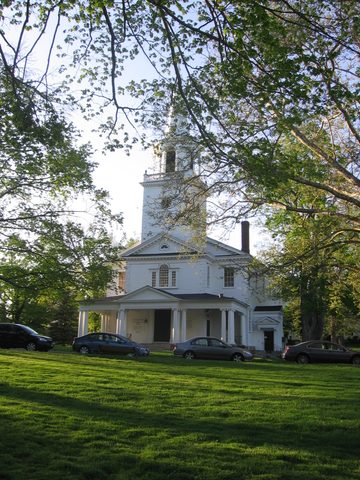

Campitelli, Rome: the Capitoline, the Roman Forum and the Palatine
Campitelli, Rome
Pictures from Campitelli
See all 1 photos →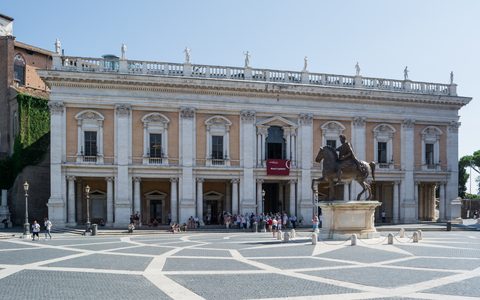
Campitelli is the tenth of Rome's twenty-two rioni, and it is two very different places sharing one boundary. Most of its area is archaeology: the Roman Forum, run by the Parco archeologico del Colosseo, the Palatine hill above it, and the southern half of the Imperial Fora strip. Over the Forum stands the Capitoline, where the Musei Capitolini occupy the palaces around a square their own site credits to Michelangelo, and on its northern slope the Vittoriano. The rest is a small inhabited quarter of a few squares, some Mannerist and Baroque palaces, a working theatre and a short list of places to eat. Nearly every edge of the rione is a street or a square that is itself the boundary, so several things visitors assume are in Campitelli, including the Theatre of Marcellus, are not.
-
walk
The ramped stair up from via del Teatro di Marcello, designed 1534-38 by Michelangelo for Paul III and partly modified by Giacomo Della Porta, with the Dioscuri set on the balustrade in 1583 and the Trofei di Mario in 1590.
-
sight
The paving, palaces and sculpture were carried out over centuries to a design of about the middle of the sixteenth century; the square sits in the valley between the hill's two ancient summits, whose level was some eight metres lower.
-
sight
The museum dates its birth to 1471, when Sixtus IV gave a group of bronze statues to the Roman people; the Lupa Capitolina is held here, and opening is daily 09.30-19.30 with last admission an hour before closing.
-
Reached by the Scalinata dell'Ara Coeli on the Arx, the hill's northern summit; Gothic then Baroque, built from the thirteenth century to the eighteenth, and called Santa Maria in Capitolio before the present name appears in 1323.
-
Giuseppe Sacconi built it from 1885 to 1905 and it opened on 4 June 1911, the fiftieth anniversary of unification; the burial of the Unknown Soldier turned it into a shrine, and its basements sheltered Roman civilians late in the Second World War.
-
Lifts reach the roof at seventy metres for a 360-degree view, with two bronze quadrigas at the lift exit standing for the Unity and the Liberty of Italy.
-
sight
One ticketed enclosure rather than thirty separate sites, run by the Parco archeologico del Colosseo; the EUR 18,00 Forum Pass Super covers it with the Fori Imperiali and the Palatino for the day, and named tickets have been required since 18 October 2023.
-
sight
Seat of the Senate from 29 BC to AD 526, and standing today because Honorius I built the church of Sant'Adriano inside it in 630; it was stripped back to the Curia in the 1930s.
-
sight
Erected in 202-203 at the Forum's north-west corner and dedicated by the Senate for the Parthian victories of 195 and 197-198; 23 m high, with steps under the bays that barred wheeled traffic.
-
sight
A single bay 19.15 m high at the Forum's eastern end, dedicated to Titus as divus and so raised after his death in 81, complete by 90.
-
sight
Built on the Velia between 308 and 312 and rededicated to Constantine, who replaced Maxentius's head on the colossal statue in the west apse; the vaults stand 35 m.
-
sight
The hill between the Velabrum and the Forum, with two summits, Palatium and Germalus, and the sixteenth-century Farnese gardens on its north side; the same Forum Pass Super admits you.
-
sight
Caesar inaugurated it still incomplete on 26 September 46 BC, the last day of his four triumphs, and it was finished under Augustus; the Imperial Fora walkway comes out here on via Bonella.
-
Two superimposed chambers cut into the Capitoline's south slope beside the Scale Gemonie, the deeper dated to the eighth to seventh century BC and the upper to the Republic.
The shape of the rione
Campitelli's edges are, almost everywhere, streets and squares that are themselves the boundary, which is why so much that visitors file under "Campitelli" turns out to sit next door. it.wikipedia's article on the rione lists them: via e piazza San Marco with Pigna, piazza Madonna di Loreto with Trevi, via dei Fori Imperiali with Monti, via di San Gregorio with Celio, then via dei Cerchi, piazza Sant'Anastasia, via di San Teodoro, via dei Fienili, piazza della Consolazione, vico Jugario and via di Monte Caprino with Ripa, and via Montanara, piazza di Campitelli, via Cavalletti, via dei Delfini, piazza e vicolo Margana and via dell'Aracoeli with Sant'Angelo. Three consequences are worth knowing before you walk it. The church of Santa Maria in Portico in Campitelli is not in Campitelli: it.wikipedia's article on it opens by placing it in the rione Sant'Angelo. OpenStreetMap's boundary data and Nominatim both put the Theatre of Marcellus in Sant'Angelo as well, although businesses addressed on via del Teatro di Marcello are inside Campitelli, since a street name is not a claim on the monument it is named for. And piazza Venezia is genuinely unsettled: four sources give three different rioni for it, so this guide states no rione for the square at all and lets the Vittoriano, which comes back Campitelli on every method tested, carry the geography. The northern edge matters most. Via dei Fori Imperiali is the boundary with Monti, and the archaeological strip on either side of it is split down the middle: the Foro di Cesare, the Foro di Nerva with its temple of Minerva, the Tempio della Pace and Via Alessandrina are on the Campitelli side, while Trajan's Forum, Trajan's Column, Trajan's Markets and the Forum of Augustus are on the Monti side. Almost every guidebook treats the Imperial Fora as one thing in Monti. They are not.
Getting there
The Capitoline is reached on foot from below. it.wikipedia describes the Cordonata as running from via del Teatro di Marcello up to the piazza del Campidoglio, designed by Michelangelo for Paul III in 1534-38 and partly modified by Giacomo Della Porta; it also says the basilica of Santa Maria in Aracoeli is reached by the Scalinata dell'Ara Coeli, which climbs alongside. OpenStreetMap maps three more named ways on the hill: the Rampa Caffarelli, the Scala dell'Arce Capitolina and the ancient Clivus Capitolinus. The Musei Capitolini give Piazza del Campidoglio 1, 00186 Roma as the address of the Capitoline complex. For the archaeological side, the Sovrintendenza Capitolina describes a walkway through the Imperial Fora entering at the Trajan's Column end and leaving at the Foro di Cesare on via Bonella, passing beneath via dei Fori Imperiali. The entrance stands in the rione Monti and the exit in Campitelli; the road between them is the boundary.
Tickets, hours and the World Heritage record
Two ticketing systems cover most of what people come to Campitelli for, and different bodies run them. The Musei Capitolini are municipal, and their own site gives daily opening 09.30-19.30 with last admission an hour before closing, 09.30-14.00 on 24 and 31 December, 11.00-20.00 on 1 January 2026, and closure on 1 May and 25 December; from February 2026 that site states that admission is free for residents of Roma and the Citta Metropolitana on production of an identity card. The Roman Forum is run by the Parco archeologico del Colosseo. Its hours and the EUR 18,00 Forum Pass Super are given here as the Sovrintendenza Capitolina publishes them, not as the Parco gives them. Named tickets have been required for all admissions to the Parco archeologico del Colosseo since 18 October 2023. Check with the Parco before travelling. UNESCO records the World Heritage property Historic Centre of Rome, the Properties of the Holy See in that City Enjoying Extraterritorial Rights and San Paolo Fuori le Mura (ref. 91) as first inscribed in 1980, with a significant boundary modification in 1990 that extended the property to the walls of Urban VIII, the Holy See's extraterritorial properties and San Paolo fuori le Mura, and minor modifications in 2015 and 2023; the criteria are (i)(ii)(iii)(iv)(vi), the property 1,469.7 ha and the buffer zone 7,158.933 ha. UNESCO's brief synthesis describes the property as encompassing the whole historic centre of Rome within the city walls at their widest extent in the 17th century. UNESCO's record names no rione.
Frequently asked questions
- What is actually in Campitelli?
- Two ticketed archaeological enclosures - the Roman Forum and the Palatine - plus the southern half of the Imperial Fora, the Capitoline hill with the piazza del Campidoglio and the Musei Capitolini, and the Vittoriano on the hill's northern slope. Outside those, the inhabited part of the rione is small: piazza d'Aracoeli, a handful of Mannerist and Baroque palaces, about a dozen churches, a working theatre and six or seven places to eat.
- How much are the Capitoline Museums, and when are they open?
- The museum's own site gives daily opening 09.30-19.30, last admission an hour before closing, 09.30-14.00 on 24 and 31 December, 11.00-20.00 on 1 January 2026, and closure on 1 May and 25 December. From February 2026 the site states that admission is free for residents of Roma and the Citta Metropolitana on production of an identity card. For non-residents the site gives, in the absence of temporary exhibitions, EUR 15,00 full and EUR 9,50 reduced; with the exhibitions running when this page was checked on 2 September 2026, EUR 20,50 full and EUR 15,00 reduced, a ticket which the site states does not admit to exhibitions at Villa Caffarelli. Online, 060608 and box-office presale carry a EUR 1,00 booking fee, and presold tickets are stated to be non-refundable and non-changeable. Tariffs change with the exhibition programme; check the museum's own page.
- What does it cost to get into the Roman Forum and the Palatine?
- The Sovrintendenza Capitolina gives the Forum Pass Super as EUR 18,00 full, valid for the day across the Foro Romano, the Fori Imperiali and the Palatino. That is a third party republishing the operator's tariff, not the Parco archeologico del Colosseo itself, so check with the Parco before travelling. Named tickets have been required for all admissions to the Parco since 18 October 2023.
- Can you go up the Vittoriano?
- VIVE, the Ministry of Culture institute that runs the complex, describes a panoramic terrace, also called the terrazza delle Quadrighe, standing at seventy metres with a 360-degree view and reached by lifts, with two bronze quadrigas at the lift exit standing for the Unity and the Liberty of Italy. it.wikipedia's infobox gives the monument's overall height as 81 metres and its roof height as 70. The Ala Fori Imperiali, the wing facing via dei Fori Imperiali, is a separate space and VIVE's page describes it as under complete restoration and due to open.
- Which churches in Campitelli publish opening times?
- Very few. San Sebastiano al Palatino is run by the Fraternite Monastique de Jerusalem, whose own site publishes the week's prayer times. Santa Maria Annunziata a Tor de' Specchi is recorded by it.wikipedia as open to the public only on 9 March, the feast of Santa Francesca Romana. The Nobile Collegio Chimico Farmaceutico, in and above San Lorenzo in Miranda, publishes no opening hours on its own site - only guided visits by booking. For Santa Maria in Aracoeli, Santa Francesca Romana, San Teodoro al Palatino, San Bonaventura al Palatino, Santi Cosma e Damiano and the Carcere Mamertino, no reachable official source gave hours, so this guide publishes none.
- Is the Imperial Fora walk in Campitelli or in Monti?
- Both, and the split is the point. The Sovrintendenza Capitolina describes a walkway entering at the Trajan's Column end and leaving at the Foro di Cesare on via Bonella, passing beneath via dei Fori Imperiali. The entrance stands in Monti and the exit in Campitelli; the road between them is the boundary between the two rioni.
Connected pages
Nearby
-
Monti, Rome: The North Half of the Imperial Fora, Four Towers and the Lateran
· Monti, Rome
Via dei Fori Imperiali is the boundary. Trajan's Forum, Column and Markets are Monti's; the Imperial Fora walkway starts there and ends in Campitelli.
-
Celio, Rome: the Colosseum, the Caelian hill and the road to the Porta Latina
· Celio, Rome
The neighbour west along via di San Gregorio, holding the Campidoglio and the Roman Forum.
-
Sant'Angelo, Rome: the Portico d'Ottavia, the Teatro di Marcello and the old Jewish quarter
· Sant'Angelo, Rome
The neighbour along via dell'Aracoeli, piazza Margana and via dei Delfini, holding the Capitoline hill and its museums.
-
Ripa, Rome: the Forum Boarium, the Circus Maximus, the Aventine and the Tiber island
· Ripa, Rome
The neighbour along vico Jugario, via dei Fienili, via di San Teodoro and via dei Cerchi, holding the Capitoline and the Palatine.
-
Trastevere (R. XIII), Rome: Fountains, the Janiculum and 1849
· Trastevere, Rome
Campitelli, across the river, holds the Roman Forum, the Palatine and the Capitoline Museums.
Same region
-
Trastevere (R. XIII), Rome: Fountains, the Janiculum and 1849
· Trastevere, Rome
Another rione of Municipio I covered in this series, across the Tiber from the Capitoline.
-
Borgo, Rome: Castel Sant'Angelo, the Leonine City and the Quarter That Was Demolished
· Borgo, Rome
Another rione of Municipio I covered in this series.
-
San Saba, Rome: the Baths of Caracalla, Porta San Paolo and the Piccolo Aventino
· San Saba, Rome
Another rione in this series, north across the Circus Maximus: the Capitoline hill, the Roman Forum and Santa Maria in Aracoeli.
See also
-
3 Days in Rome: Colosseum Arena Floor, the Vatican, and the Back Streets of Monti
· Rome, Italy
The three-day itinerary that uses the Forum, the Palatine and the Capitoline as one day of ancient Rome.
What travelers think
Log in to react.
No reviews yet.