_-_south_facade.JPG)
Monti, Rome: The North Half of the Imperial Fora, Four Towers and the Lateran
Monti, Rome
Pictures from Monti
See all 1 photos →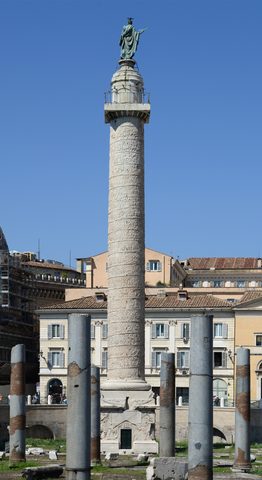
Monti is rione I in Roma Capitale's list of Rome's 22 rioni, toponymic code 101. The Comune says the rione was named for three of the seven hills — the Esquiline, the Viminal and part of the Quirinal — and that the Esquiline no longer forms part of it. Half of the Imperial Fora stand here. Via dei Fori Imperiali is the boundary with Campitelli, and the Forum of Trajan, Trajan's Column, the Markets of Trajan and the Forum of Augustus are all on the Monti side of the road. Above them rise four medieval towers, one of them built by a pope for his brother. Roma Capitale also names the cathedral of Rome, San Giovanni in Laterano, among the monuments present in the rione, and Santa Maria Maggiore stands on a seam the Comune's own pages do not resolve.
-
sight
Seventeen monolithic drums around an internal spiral stair of 185 steps, with Trajan's ashes in the base and a figure of St Peter put on top by Sixtus V in 1587.
-
Six levels of Roman building stepped up the Quirinal slope; the museum inside was inaugurated in the autumn of 2007, and the Torre delle Milizie is entered through it.
-
sight
Inaugurated in 2 BC around the temple of Mars Ultor, three of whose Carrara marble columns still stand, with a firewall of peperino and travertine up to thirty-three metres behind it.
-
Opened in 1932 as via dell'Impero over a demolished sixteenth-century quarter, and the line that puts the fora of Trajan and Augustus on the Monti side and the rest in Campitelli.
-
sight
About fifty metres of brick, attributed to the Conti di Segni at the start of the thirteenth century; a mid-fourteenth-century earthquake brought down the third storey and started the lean.
-
sight
Built around 1203 by Innocent III for his brother Riccardo and once about 60 metres high; its cellars incorporate a squared-tufa exedra of the Forum of Peace.
-
sight
Built in 1223 on Trajanic remains; the del Grillo bought it in 1675 and added the corner eagles and the inscription EX MARCHIONE DE GRILLIS, and Renato Guttuso later painted in it.
-
sight
Thirty-six metres of brick taken from the Terme di Traiano, its colour changing at third-floor level where the surrounding houses were pulled down; not visitable inside.
-
Roma Capitale names it among the rione's monuments; under the Lateran Treaty of 1929 the Holy See owns it, but the ground is Italian and Italian law applies to visitors.
-
sight
An octagon on eight porphyry columns beside the basilica, with Borromini's external frieze of 1657 and a green basalt font under a bronze cover by Ciro Ferri.
-
sight
The Lateran Pacts were signed inside on 11 February 1929 and took their name from it; the Museo storico vaticano stands within, on Italian soil.
-
Nave mosaics of the fifth century, the Sistina and Paolina chapels of Sixtus V and Paul V, and the snow miracle commemorated on 5 August.
-
Two churches stacked over Republican-era buildings and a Mithraeum: the lower wrecked in Robert Guiscard's sack of 1084, the upper built in 1108 by Paschal II.
-
Publishes its hours on its own site: Tuesday to Sunday 9.00–12.00 and 15.00–18.00, closed Monday.
The Imperial Fora, north of the road
Via dei Fori Imperiali, opened in 1932 as via dell'Impero, runs between Monti and Campitelli, and the archaeological strip it crosses is cut in two by it. The Forum of Trajan, Trajan's Column, the Markets of Trajan with the Museo dei Fori Imperiali, and the Forum of Augustus with the Arco dei Pantani and the Aula del Colosso are all on the Monti side. The fora on the south side belong to Campitelli, and so does the ticketed walkway that crosses beneath the road: it enters at the Trajan's Column end, in Monti, and leaves at the Foro di Cesare on via Bonella, in Campitelli.
Roma Capitale dates Trajan's Column to 113 AD and credits the design to Apollodorus of Damascus: about forty metres with the base, seventeen monolithic drums, an internal spiral stair of 185 steps, and Trajan's ashes in the base — he died on 8 August 117. In 1587 Sixtus V put a figure of St Peter on top of it in place of the lost bronze statue. Behind the Forum of Augustus stands a firewall of peperino, pietra gabina and travertine, up to thirty-three metres high, built to shield the forum from the fires of the Suburra: the crowded low quarter that the Italian Wikipedia article on the rione places around the Argiletum, on the line of today's via Leonina and via Madonna dei Monti.
Uphill from the fora are the towers. The Torre delle Milizie, about fifty metres, is entered today through the Markets of Trajan; the Torre dei Capocci is thirty-six metres of brick on piazza di San Martino ai Monti; the Torre del Grillo carries the corner eagles and the inscription EX MARCHIONE DE GRILLIS that the del Grillo family added after buying it in 1675; and the Torre dei Conti, on largo Corrado Ricci, was built around 1203 by Pope Innocent III for his brother Riccardo and has one of the four squared-tufa exedrae of the Forum of Peace in its cellars.
The Lateran, Santa Maria Maggiore and the seams
Roma Capitale's own page for Rione I – Monti names the Basilica di San Giovanni in Laterano among the monuments, archaeological sites and places of worship present in the rione, describing it as the cathedral of Rome. The Comune's perimeter description for the rione lists «complesso del Laterano (entro le mura aureliane)» among the rione's boundary elements. The complex is not indivisible, though: boundary tests put the Scala Santa on the Esquilino side, and it is not covered in this guide. What is covered is the basilica, the baptistery, the Palazzo del Laterano where the Lateran Pacts were signed on 11 February 1929, the Lateran obelisk and the treasury museum.
Three of those properties belong to a legal tier that is neither Italian in the ordinary way nor Vatican. Under the Lateran Treaty of 11 February 1929, Italy recognises the Holy See's full ownership of them (Art. 13; Annex II). Art. 15 states that such a property, «benché facenti parte del territorio dello Stato italiano» — although forming part of the territory of the Italian State — enjoys the immunities that international law grants to the headquarters of the diplomatic agents of foreign States. They are on Italian soil and visitors are subject to Italian law. That is worth reading twice, because one of the museums inside the Palazzo del Laterano is called the Museo storico vaticano and stands on Italian soil, not in Vatican City.
Santa Maria Maggiore is the unresolved case. Roma Capitale's material on the basilica is internally inconsistent. Its Rione I – Monti page names the basilica among the monuments present in the rione; the same page states that the Esquiline hill no longer forms part of the rione, and its page for the basilica places the basilica on the summit of the Esquiline hill. The rione assignment is unresolved. The postcodes change across the block too — 00184 on the facade side, 00185 at Piazza di Santa Maria Maggiore 28.
Several of the streets a visitor will walk are the rione's edges rather than its interior. Roma Capitale's perimeter for Monti reads: «piazza del Colosseo, via dei Fori Imperiali, piazza Madonna di Loreto, vicolo San Bernardo, via Magnanapoli, via XXIV Maggio, via del Quirinale, via delle Quattro Fontane, via Agostino Depretis, piazza Esquilino; via Esquilino, piazza Santa Maria Maggiore, via Merulana, piazza di San Giovanni in Laterano, complesso del Laterano (entro le mura aureliane), via della Ferratella, piazza di Porta Metronia, via della Navicella, via Santo Stefano Rotondo, via Oliviero Plunkett, via di San Giovanni in Laterano.» Via Merulana and via del Quirinale are boundaries, not interior streets, and this guide claims neither piazza del Quirinale nor piazza del Colosseo for Monti.
The interior streets are where the rione's own names survive. The Italian Wikipedia article on the rione records that via in Selci follows the ancient Vicus Suburranus and takes its name from the paving stones found during works there; that the salita dei Borgia runs partly along what is believed to be the Vicus sceleratus; that vicolo delle Carrette survives from a piazza and street where the carts bringing wine and food from the Castelli waited by the Forum market; that via Magnanapoli is said to be a corruption of Balnea Napoli; and that via degli Annibaldi and its neighbours are named for the families who held fortified houses and towers there. An inscription in piazza della Suburra still records the edicola di San Salvatore delle tre immagini ai Monti.
Getting there
The metro station inside Monti is Cavour, at Via Cavour 197, 00184. The Italian Wikipedia article on the rione says Line B serves it. Colosseo station is contested between Monti and Celio and is not claimed here, and no source was obtained for which lines other than B serve it, so none is named.
Via Cavour itself was opened at the end of the nineteenth century to link the Esquiline to piazza Venezia through the Suburra valley, per the same article. Via Nazionale was «istituita il 30 novembre 1871», originally joining piazza Venezia to piazza dell'Esedra, which was renamed piazza della Repubblica in 1953; Palazzo delle Esposizioni is at Via Nazionale 194, 00184, and the Banca d'Italia head office at Palazzo Koch is at Via Nazionale 91, 00184.
Other street addresses worth writing down: San Pietro in Vincoli at Piazza di San Pietro in Vincoli 4/a, 00184; San Clemente at Via Labicana 95, 00184, which Roma Capitale places «circa 300 metri oltre il Colosseo», about 300 metres beyond the Colosseum; the Markets of Trajan at Via Quattro Novembre 94, 00187; Sant'Andrea al Quirinale at Via del Quirinale 30, 00187; the Museo Vite di IMI at Via Labicana 15a, 00184; Mercato Monti at Via Leonina 46/48, 00184; and Ai Tre Scalini at Via Panisperna 249/251, 00184.
One warning about hours. Only one place in this guide publishes them: Sant'Andrea al Quirinale, Tuesday to Sunday 9.00–12.00 and 15.00–18.00, closed Monday, from the church's own site. No source states hours for Santa Maria Maggiore or the Domus Aurea, so neither carries opening or ticketing information here. Check before you travel.
Frequently asked questions
- Is the Colosseum in Monti?
- No. Roma Capitale's page for Rione I – Monti names fourteen monuments as present in the rione and the Colosseum is not among them; the amphitheatre and piazza del Colosseo are in the neighbouring rione of Celio. The Comune does name piazza del Colosseo in the rione's perimeter — as a boundary element, not as something inside it. The Colosseum is not covered in this guide. It appears here only where a source names it: Roma Capitale says Nero's artificial lake at the Domus Aurea lay in the valley where the Colosseum was later built, and it places San Clemente about 300 metres beyond it.
- Which rione is Santa Maria Maggiore in?
- Roma Capitale's material on Santa Maria Maggiore is internally inconsistent. Its Rione I – Monti page names the basilica among the monuments present in the rione; the same page states that the Esquiline hill no longer forms part of the rione, and its page for the basilica places the basilica on the summit of the Esquiline hill. The rione assignment is unresolved. The postcodes seam across the block as well, 00184 on the facade side and 00185 at Piazza di Santa Maria Maggiore 28. The basilica is written up here once, under Monti, with the seam stated rather than smoothed over.
- Are the Lateran buildings and Santa Maria Maggiore part of Vatican City?
- No. They are a third legal tier. Under the Lateran Treaty of 11 February 1929, Italy recognises the Holy See's full ownership of these properties (Art. 13; Annex II). Art. 15 states that the property, «benché facenti parte del territorio dello Stato italiano» — although forming part of the territory of the Italian State — enjoys the immunities that international law grants to the headquarters of the diplomatic agents of foreign States. It is on Italian soil and visitors are subject to Italian law. The Museo storico vaticano, whose name suggests otherwise, stands inside the Palazzo del Laterano on Italian soil.
- Where does Monti begin and end?
- Roma Capitale publishes a perimeter for the rione in words: «piazza del Colosseo, via dei Fori Imperiali, piazza Madonna di Loreto, vicolo San Bernardo, via Magnanapoli, via XXIV Maggio, via del Quirinale, via delle Quattro Fontane, via Agostino Depretis, piazza Esquilino; via Esquilino, piazza Santa Maria Maggiore, via Merulana, piazza di San Giovanni in Laterano, complesso del Laterano (entro le mura aureliane), via della Ferratella, piazza di Porta Metronia, via della Navicella, via Santo Stefano Rotondo, via Oliviero Plunkett, via di San Giovanni in Laterano.» Those streets are the edges. Via Merulana, via del Quirinale and via dei Fori Imperiali are all boundaries rather than interior streets.
- How do I reach Monti on the metro?
- Cavour station, at Via Cavour 197, 00184, is inside the rione, and the Italian Wikipedia article on the rione says Line B serves it. Colosseo station is contested between Monti and Celio, so this guide does not claim it, and no transit-authority source was obtained for the other lines said to call there.
- Which places in this guide publish opening hours?
- One. Sant'Andrea al Quirinale, Via del Quirinale 30, 00187, gives its hours on its own website: Tuesday to Sunday 9.00–12.00 and 15.00–18.00, closed Monday. Nothing else here carries hours, tickets or opening information, because no source states them — including Santa Maria Maggiore and the Domus Aurea. Treat every other entry as a description of what a place is and where it stands, not a statement that it is open today.
Connected pages
Nearby
-
Campitelli, Rome: the Capitoline, the Roman Forum and the Palatine
· Campitelli, Rome
Via dei Fori Imperiali is the Monti/Campitelli boundary. The fora south of the road, and the ticketed walkway between them, belong to Campitelli.
-
Celio, Rome: the Colosseum, the Caelian hill and the road to the Porta Latina
· Celio, Rome
The neighbour across piazza del Colosseo and via di San Giovanni in Laterano, holding San Clemente, Santo Stefano Rotondo and San Giovanni in Laterano.
-
Esquilino, Rome: Termini, piazza Vittorio and Santa Croce in Gerusalemme
· Esquilino, Rome
The neighbour across via Merulana, which holds Santa Maria Maggiore, the Lateran basilica and palace, Santa Prassede and Palazzo Brancaccio.
-
Trastevere (R. XIII), Rome: Fountains, the Janiculum and 1849
· Trastevere, Rome
Monti holds Santa Maria Maggiore and the north side of the Imperial Fora, across the Tiber.
Shared history
-
Vatican City: St Peter's, the Vatican Museums and the Sistine Chapel
· Vatican City
San Giovanni in Laterano and Santa Maria Maggiore stand in Monti: Art. 15 properties on Italian soil, with the immunities of diplomatic headquarters.
-
Borgo, Rome: Castel Sant'Angelo, the Leonine City and the Quarter That Was Demolished
· Borgo, Rome
Santa Maria Maggiore, in Monti, is a Lateran Treaty extraterritorial property of the same third tier as Borgo's Holy See palaces.
Same region
-
Trastevere (R. XIII), Rome: Fountains, the Janiculum and 1849
· Trastevere, Rome
Trastevere is rione XIII in Roma Capitale's toponymic list of Rome's 22 rioni; Monti is rione I.
-
Borgo, Rome: Castel Sant'Angelo, the Leonine City and the Quarter That Was Demolished
· Borgo, Rome
Borgo is rione XIV in Roma Capitale's toponymic list of Rome's 22 rioni; Monti is rione I.
See also
-
3 Days in Rome: Colosseum Arena Floor, the Vatican, and the Back Streets of Monti
· Rome, Italy
A three-day Rome itinerary that walks the back streets of Monti alongside the Vatican and ancient Rome.
What travelers think
Log in to react.
No reviews yet.