
Sant'Eustachio, Rome: Borromini's Sant'Ivo, the Caravaggios of San Luigi dei Francesi and the Senate's palaces
Sant'Eustachio, Rome
Pictures from Sant'Eustachio
See all 1 photos →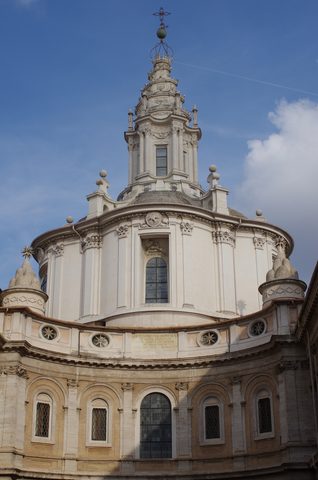
Sant'Eustachio is R. VIII, the eighth of Rome's rioni by toponymic code, and it is a long, narrow strip of the historic centre with a stag's head for its emblem. Borromini's church of Sant'Ivo stands in the courtyard of the Palazzo della Sapienza, seat of Rome's university until 1935 and of the State Archive since 1936. The Senate sits in Palazzo Madama, and the Constitution of the Italian Republic was signed in the library room of Palazzo Giustiniani on 27 December 1947. Three Caravaggios hang in the Contarelli chapel of San Luigi dei Francesi and a fourth in Sant'Agostino, on the same pillar as a Raphael. Two working theatres, the Argentina and the Valle, have published 2026/2027 seasons. Eight further churches serve the French, Belgian, Romanian, Piedmontese, Norcian and Baptist communities of Rome. Nearly every edge of the rione is a street shared with a neighbour.
-
Borromini's church in the courtyard of the Palazzo della Sapienza, with a six-pointed-star plan and a spiral lantern; the rector's office states that it is closed for works in progress.
-
The French national church, whose Contarelli chapel holds the three canvases Caravaggio painted between 1599 and 1602 on the life of St Matthew.
-
Caravaggio's Madonna dei Pellegrini of 1604, Raphael's Prophet Isaiah of 1512 and two Sansovino marbles in one church, raised above a flight of steps.
-
Maderno's dome of 1622, frescoed inside by Lanfranco, with Domenichino on the pendentives; open Monday to Saturday 15.00 to 19.30 and Sunday 08.30 to 19.30.
-
The church that names the rione, with a stag's head above the pediment, Salvi's altar of 1739 and a plaque marking the Tiber flood of 5 December 1495.
-
Rome's university sat here from 1303 until 1935; the State Archive has held the building since 1936 and uses the Alessandrina's hall as an exhibition room.
-
Named for Margherita d'Austria, given its Baroque facade by Marucelli in 1642, and the Senate's seat since February 1871; Roma Capitale states that visits are suspended.
-
sight
The Constitution of the Italian Republic was signed in the library room here on 27 December 1947 by President Enrico De Nicola.
-
tour
The Teatro di Roma's main house opened on 13 January 1732 with Sarro's Berenice; the 2026/2027 season is running and tickets go through teatrodiroma.vivaticket.it.
-
A 900-seat house inaugurated on 7 January 1727, reopened in part in 2018 and named for Franca Valeri in 2021, with a published 2026/2027 season.
-
sight
Angelo Rocca gave his 20,000 volumes to the friars of Sant'Agostino in 1604 and directed that the library be open to all without limit of rank or means.
-
walk
Pietro Lombardi's fountain of 1927 in the flank of the Sapienza: a stag between four books, inscribed with a rione numeral that Roma Capitale says is wrong.
-
walk
A headless late-Roman statue of a public official, one of the talking statues, standing at the corner of piazza Vidoni since 1924.
-
Pens, inks, wooden set squares, drafting boards and typewriters on piazza dei Caprettari; Roma Capitale lists it among the city's historic shops.
The rione and its borders
The rione is roughly 900 metres from north to south and about 250 metres across, and it touches seven neighbours. it.wikipedia's article on the rione gives Roma Capitale's border description: via dei Portoghesi, via della Stelletta and piazza e via di Campo Marzio with Campo Marzio; via e piazza della Maddalena, via del Pantheon and piazza della Rotonda with Colonna; via della Rotonda, piazza Santa Chiara, via di Torre Argentina and largo di Torre Argentina with Pigna; largo Arenula, via di Sant'Elena, via in Publicolis and via di Santa Maria del Pianto with Sant'Angelo; via Arenula, piazza Benedetto Cairoli and via dei Giubbonari with Regola; via dei Chiavari, piazza dei Satiri, largo Pallaro, largo dei Chiavari, corso Rinascimento and piazza delle Cinque Lune with Parione; and piazza Sant'Agostino and via dei Pianellari with Ponte.
At Largo di Torre Argentina the Teatro Argentina is in Sant'Eustachio; the Area Sacra with its four Republican temples, the Curia di Pompeo and the Torre del Papito are in Pigna, and the sources name different rioni for the square itself. Corso del Rinascimento, cut through this quarter in the 1930s, is the line between Parione and Sant'Eustachio, and Palazzo Madama, the Palazzo della Sapienza and Palazzo Baldinotti Carpegna all carry addresses on it. The church of Santa Maria in Publicolis, which a map may put on this side of the line, stands in Sant'Angelo on it.wikipedia's own statement that it is in that rione. Piazza Benedetto Cairoli is in Regola, while the church of Santi Biagio e Carlo ai Catinari addressed on it is in Sant'Eustachio, because Roma Capitale says in its own words that the church sorge nel rione Sant'Eustachio.
One name causes confusion and is not a boundary problem at all. Roma Capitale heads its page Basilica di Sant'Agostino in Campo Marzio; Campo Marzio there is the ancient region of the city, not Rione IV, and the basilica, its piazza and the Biblioteca Angelica in the convent block are all in Sant'Eustachio.
The Sapienza block, the national churches and two theatres
The spine of the rione is the block bounded by Corso del Rinascimento, via degli Staderari and piazza Sant'Eustachio. The Palazzo della Sapienza held the Studium Urbis, the university Boniface VIII founded in 1303, until 1935; the Archivio di Stato di Roma has been in it since 1936, with the Biblioteca Alessandrina's hall of 1659 to 1665 now used for exhibitions. Borromini's Sant'Ivo alla Sapienza stands in the courtyard, and the rector's office states that the church is closed for works in progress, so a visitor arriving today sees the spiral lantern from the street and not the interior. In the flank wall on via degli Staderari, Pietro Lombardi's Fontana dei Libri of 1927 carries the rione's stag between four antique books, inscribed S. EVSTACCHIO with the rione numeral R IV, which Roma Capitale points out is wrong: Sant'Eustachio is the eighth rione.
Five churches here belong to communities from outside Rome, and they are the reason the rione's church-going hours are so uneven. San Luigi dei Francesi is the French national church; San Giuliano dei Fiamminghi is the royal Belgian church, whose vault carries the arms of Bruges, Ghent and Ypres and a Glory of St Julian frescoed by William Kent; San Salvatore alle Coppelle is the national church of Romania, with an iconostasis and the Eastern rite; the Santissimo Sudario dei Piemontesi was built by Piedmontese, Niçois and Savoyards and is now a subsidiary church of the Ordinariato Militare in Italia; and Santi Benedetto e Scolastica all'Argentina is the church of the nursini, the people of Norcia. The Chiesa evangelica battista on via del Teatro Valle was inaugurated with a service on Sunday 2 November 1878.
The two theatres both work. The Teatro Argentina, which stands in front of the Area Sacra, opened on 13 January 1732 with Domenico Sarro's Berenice and is the Teatro di Roma's main house. The Teatro Valle, inaugurated on 7 January 1727 and named for Franca Valeri in 2021, reopened in part in 2018 after a closure and an occupation, and Teatro di Roma programmes it.
Getting there
No source states a metro station or a bus route for Sant'Eustachio, and no walking times or distances are given either. Steer by street numbers instead, and remember that several of them sit on streets that are rione boundaries.
Roma Capitale gives Corso del Rinascimento 40 for the Palazzo della Sapienza and for the church of Sant'Ivo alla Sapienza, whose Sunday entrance during the works is Via del Teatro Valle 33. San Luigi dei Francesi is at Piazza di San Luigi de' Francesi 5, Sant'Agostino at Piazza di Sant'Agostino 80 and the Biblioteca Angelica at Piazza di Sant'Agostino 8. Palazzo Giustiniani is at Via della Dogana Vecchia 29 and Palazzo Madama on Piazza Madama. The rione's title church is at Via di Sant'Eustachio 19, and the Palazzetto di Tizio da Spoleto at Piazza di Sant'Eustachio 6, on the same square. Sant'Andrea della Valle is addressed at Piazza Vidoni 6, with the Abate Luigi statue at the corner of that square. Via del Sudario holds three buildings in a row: the Palazzetto del Burcardo at 44, the Santissimo Sudario dei Piemontesi at 47 and San Giuliano dei Fiamminghi, which the church gives as 41 and Roma Capitale as 40. The Teatro Argentina is at Largo di Torre Argentina 52 and the Teatro Valle at Via del Teatro Valle 21.
One address needs a warning. Roma Capitale places Palazzo Patrizi Montoro on Piazza di San Luigi de' Francesi, while its address field gives a street in another rione, so no street number for that palace is given here.
Frequently asked questions
- Can I go into Borromini's Sant'Ivo alla Sapienza?
- Not at present. The rector's office states that the church is closed for works in progress. The Sunday 11.00 Mass is held in the Sala della Rettoria, entrance Via del Teatro Valle 33, from September to June and not in July or August, and Roma Capitale states that a Mass is celebrated Monday to Friday at 9.00 in the same room. The lobed dome and the spiral cusped lantern, with their travertine torches and the wrought-iron sphere, cross and dove, are visible from outside the Palazzo della Sapienza.
- Where are the Caravaggios?
- Three of them are in the Cappella Contarelli, the last chapel on the left in San Luigi dei Francesi: the Vocazione di san Matteo, San Matteo e l'angelo and the Martirio di san Matteo, painted between 1599 and 1602. A fourth, the Madonna dei Pellegrini of 1604, is in the first chapel on the left in Sant'Agostino, in the same church as Raphael's fresco of the Prophet Isaiah of 1512 and two Sansovino marbles. Roma Capitale directs enquiries about Mass times and visiting at San Luigi dei Francesi to the church itself, so no hours are given here; for Sant'Agostino it publishes Mass on Monday to Saturday at 08.00 and 18.30 and on Sundays and feasts at 08.00, 10.00, 12.00 and 18.30, with its own caveat that times may change.
- Can I visit Palazzo Madama, the seat of the Senate?
- Roma Capitale states that visits to Palazzo Madama are suspended. Palazzo Giustiniani, where President Enrico De Nicola signed the Constitution of the Italian Republic on 27 December 1947 in the library room, is the residence of the President of the Senate; no source states any visiting arrangement for it, so none is given here. Palazzo Baldinotti Carpegna, joined to Palazzo Madama by a two-storey portico, houses Senate offices and standing committees.
- Is the Area Sacra di Largo Argentina in this rione?
- No. The sunken archaeological enclosure with its four Republican temples, the Curia di Pompeo and the Torre del Papito is in Pigna, and the sources name different rioni for the square around it. What Sant'Eustachio holds at that address is the Teatro Argentina, which stands in front of the Area Sacra, and the Palazzetto del Burcardo on via del Sudario, whose absorbed tower gave the largo its name.
- Which places in Sant'Eustachio state opening or Mass times?
- Sant'Andrea della Valle's own site gives Monday to Saturday 15.00 to 19.30 and Sunday 08.30 to 19.30; San Giuliano dei Fiamminghi states that it is open for prayer and visits Monday to Thursday, 10.00 to 12.00; Roma Capitale publishes Mass times for Sant'Agostino, the Santissimo Sudario dei Piemontesi, Santi Benedetto e Scolastica and Santi Biagio e Carlo ai Catinari. No source states hours for the basilica of Sant'Eustachio, the Archivio di Stato, the Biblioteca Angelica or the palaces.
- What is the Abate Luigi?
- A late-Roman statue of a togate man, headless, standing at the corner of piazza Vidoni against the flank of Sant'Andrea della Valle. It is one of Rome's talking statues, the Congresso degli Arguti, with Marforio, Babuino, Facchino, Madama Lucrezia and Pasquino, and it has stood in its present place since 1924. Roma Capitale sites both the statue and piazza Vidoni in the rione Sant'Eustachio.
Connected pages
Nearby
-
Pigna, Rome: the Pantheon, the Largo Argentina temples and the Jesuit quarter
· Pigna, Rome
The neighbour across via di Torre Argentina, holding the Area Sacra temples, the Curia di Pompeo and the Torre del Papito.
-
Parione, Rome: Piazza Navona, Campo de' Fiori and the Cancelleria
· Parione, Rome
The rione on the other side of Corso del Rinascimento, holding piazza Navona and the Palazzo della Cancelleria.
-
Colonna, Rome: Piazza Colonna, Montecitorio and the seat of government
· Colonna, Rome
The neighbour along via della Maddalena, via del Pantheon and piazza della Rotonda, named in this rione's own boundary list.
-
Regola, Rome: Palazzo Farnese, via Giulia and the national churches
· Regola, Rome
The neighbour across via Arenula and piazza Benedetto Cairoli, which holds the square that San Carlo ai Catinari is addressed on.
-
Sant'Angelo, Rome: the Portico d'Ottavia, the Teatro di Marcello and the old Jewish quarter
· Sant'Angelo, Rome
The neighbour across largo Arenula and via in Publicolis, which holds the church of Santa Maria in Publicolis.
See also
-
3 Days in Rome: Colosseum Arena Floor, the Vatican, and the Back Streets of Monti
· Rome, Italy
The three-day Rome itinerary in this series, if you are fitting the Caravaggios and the Senate's quarter into a first visit.
What travelers think
Log in to react.
No reviews yet.