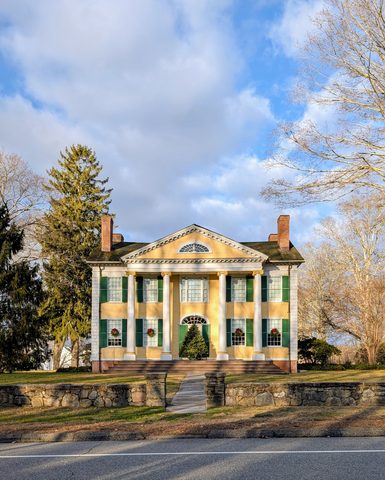

Harrow, London: Harrow School, Headstone Manor, Bentley Priory, Grim's Dyke and St Lawrence Whitchurch
Harrow, England
Pictures from Harrow
See all 1 photos →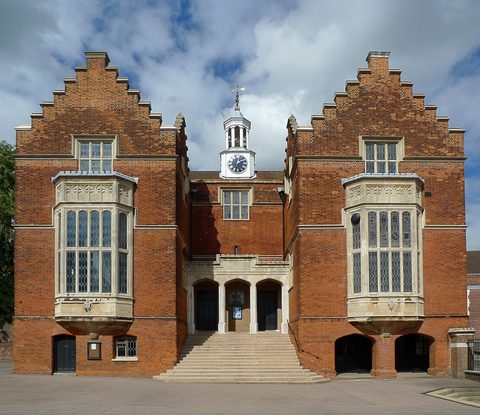
Harrow is an outer London borough on the north-western edge of the capital, and the National Heritage List for England records 290 listed entries inside it: 4 at Grade I, 20 at Grade II* and 266 at Grade II, with 8 scheduled monuments and 4 registered parks and gardens beside them. It reads as four places rather than one. Harrow on the Hill is a village core on a 124-metre hill, where a parish church dated from 1094 and a school founded in 1572 hold two of the four Grade I entries. Pinner and Hatch End carry a fourteenth-century church, a High Street with 28 individual list entries, and a museum built for one illustrator's work. Stanmore, Harrow Weald and Canons hold a Soane mansion, a Norman Shaw house of 1870, an Iron Age earthwork scheduled in three stretches, and a Baroque church with a mausoleum attached. Headstone, Wealdstone and Rayners Lane are where the railways made the modern borough.
-
A parish church dated from 1094 on the 124-metre hill, listed Grade I as NHLE 1079742, with its Lych Gate Grade II, NHLE 1286339.
-
walk
Founded in 1572, with The Old Schools listed Grade I as NHLE 1079741; a working boarding school read from the public High Street and Church Hill.
-
sight
Listed Grade II* as NHLE 1079728, about 120 m south-east of the Grade I parish church of St Mary, NHLE 1079742.
-
Listed Grade II* as NHLE 1193423, on the High Street frontage about 100 m south of the Speech Room, Grade II*, NHLE 1193321.
-
A fourteenth-century church at the head of the High Street, listed Grade II* as NHLE 1286312, with the Loudon monument Grade II, NHLE 1079745.
-
walk
Twenty-eight individual entries on one street, among them The Queen's Head, Grade II, NHLE 1079700, and The Hand in Hand, Grade II, NHLE 1193708.
-
sight
Opened on 15 October 2016 in Pinner Memorial Park for the work of William Heath Robinson; 11am-4pm Thursday to Sunday and Bank Holiday Mondays.
-
The borough's performing-arts venue, in the Elliott Hall at Hatch End, listed Grade II as NHLE 1079657; box office (020) 3773 7161.
-
sight
The Soane house that was RAF Fighter Command's headquarters, listed Grade II* as NHLE 1358638 in a Grade II registered landscape, NHLE 1001440.
-
stay
Norman Shaw's house of 1870-72 for Frederick Goodall, named after the earthwork Grim's Ditch, later W. S. Gilbert's home and a hotel since 1970, listed Grade II* as NHLE 1079676.
-
walk
The earthwork the house Grim's Dyke is named after, scheduled in three stretches as NHLE 1002044, NHLE 1003530 and NHLE 1002007, with no grade.
-
A church of 1850 in use, NHLE 1193096, beside the roofless church of 1632, NHLE 1079747, both listed Grade II*, with Gilbert's grave Grade II, NHLE 1193140.
-
A tower of about 1360 with a Baroque body for the 1st Duke of Chandos, listed Grade I as NHLE 1194471, the Chandos Mausoleum attached to its north side.
-
walk
A Grade II registered park and garden of 44.80 hectares, NHLE 1001394, free to enter, with the Garden Temple listed Grade II, NHLE 1079739.
-
tip
Home of Barnet and London Bees, capacity 6,500, record attendance 6,215 on 28 January 2019; the ground is in Harrow despite the Edgware address.
-
sight
A moated manor listed Grade I as NHLE 1285855 with a scheduled moat, NHLE 1005558; free entry, Tuesday to Sunday 10am to 4pm, closed Monday.
-
The Art Deco Grosvenor Cinema of Alexandra Avenue, listed Grade II* as NHLE 1079729, now a religious and community centre with access by arrangement.
-
Listed Grade II as NHLE 1253982 with its platform buildings NHLE 1253986, 11 miles 30 chains from Euston; the Bakerloo line terminates here.
Harrow on the Hill
The hill rises to 124 metres and carries the village that named the borough. Two of Harrow's four Grade I entries stand on it, and a dense run of Grade II and Grade II* school buildings fills the street between them.
St Mary's Church, on Church Hill, HA1 3HL, was listed Grade I on 21 September 1951 as NHLE 1079742, under the list name "Parish Church of St Mary". The parish dates the church from 1094 and describes itself as "A place of peace and prayer for over 900 years"; it reports that restoration of the spire is complete and that the full cost, circa GBP 600,000, has been raised. It is a working parish church with a Choral Eucharist at 10:30am on Sundays, and no source states its general opening hours, so none are given here. The churchyard carries four further entries of its own: the Lych Gate, Grade II, NHLE 1286339; the grave of Thomas Port, Grade II, NHLE 1079743; the Peachey Tomb south of the west entrance, Grade II, NHLE 1079744; and the Leighton family tomb, Grade II, NHLE 1433435.
Harrow School wraps around the church. John Lyon, a local landowner and farmer, founded it in 1572 under a royal charter of Elizabeth I, and it was one of the seven public schools selected for reform in the Public Schools Act 1868. As of July 2026 the school reported an enrolment of 833 boys, all boarding full-time, in twelve boarding houses; its alumni include seven British prime ministers — Aberdeen, Spencer Perceval, F. J. Goderich, Robert Peel, Henry Palmerston, Stanley Baldwin and Winston Churchill — and the Indian prime minister Jawaharlal Nehru. The Old Schools was listed Grade I on 21 September 1951 as NHLE 1079741. Four school buildings are listed Grade II*: the Chapel, NHLE 1079728; the Vaughan Library, NHLE 1193423; the Speech Room, NHLE 1193321; and the War Memorial Building with its Memorial Shrine, Ceremonial Staircase and Retaining Wall, NHLE 1358630. The Chapel and the Vaughan Library were both listed on 9 July 1968. Grade II entries on the estate include the Wall, Railings, Gates and Steps to right and front of the Old Schools, NHLE 1192976; the Butler Museum, NHLE 1358603; the Music School, NHLE 1193276; New Schools, NHLE 1193411; Leaf Schools, NHLE 1079722; The Art School, NHLE 1079721; and the Headmaster's House, NHLE 1358608. The school grounds at Harrow Park, formerly Flambards, are a Grade II registered park and garden of 15.08 hectares, NHLE 1001424; no source confirms public access to them.
This is a working boarding school, so the buildings are read from the public High Street and Church Hill, and interiors are seen by arranged tour or on advertised open days. The Speech Room, the War Memorial Building and the Vaughan Library form a continuous listed frontage along the High Street, the Vaughan Library standing about 100 m south of the Speech Room. The Chapel sits about 120 m south-east of St Mary's.
Pinner and Hatch End
Pinner is a village street with a church at its head, 12 miles (19 km) north-west of Charing Cross, and the suburb around it had a population of 38,698 at the 2021 census. Hatch End is a separate place about 3 km away on a different railway, and it holds the borough's performing-arts venue.
The Church of St John the Baptist, on Church Lane, HA5 3AA, was listed Grade II* on 21 September 1951 as NHLE 1286312. The church dates from the fourteenth century and Pinner began as a mediaeval hamlet. Two churchyard features are listed in their own right: the monument to William and Agnes Loudon on the south side, Grade II, NHLE 1079745, the obelisk driven through a sarcophagus, and the War Memorial, Grade II, NHLE 1246345. About 230 m north, in Pinner Cemetery, the grave of Horatia Nelson Ward, daughter of Horatio Nelson and Emma Hamilton, is listed Grade II, NHLE 1079680, entered as "Grave of Horatia Nelson Ward approximately 15 yards to south west of chapel in Pinner Cemetery". It is an active Anglican parish church; no source states its opening hours, so none are given here.
Pinner High Street runs downhill from the church, and the National Heritage List for England carries 28 individual entries along it. They include number 1, NHLE 1358626; number 3, NHLE 1079688; number 7, NHLE 1079689 and NHLE 1358633; number 9, NHLE 1193639; number 11, NHLE 1079698; numbers 18-24, NHLE 1079703; numbers 25-27, NHLE 1193645; 25A, 25B and 27-35, NHLE 1358629; number 26, NHLE 1286041; number 29, NHLE 1079699; number 32, NHLE 1079704; numbers 33-35, NHLE 1286059; 34, 34A and 36, NHLE 1358634; number 37, NHLE 1079701; number 39, NHLE 1079702; number 41, NHLE 1079692; numbers 45-49, NHLE 1079693; number 46, NHLE 1079695; numbers 48-50, NHLE 1079696; number 52, NHLE 1193606; number 58, NHLE 1193713; numbers 65-67, NHLE 1358606; numbers 82-86, NHLE 1272460; numbers 85-89, NHLE 1193401; number 95, NHLE 1193407; number 97, NHLE 1358607; and numbers 99-101, NHLE 1079727. The Queen's Head, at the foot of the street, is listed Grade II, NHLE 1079700, and The Hand in Hand Public House is Grade II, NHLE 1193708. Two K6 telephone kiosks are listed separately, one outside number 52A, NHLE 1253902, and one outside number 90, NHLE 1253901. Tudor buildings survive in other parts of the old village; the High Street is mainly eighteenth-century, and Bridge Street beside it carries chain stores and a more urban character.
In Pinner Memorial Park, at 50 West End Lane, HA5 1AE, the Heath Robinson Museum is dedicated to William Heath Robinson (1872-1944), illustrator, humorist and social commentator. The author Michael Rosen opened it on 15 October 2016 at a ceremony in the park. It is run by The West House and Heath Robinson Museum Trust, "Charity No 1086567", and stands beside West House. The operator publishes the hours as "11am-4pm Thu-Sun & Bank Holiday Mondays except Christmas, Boxing Day, and New Year's Day".
Harrow Arts Centre is at 171 Uxbridge Road, Hatch End, HA5 4EA, in the Elliott Hall and other buildings formerly part of the Royal Commercial Travellers School. The Elliott Hall was listed Grade II on 25 May 1983 as NHLE 1079657, entered as "B G Elliot Hall to Harrow College of Further Education". Since 2022 the building has also hosted meetings of Harrow Council and housed the mayor's parlour. The box office number is (020) 3773 7161, and the centre shares a ticketing platform with Headstone Manor & Museum.
Stanmore, Harrow Weald and Canons
This is the high wooded north of the borough and the Edgware edge, and it holds seven of the eighteen places here: three of the four registered landscapes, an Iron Age earthwork scheduled in three stretches, a Grade I Baroque church, and a Second World War headquarters.
Grim's Ditch is a linear earthwork scheduled in three separate stretches inside the borough: "Grim's Ditch: section extending 1500yds (1370m) NE from Oxhey Lane", NHLE 1002044, over 5.26 hectares; "Grim's Ditch: four linear sections between Uxbridge Road and Oxhey Lane", NHLE 1003530, over 2.83 hectares; and "Grim's Ditch: section N of Blythwood House", NHLE 1002007, over 0.80 hectares. A scheduled monument carries no grade. The earthwork is thought to have been built by the Catuvellauni as a defence against the Romans, and it ran east to west about 6 miles (9.7 km) from the edge of Stanmore to Pinner Green and Cuckoo Hill; the surviving earthworks start mid-way, at Harrow Weald Common. A related and separately scheduled earthwork survives to the east, "Linear earthworks in Pear Wood, W of Watling Street", NHLE 1001996, over 0.40 hectares. Of the nine scheduled monuments in the Harrow envelope, eight lie wholly inside the borough and three of those eight are Grim's Ditch sections; the ninth, Brockley Hill Romano-British pottery and settlement, NHLE 1018006, straddles the Harrow and Barnet boundary.
Grim's Dyke, at Old Redding, Harrow Weald, HA3 6SH, is a house named after that earthwork, and the two are separate things. Richard Norman Shaw built it from 1870 to 1872 for the painter Frederick Goodall, and it was listed Grade II* on 5 September 1969 as NHLE 1079676, under the list name "Grimsdyke"; the grounds are a Grade II registered park and garden of 14.27 hectares, NHLE 1001254, and the South Lodge is listed Grade II, NHLE 1193943. It was the home of the dramatist W. S. Gilbert, of Gilbert and Sullivan, for the last two decades of his life, and he died there attempting to save a girl from drowning in his lake. Caius Gabriel Cibber's statue of Charles II, carved in 1681 and now in Soho Square, was given to Goodall in 1875 and stood on an island in the lake here until 1938. The house was converted into a hotel in 1970. The hotel leases 30 of the 110 acres Gilbert bought with the house, and the operator advertises 40 acres of gardens and grounds open to the public all year, nine main-house bedrooms and 38 garden-lodge rooms.
Bentley Priory, on Mansion House Drive, Stanmore, HA7 3FB, is a Sir John Soane house of 1775, built north of the original priory for James Duberley, an Army contractor. It was sold in 1788 to John Hamilton, who succeeded as Earl of Abercorn in 1789, was created Marquess in 1790, and only then made extensive alterations to the house and park. It was the final home of the Dowager Queen Adelaide, queen consort of William IV, before her death there in 1849, and it later served as a hotel and a girls' school before the Royal Air Force acquired it in 1926. In the Second World War it was the headquarters of RAF Fighter Command, and it stayed in RAF hands in various roles until 2008; the Bentley Priory Battle of Britain Trust secured part of the building as a museum and memorial to those who served. The list entry is named "Central Entrance Block to Bentley Priory", Grade II*, NHLE 1358638, listed on 25 May 1983, and the surrounding landscape is a Grade II registered park and garden of 101.94 hectares, NHLE 1001440. No source states the museum's opening hours, so none are given here.
At Stanmore, two churches stand side by side on Church Road, HA7 3EX, and are listed separately: the stone church of 1850, still in use, Grade II, NHLE 1193096, listed 25 May 1983, and the red-brick church of 1632 beside it, now a roofless ruin, Grade II, NHLE 1079747, listed 21 September 1951, entered as "Old Stanmore Church". The grave of W. S. Gilbert, south-west of the church, is listed Grade II, NHLE 1193140. Four further churchyard monuments are individually listed at Grade II: the monument to Philip Jackson, NHLE 1079748; a chest tomb at the north-east corner of the old church, NHLE 1193135; the urn tomb to Mary Wood, NHLE 1358617; and the tomb of Betty Jellicoe, NHLE 1096146. Stanmore War Memorial in the churchyard is Grade II, NHLE 1096148.
At Little Stanmore, on Whitchurch Lane, HA8 6RB, St Lawrence's Church was listed Grade I on 21 September 1951 as NHLE 1194471, entered as "Church of St Lawrence, Little Stanmore". It keeps a stone tower of about 1360, and the main body was rebuilt in the eighteenth century in Baroque style for James Brydges, 1st Duke of Chandos, whose seat at Canons stood immediately to the north. The Chandos Mausoleum, an early eighteenth-century English Baroque building by James Gibbs in the care of the Churches Conservation Trust, is attached to the north side and is covered by the same Grade I entry rather than one of its own. It is an active Church of England parish church and opening times vary; no source states them, so none are given here.
Canons Park, entered from Donnefield Avenue, HA8 6RB, is what survives of the eighteenth-century gardens of the Canons estate. It is a Grade II registered park and garden of 44.80 hectares, NHLE 1001394 — a registered landscape, not a listed building — and the public park inside that boundary is 18 hectares (44 acres). The Garden Temple, with its supporting walls and raised paved area, is listed Grade II, NHLE 1079739, on 25 May 1983; the wall enclosing the George V Memorial Garden is Grade II, NHLE 1079738, and the wall enclosing the garden to its north-west is Grade II, NHLE 1192924. The main building of North London Collegiate School, formerly Canons House, stands in the park and is listed Grade II, NHLE 1286403, with its screen walls, terraces, balustrades, garden steps and rotunda separately Grade II, NHLE 1079737. Entry to the public park is free.
The Hive Stadium, on Camrose Avenue, HA8 6AG, was built on the former site of the municipal Prince Edward Playing Fields in Canons Park. It carries no entry on the National Heritage List for England. Its official total capacity is 6,500 and its record attendance is 6,215, set on 28 January 2019 for Barnet's 3-3 draw with Brentford. It is the home ground of EFL League Two club Barnet and of London Bees of the FA Women's Championship, and was home to Tottenham Hotspur F.C. Women of the FA WSL from 2019 to 2022. Despite the Edgware postal address and the club's name, HA8 6AG resolves to Harrow, Centenary ward: the ground is in Harrow, not Barnet.
Headstone, Wealdstone and Rayners Lane
The flat centre and south of the borough is where the railways made it, and the three places here are a moated manor, an Art Deco cinema and an interchange station, all three listed.
Headstone Manor stands in Headstone Recreation Ground, Pinner View, HA2 6PX, and was listed Grade I on 21 September 1951 as NHLE 1285855 — one of the borough's four Grade I entries. The moated site around it is a scheduled monument in its own right, NHLE 1005558, over 1.97 hectares; a scheduled monument carries no grade, so the moat is never described as graded. Three further buildings on the site are individually listed: the Great Barn, entered as "Barn south west of Headstone Manor", Grade II, NHLE 1358623, listed 21 September 1951; the Former Granary, Grade II, NHLE 1420464, listed 13 August 2014; and the outbuilding parallel to the barn south of the manor, Grade II, NHLE 1079684. It is the local history museum for the London Borough of Harrow and is also known as the Harrow Museum. The operator publishes: "Museum Opening Times Tuesday – Sunday, 10am – 4pm. Closed: Monday. FREE ENTRY. last museum entry is 30 mins before closing." The Moat Café keeps the same hours.
At 440 Alexandra Avenue, Rayners Lane, HA2 9TL, the Zoroastrian Centre occupies the former Grosvenor Cinema, an Art Deco super-cinema listed Grade II on 13 March 1981 as NHLE 1079729, entered as "Ace Cinema". Two cinema buildings in the borough are listed: this one at Grade II and the Granada at Kenton at Grade II, NHLE 1253949. The building is in use as a religious and community centre, so interior access is by arrangement; no source states visitor hours, so none are given here. Rayners Lane Underground station, 251 m away, is itself listed Grade II, NHLE 1261430, and is where the Metropolitan and Piccadilly lines share track.
Harrow & Wealdstone station, on Station Road, HA3 5AH, is 11 miles 30 chains (18.31 km) along the West Coast Main Line from London Euston. The station was listed Grade II on 6 September 1989 as NHLE 1253982, and the platform buildings — the ticket office and waiting rooms — are a separate Grade II entry, NHLE 1253986. The rail crash of 1952 happened here and killed 112 people. TfL returns the station as interchange HUBHRW, carrying four named services across three operators: the Bakerloo line, which terminates here; the Lioness line of the London Overground; and Southern and West Midlands Trains, the latter running under its London Northwestern Railway brand. Nearby designations include Wealdstone Police Station, Grade II, NHLE 1245418, the Wealdstone War Memorial, Grade II, NHLE 1389404, and the grave of Captain Leefe Robinson VC, Grade II, NHLE 1414459.
Getting there
Harrow is served by four London Underground lines, one London Overground line and three National Rail operators. There is no Elizabeth line station, no DLR station and no tram in the borough. The Metropolitan line runs west across the middle of it, calling at Harrow-on-the-Hill, West Harrow, North Harrow, Pinner and Rayners Lane. The Jubilee line terminates at Stanmore in the north-east and also calls at Canons Park. The Piccadilly line clips the south at South Harrow, Sudbury Hill and Rayners Lane. The Bakerloo line reaches its northern terminus at Harrow & Wealdstone. The Lioness line of the London Overground runs the Watford DC line up the eastern side through Harrow & Wealdstone, Headstone Lane and Hatch End. On National Rail, Chiltern Railways calls at Harrow-on-the-Hill and Sudbury Hill Harrow, and Southern and West Midlands Trains, branded London Northwestern Railway, call at Harrow & Wealdstone. Five stations serving the borough's edges stand outside it: Northwood Hills, on the Metropolitan line, is in Hillingdon; Northwick Park, on the Metropolitan line, Kenton, on the Bakerloo line and the Lioness line, and Queensbury, on the Jubilee line, are all in Brent; and Edgware, on the Northern line, is in Barnet.
For Harrow on the Hill, take the Metropolitan line or Chiltern Railways to Harrow-on-the-Hill, the borough's main interchange, which TfL returns as HUBHOH with 21 bus routes: 114, 140, 182, 183, 223, 258, 340, 395, 483, 640, H9, H10, H11, H14, H17, H18, H19, N18, N140, and the SL9 and SL10 Superloop. St Mary's Church is 579 m from the station, the Old Schools at Harrow School about 690 m, and the Chapel about 700 m; the hill is a steep 500 m climb from the station forecourt. West Harrow, on the Metropolitan line, is 1,300 m from the hill, and South Harrow, on the Piccadilly line, 1,475 m. Sudbury Hill Harrow, on Chiltern Railways, is 1,620 m from the Old Schools.
For Pinner and Hatch End, note that the two are on different lines and are about 3 km apart. Pinner, on the Metropolitan line, is 146 m from Pinner High Street, 250 m from the Church of St John the Baptist and 416 m from the Heath Robinson Museum. Hatch End, on the Lioness line, is 418 m from the Elliott Hall at Harrow Arts Centre, and Headstone Lane, on the same line, is 717 m from it. North Harrow, on the Metropolitan line, is 1,481 m from the Pinner church.
For Stanmore, Harrow Weald and Canons, expect longer approaches: buses rather than rail serve the Weald. Stanmore, the Jubilee line terminus, is 917 m from St John the Evangelist and 2,166 m from Bentley Priory, which has no station within 2 km. Grim's Dyke is 1,940 m from Hatch End on the Lioness line, and the centre of the Oxhey Lane section of Grim's Ditch is 1,898 m from the same station, though that section, scheduled as NHLE 1002044, runs 1,370 m, so its nearer end is closer. Canons Park, on the Jubilee line, is 395 m from St Lawrence's Church and 590 m from the Garden Temple in Canons Park, with Stanmore 952 m from the temple. For The Hive Stadium, Queensbury on the Jubilee line is 768 m away and Canons Park 878 m; Queensbury is in Brent, so Canons Park is the nearest station inside Harrow.
For Headstone, Wealdstone and Rayners Lane, Harrow & Wealdstone carries the Bakerloo line, the Lioness line, Southern and West Midlands Trains. Headstone Lane, on the Lioness line, is 988 m from Headstone Manor & Museum, and North Harrow, on the Metropolitan line, 1,170 m. Rayners Lane, on the Metropolitan and Piccadilly lines, is 251 m from the Zoroastrian Centre. Every distance given here is a TfL StopPoint straight-line measurement rather than a walking route.
Frequently asked questions
- Does Harrow have an Underground station?
- Harrow has four London Underground lines. The Metropolitan line calls at Harrow-on-the-Hill, West Harrow, North Harrow, Pinner and Rayners Lane; the Jubilee line terminates at Stanmore and calls at Canons Park; the Piccadilly line calls at South Harrow, Sudbury Hill and Rayners Lane; and the Bakerloo line reaches its northern terminus at Harrow & Wealdstone. The Lioness line of the London Overground runs through Harrow & Wealdstone, Headstone Lane and Hatch End. On National Rail, Chiltern Railways calls at Harrow-on-the-Hill and Sudbury Hill Harrow, and Southern and West Midlands Trains, branded London Northwestern Railway, at Harrow & Wealdstone. There is no Elizabeth line station, no DLR station and no tram in the borough.
- Which museums in Harrow open on posted hours?
- Headstone Manor & Museum, in Headstone Recreation Ground, Pinner View, HA2 6PX, publishes "Museum Opening Times Tuesday – Sunday, 10am – 4pm. Closed: Monday. FREE ENTRY. *last museum entry is 30 mins before closing", and the Moat Café keeps the same hours. The manor is listed Grade I, NHLE 1285855, and its moated site is a scheduled monument, NHLE 1005558. The Heath Robinson Museum, at 50 West End Lane, Pinner, HA5 1AE, publishes "11am-4pm Thu-Sun & Bank Holiday Mondays except Christmas, Boxing Day, and New Year's Day". Bentley Priory Museum, Mansion House Drive, Stanmore, HA7 3FB, is in a building listed Grade II*, NHLE 1358638; no source states its opening hours, so none are given here.
- Can I visit Harrow School?
- Harrow School is a working boarding school with 833 boys boarding full-time as of July 2026, so the buildings are read from the public High Street and Church Hill, and interiors are seen by arranged tour or on advertised open days. No source states visitor hours, so none are given here. The Old Schools is listed Grade I, NHLE 1079741; the Chapel, NHLE 1079728, the Vaughan Library, NHLE 1193423, the Speech Room, NHLE 1193321, and the War Memorial Building group, NHLE 1358630, are Grade II*. The school grounds at Harrow Park are a Grade II registered park and garden of 15.08 hectares, NHLE 1001424, and no source confirms public access to them. Harrow-on-the-Hill station is about 690 m from the Old Schools.
- What is the difference between Grim's Dyke and Grim's Ditch?
- They are two different things and the house is named after the earthwork. Grim's Ditch is the linear earthwork itself, scheduled in three stretches inside the borough — NHLE 1002044, NHLE 1003530 and NHLE 1002007 — and a scheduled monument carries no grade. It ran east to west about 6 miles (9.7 km) from the edge of Stanmore to Pinner Green and Cuckoo Hill, and the surviving earthworks start at Harrow Weald Common. Grim's Dyke is the house Richard Norman Shaw built from 1870 to 1872 for Frederick Goodall at Old Redding, Harrow Weald, HA3 6SH, listed Grade II* as NHLE 1079676, later W. S. Gilbert's home, and a hotel since 1970, with grounds registered Grade II, NHLE 1001254.
- How many listed buildings does Harrow hold?
- The National Heritage List for England records 290 listed entries inside the borough: 4 at Grade I, 20 at Grade II* and 266 at Grade II. The four Grade I entries are the Church of St Lawrence, Little Stanmore, NHLE 1194471; Headstone Manor, NHLE 1285855; the Parish Church of St Mary, Harrow on the Hill, NHLE 1079742; and The Old Schools, Harrow School, NHLE 1079741. Eight scheduled monuments lie wholly inside the borough, three of them stretches of Grim's Ditch, and a ninth, Brockley Hill Romano-British pottery and settlement, NHLE 1018006, straddles the Harrow and Barnet boundary. Four registered parks and gardens are all Grade II: Bentley Priory, NHLE 1001440; Canons Park, NHLE 1001394; Grim's Dyke, NHLE 1001254; and Harrow Park, NHLE 1001424.
- What is there to see around Stanmore and Canons?
- St Lawrence's Church, Whitchurch Lane, Little Stanmore, HA8 6RB, is listed Grade I, NHLE 1194471, keeps a tower of about 1360 and a Baroque body rebuilt for the 1st Duke of Chandos, with the Chandos Mausoleum by James Gibbs attached to its north side under the same entry. Canons Park, entered from Donnefield Avenue beside it, is a Grade II registered park and garden of 44.80 hectares, NHLE 1001394, with the Garden Temple listed Grade II, NHLE 1079739, and free entry; Canons Park station is 395 m from the church and 590 m from the temple. At Great Stanmore, the church of 1850, NHLE 1193096, and the ruined church of 1632 beside it, NHLE 1079747, are both Grade II*, with W. S. Gilbert's grave Grade II, NHLE 1193140. Bentley Priory is 2,166 m from Stanmore station.
Connected pages
Nearby
-
Hillingdon, London: the Battle of Britain Bunker, Harmondsworth Great Barn, Manor Farm at Ruislip and Cowley Lock
· Hillingdon, England
The Metropolitan line built both boroughs as Metro-land; Northwood Hills, the next station west of Pinner, is in Hillingdon and serves a Harrow suburb.
-
Brent, London: Wembley Stadium, the OVO Arena, Old St Andrew's Kingsbury and the Welsh Harp
· Brent, England
Queensbury, the nearest station to The Hive Stadium, and Northwick Park and Kenton on Harrow's eastern edge, are all in the London Borough of Brent.
-
Barnet, London: the RAF Museum, Hampstead Garden Suburb, Chipping Barnet and the field of 1471
· Barnet, England
Brockley Hill Romano-British pottery and settlement, NHLE 1018006, straddles the Harrow and Barnet boundary; Edgware, on the Northern line, is Barnet's.
Same region
-
Ealing, London: Pitzhanger Manor, Ealing Studios, Wharncliffe Viaduct and the Southall gurdwara
· Ealing, England
Sudbury Hill, on the Piccadilly line, sits inside Harrow on the Ealing border, and Sudbury Hill Harrow beside it is a Chiltern Railways station.
What travelers think
Log in to react.
No reviews yet.